


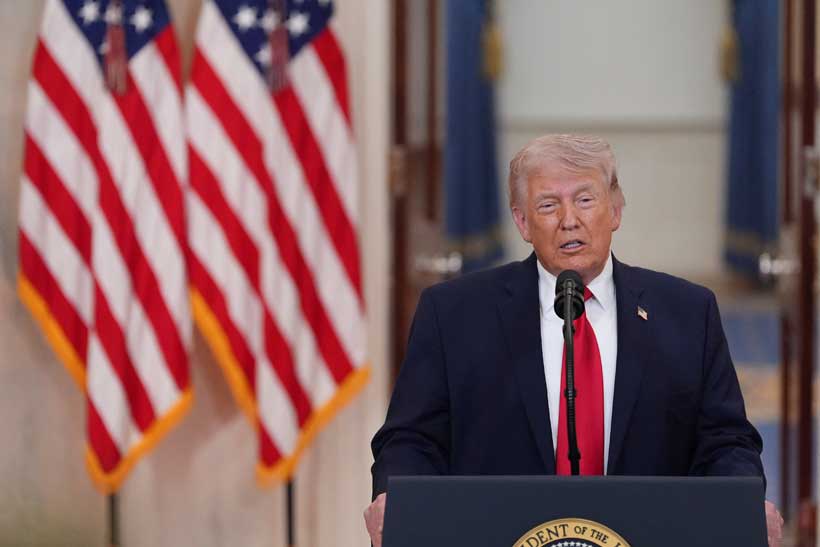
US President Donald Trump says he will hold off on launching fresh military strikes against Iran for now, following appeals from regional governments concerned about a renewed escalation. However, Washington intends to maintain its naval blockade in the Strait of Hormuz, while continued military exchanges and deep disagreements over Tehran’s conditions for ending the conflict leave the prospects for a diplomatic breakthrough uncertain.
Trump made the announcement after meeting Qatari Prime Minister Sheikh Mohammed bin Abdulrahman Al-Thani at the White House. Qatar, alongside Saudi Arabia, the United Arab Emirates, Bahrain and Kuwait, has urged Washington to avoid further attacks.
The decision comes more than eight months after the United States and Israel launched their war against Iran on February 28. Although Trump has played down the likelihood of major military operations restarting immediately, he has not accepted Iran’s proposal for ending the conflict.
Gulf Countries Urge Trump to Avoid Further Strikes
Trump said he was postponing additional military action at the request of countries neighbouring Iran, which fear that renewed US strikes could widen the conflict and threaten regional stability.
Stay ahead of the geopolitical week.
MD Briefing delivers expert analysis across five global fronts — the Indo-Pacific, energy, geoeconomics, European security, and the Middle East — every Monday morning. Free.
“The United States of America is fully locked and loaded with the best equipment ever made, and we don’t think there’s going to be any reason to use it,” Trump told reporters.
He specifically identified Qatar, Saudi Arabia, the UAE, Bahrain and Kuwait among the countries that prefer Washington not to launch further attacks.
Qatar has played a particularly important diplomatic role throughout the conflict. Its prime minister met Trump after visiting Tehran last week, making the latest White House discussions part of broader efforts to communicate between Washington and Iranian officials.
Al-Thani described his meetings with Trump and Vice President JD Vance as positive, expressing hope that discussions could help secure an agreement and restore peace to the region.
However, regional calls for restraint do not necessarily indicate that a settlement is close. Gulf governments have strong reasons to prevent further escalation, particularly given the risks to energy infrastructure, maritime trade and their own security.
Washington and Tehran Remain Divided Over a Peace Agreement
Despite renewed diplomatic activity, the United States and Iran remain far apart on the conditions required to end the war.
Iran’s proposal calls for Washington to end its blockade of Iranian ports, lift certain sanctions and stop its bombing campaign. In return, Tehran would end its own blockade of the Strait of Hormuz. Negotiations over Iran’s nuclear programme and additional sanctions would follow.
The Trump administration has repeatedly rejected the proposal. US Secretary of State Marco Rubio described Tehran’s conditions as unrealistic, arguing that they were not a reasonable basis for an agreement.
Iranian Foreign Ministry spokesperson Esmaeil Baghaei defended the proposal, describing it as the most reasonable offer currently available.
The disagreement reflects a fundamental divide over the sequence of concessions. Tehran wants immediate relief from military and economic pressure, while Washington has shown little willingness to accept an arrangement that would leave major security and nuclear issues unresolved.
Iranian security council chief Mohsen Rezaei also rejected suggestions of negotiations, calling on Washington to stop promoting what he described as imaginary talks and instead accept Iran’s stated conditions.
These opposing positions make it difficult to establish whether the recent diplomatic contacts can produce a workable framework for ending the conflict.
Political Pressure at Home Complicates Trump’s Strategy
Trump’s decision to delay further strikes also comes amid growing domestic political pressure following last week’s US midterm elections.
Senior Republicans, including Vice President JD Vance, have blamed the party’s electoral losses partly on the Iran war. The conflict has therefore become an increasingly important political issue for the administration, adding pressure to demonstrate progress towards ending hostilities.
Nevertheless, Rubio has warned against expecting an immediate diplomatic breakthrough.
A senior UAE official, Anwar Gargash, expressed similar concerns, arguing that a comprehensive political settlement between Washington and Tehran would be difficult to achieve. He warned that the region should prepare for an extended period of uncertainty in which neither a decisive resolution nor a stable regional order could be guaranteed.
The political challenge for Trump is balancing pressure to avoid another prolonged military confrontation with his administration’s demand for concessions from Iran. Suspending new strikes may reduce immediate escalation risks, but maintaining the blockade means economic and military pressure on Tehran will continue.
Strait of Hormuz Remains the Centre of the Conflict
Although Trump has indicated that he will avoid fresh attacks for now, Washington plans to maintain its naval blockade in the Strait of Hormuz, one of the world’s most important energy shipping routes.
The waterway has remained central to the conflict because disruptions threaten the movement of oil and other essential commodities through the Gulf.
Military activity has continued despite diplomatic efforts. Iranian state media reported that the United States struck Qeshm island overnight on Sunday. A provincial official told the semi-official Fars news agency that the attacks did not affect vital infrastructure or public services. Washington had not publicly commented on the reported strikes.
A senior Iranian source told Reuters that US attacks were targeting radar systems used for air defence and ship navigation, as well as facilities associated with missile launchers and mine-laying systems.
Meanwhile, attacks on commercial vessels have continued. International maritime agency figures showed that tanker attacks in the Gulf and Strait of Hormuz increased sharply in October and remained at their highest rate since the beginning of the war.
Iran said on Sunday that a tanker had struck a mine east of the strait. Iranian state television also reported that 11 tankers had been disabled over the previous 10 days.
These developments demonstrate that the conflict remains active even as diplomatic efforts gather momentum. The continued threat to commercial shipping also complicates any attempt to restore normal maritime traffic.
Regional Powers Seek to Prevent Another Escalation
Qatar is not the only regional government attempting to prevent the conflict from intensifying.
Turkish President Recep Tayyip Erdogan said on Monday that he had told Trump that Ankara did not want to see a renewed escalation. He emphasised that dialogue and diplomacy remained the preferred means of resolving the crisis and said Turkey was making efforts to prevent further deterioration.
Vice President Vance is also expected to meet Al-Thani, whose government has served as a key intermediary between Washington and Tehran since the early stages of the war.
These diplomatic efforts reflect a shared concern among regional governments that a renewed military campaign could produce consequences beyond the immediate confrontation. Gulf states face potential threats to energy facilities and maritime infrastructure, while countries dependent on trade through the region could experience further economic disruption.
However, their ability to influence the outcome remains limited by the fundamental disagreement between the United States and Iran.
What Happens Next for the US-Iran War?
Trump’s decision to postpone additional strikes offers a temporary opening for diplomacy, but it does not amount to a ceasefire or a comprehensive agreement to end the war.
The continued US blockade, reported American strikes and Iranian attacks on commercial shipping indicate that both sides are maintaining military pressure while exploring diplomatic options.
The next phase will depend on whether Qatar and other regional intermediaries can narrow the gap between Washington’s demands and Tehran’s proposed conditions. The positions of Rubio, Vance and other senior US officials will also indicate whether the administration is prepared to consider a compromise or intends to maintain its pressure campaign.
For now, the Gulf countries appear focused on preventing another round of major attacks. Yet with the Strait of Hormuz still contested and no agreement in sight, the region faces the prospect of an extended confrontation in which military restraint and economic pressure continue side by side.
With information from Reuters.
