


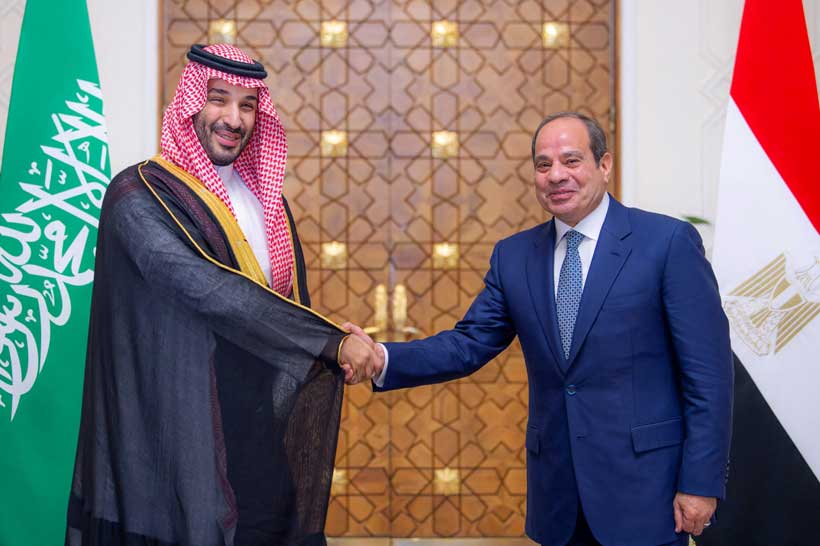
On 26 October, Egypt’s House of Representatives voted, in closed session and by the two-thirds majority the constitution requires, to give President Abdel Fattah al-Sisi a broad mandate to help Saudi Arabia defend itself against Yemen’s Houthis. The decision followed three rare secret sessions and two postponements. For a country that has not undertaken a large-scale foreign ground deployment since the 1991 Gulf War, it was a significant step. It also landed in a month full of similar ones: Algeria ordered its first troop deployment abroad since 1973, and ministers from Saudi Arabia, Pakistan and Turkey met in Riyadh and agreed to ensure the rapid deployment of forces into the kingdom.
It is tempting to read all of this as the Middle East finally building the self-reliant security architecture Washington has demanded for years. That reading is only half right. What is emerging is not an alliance that replaces the United States but a market of conditional commitments, each carefully priced by the state that makes it. Egypt’s mandate is the clearest illustration of how narrow those prices are.
The gap Washington chose to leave
The most important fact behind Cairo’s vote is not found in Cairo. According to people familiar with the matter cited by Reuters, Saudi Crown Prince Mohammed bin Salman asked the United States for military help against the Houthis, and President Donald Trump declined to order strikes, offering intelligence-sharing and targeting support instead. Meanwhile the Houthis have hit Riyadh’s international airport and Saudi Aramco facilities, disrupting flights and oil exports.
Stay ahead of the geopolitical week.
MD Briefing delivers expert analysis across five global fronts — the Indo-Pacific, energy, geoeconomics, European security, and the Middle East — every Monday morning. Free.
That refusal sits on top of a deeper grievance. The war that turned the Houthi front into a strategic threat began on 28 February, when the United States and Israel struck Iran. As Ankara University’s Betul Dogan-Akkas has argued, Gulf states were not consulted, yet they absorbed the Iranian retaliation that followed, with Iranian strikes targeting US embassies and bases across the UAE, Saudi Arabia, Qatar, Kuwait, Bahrain, Iraq, Oman and Jordan.
Washington has not left the region. Roughly 50,000 American troops remain deployed there, and US forces continue to strike Iranian targets. What has changed is how risk is distributed. The United States fights the war it chose; its partners are increasingly expected to defend themselves against the spillover. Trump has said as much. When Saudi Arabia, Pakistan and Turkey signed the Mecca Joint Defence Agreement in August, he publicly welcomed it as evidence that regional states could now defend themselves more meaningfully. Burden-shifting, in other words, is not a rupture in American policy. It is the policy.
Egypt’s carefully priced commitment
Cairo’s reasons for answering Riyadh are not hard to find. Saudi Arabia has been one of the main financial pillars of Sisi’s Egypt, providing billions of dollars in aid, central bank deposits and energy supplies. The Houthis also threaten the Bab el-Mandeb Strait, the southern entrance to the Red Sea and therefore to the Suez Canal, one of Egypt’s most important sources of foreign currency. Defending Saudi Arabia is, in part, defending Egypt’s own balance sheet.
But the limits matter more than the mandate. Before the vote, Foreign Minister Badr Abdelatty and intelligence chief Hassan Rashad carried a letter from Sisi to the crown prince making clear that Egyptian support would be confined to defending Saudi territory and borders, not attacking Yemen. The Senate speaker described Egypt’s role as “a shield that protects, not a sword that attacks.” The parliamentary statement did not specify what measures Egypt would take, and at the time of the vote no formal Saudi request for Egyptian troops had been announced.
Domestic dissent, unusual in Egypt’s tightly managed parliament, pointed to the same caution. The opposition Civil Democratic Movement rejected military involvement in a regional war and argued Cairo should focus on mediation, while the Egyptian Social Democratic Party abstained, citing a lack of information on the mission’s aims, duration and cost. History weighs on these debates. Egypt’s intervention in Yemen in the 1960s was costly enough to become a lasting warning, and when Cairo joined the Saudi-led coalition in 2015 it acted mainly as a naval partner, sending about 800 ground troops who played only a limited combat role. Analyst H.A. Hellyer expects any deployment this time to remain limited as well.
Just as telling is what Egypt has not joined. Cairo took part in earlier four-way talks with Saudi Arabia, Turkey and Pakistan but stayed out of the Mecca pact, with Abdelatty saying Egypt was weighing constitutional and legal questions first, a remark widely read as a reference to its existing treaty commitments elsewhere in the region. The result is solidarity calibrated to the size of the debt and no larger. Riyadh gets proof that its financial support buys something; Cairo makes sure that what it buys is the defence of Saudi soil, not a ground war in Yemen or an open-ended collective defence obligation.
Cairo’s real front runs south
To understand where Egypt is actually willing to put boots on the ground, look a few hundred miles further down the Red Sea. In the same weeks as the Saudi vote, Egypt was preparing to deploy a brigade-sized battle group to Somalia under a bilateral agreement, before transferring about 1,000 personnel into the African Union mission there. In early October, Sisi again insisted that Egypt would not give up its share of Nile waters.
Ethiopia, meanwhile, used the Russia–Africa Summit in Moscow to announce delivery of Su-35 fighter jets and a planned purchase of S-400 air defence batteries, weeks after breaking diplomatic ties with Eritrea.
For Cairo, the Red Sea and the Horn of Africa are a single strategic theatre. The Houthis threaten Suez from the south; Ethiopia’s dam and its expanding military threaten the Nile from the south-east. Defending Saudi Arabia and positioning in Somalia are two halves of the same calculation, and the second is where Egypt is prepared to deploy under its own flag and on its own terms. Gulf money helps make both possible. The risk is overstretch: an economy that depends on external financing is now carrying military commitments on two fronts, while promising its own public that neither will turn into a war.
A layered architecture, not an alliance
The Mecca pact shows the same pattern at a larger scale. Signed on 7 August, it declares that an attack on one member is an attack on all, and it now has a name, the Mecca Defence Alliance, and a secretariat in Riyadh whose first secretary-general will be Pakistani. Yet analysts note that it has no integrated command, standing force or joint military machinery of the kind that makes NATO’s Article 5 credible. Turkish Foreign Minister Hakan Fidan has explained that a member under attack would first have to request assistance and specify what kind it needs. And the bilateral Saudi–Pakistan defence agreement of September 2025 did not draw Pakistan into the fighting when Iran and then the Houthis attacked the kingdom this year.
The members also do not share a single threat. For the Gulf, the immediate danger is Iran and its Houthi allies. For Ankara, the pact is as much about status as security; Dogan-Akkas argues that Turkey’s main gain is presenting itself as a security provider rather than a consumer. And some analysts in Riyadh point to Israel’s growing military reach as a concern for all three. Days after the signing, Israel struck the Abu al-Duhur airbase in northern Syria, about 70 kilometres from the Turkish border, saying it was pre-empting a Turkish deployment. Ankara called the strike an attempt to undermine the pact. An alliance whose members disagree about who the enemy is will struggle to agree on when to fight.
Other actors are adding their own layers. Britain said it would deploy RAF Typhoons to help protect Saudi cities and infrastructure from Houthi attacks, and Riyadh announced a separate maritime coalition to protect shipping lanes earlier this year. Each arrangement adds options for Saudi Arabia. None adds an automatic guarantee.
The ambiguity is partly deliberate. On the day of Egypt’s vote, senior officials from all three Mecca pact states were in Tehran pushing for de-escalation, a reminder that the pact’s members still want to talk to Iran as well as deter it. Conditionality lets every member keep room to mediate, to hedge and, if necessary, to stay out.
That is why the most accurate description may be the one offered by Umer Karim of the King Faisal Center: the new arrangements do not replace American protection but add “a separate layer of deterrence.”
What the fine print means
The Gulf is not trading one patron for another. It is spreading risk across several partial ones: Egypt for manpower and Red Sea interests, Turkey for industry and air defence, Pakistan for depth and diplomacy, Britain for air power, and the United States for intelligence and the forces it still keeps in the region. This has real strengths. There is no longer a single point of failure, and arrangements built on shared interest may prove more durable than dependence on one distant power’s mood.
The weakness is equally real. Deterrence depends on adversaries believing that commitments will be honoured, and commitments drafted to preserve each member’s freedom of action invite testing. The Houthis have kept firing at the kingdom since the Egyptian vote, with the Saudi-led coalition reporting interceptions of ballistic and cruise missiles as recently as this past weekend. The test, in other words, is already under way, and so far it has been met with air defence rather than collective action.
Egypt’s mandate is best read as a measure of how far regional solidarity currently goes: defensive, territorial, reversible and priced against a financial relationship. That is not nothing. But until these promises become harder to walk away from, the region’s security will remain a patchwork stitched around an American presence that is still there but no longer dependable. The question is not whether the Middle East can defend itself without Washington. It is whether a set of carefully limited promises can deter adversaries who have already learned to read the fine print.
