


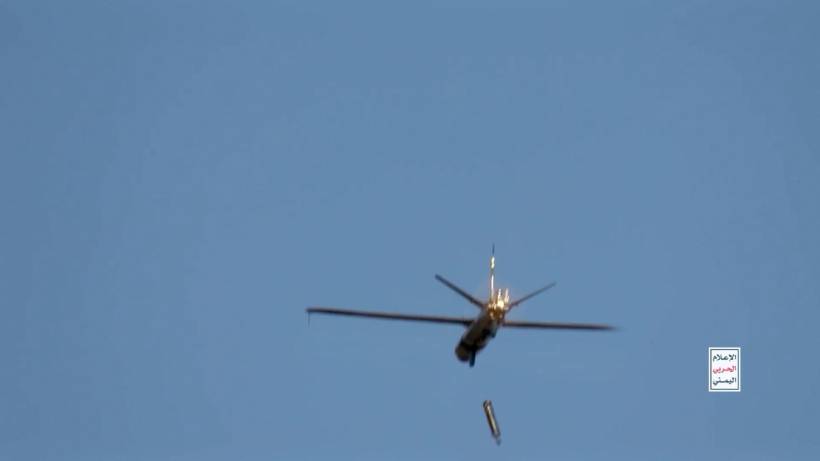
Four crew members were killed in an attack by Iran-backed Houthi forces on a cargo ship in the Bab el-Mandeb Strait on Tuesday, Yemen’s transport ministry said. Two Yemeni rescuers were also killed when the vessel came under a second attack, according to Yemen’s Coast Guard.
Separately, the U.S. military said it struck a container ship in the Gulf of Oman that was attempting to sail toward an Iranian port, highlighting the growing risks facing commercial shipping across the region.
Four Crew Members Killed in Houthi Attack
The Egyptian-owned cargo ship Tihamah was attacked while at anchor northeast of Perim Island, Yemen, according to British maritime security group Ambrey.
The deaths, if confirmed, would mark the first fatalities from a Houthi attack on commercial shipping since the Iran war began on February 28.
Stay ahead of the geopolitical week.
MD Briefing delivers expert analysis across five global fronts — the Indo-Pacific, energy, geoeconomics, European security, and the Middle East — every Monday morning. Free.
The Houthis later confirmed that they had attacked a ship in the Bab el-Mandeb, claiming it was carrying Saudi military equipment. They did not identify the vessel by name.
Reuters identified the ship as Tihamah by comparing its deck and mast with archive imagery. Satellite imagery, dock visuals and ship-tracking data also supported the identification.
The vessel was tracked near Murad, Yemen, on August 11. Yemeni coast guard sources and military officials confirmed that a small cargo ship had come under attack, while Ambrey separately reported an incident involving the vessel.
Pakistanis Among Those Killed
Pakistan’s foreign minister confirmed that three Pakistani nationals were among those killed in the attack.
Yemen’s transport ministry said one Indonesian crew member was also killed and that the crew lost control of the vessel after the attack.
The violence continued after rescue teams arrived. Yemen’s Coast Guard said two rescuers from the National Resistance Forces, an anti-Houthi military group, were killed when the Houthis launched another attack.
Ten people were injured, including seven crew members, two Coast Guard personnel and one member of the National Resistance Forces.
The Houthis declared a maritime embargo against Saudi Arabia in the Red Sea on July 20, citing what they described as a Saudi siege. Riyadh has denied that Yemen is under siege.
US Strikes Ship in Gulf of Oman
In a separate incident, U.S. Central Command said American forces fired two Hellfire missiles at the Panama-flagged container ship Vela Nova while it was sailing toward an Iranian port.
The strikes disabled the vessel’s steering gear, according to Central Command, which said the ship had ignored repeated warnings to stop violating a naval blockade on Iranian ports.
The incident marks the 12th vessel attacked by U.S. forces since the blockade was announced in April and the third since it was reimposed on July 14.
The Vela Nova was reportedly struck about 71 nautical miles, or 131 km, off Pakistan’s coast, according to maritime risk management group Vanguard.
Shipping Traffic Falls Across Key Waterways
The latest attacks are adding further pressure to already disrupted shipping routes.
Traffic through the Bab el-Mandeb Strait and Red Sea has fallen by more than 50% since an earlier wave of Houthi attacks between 2023 and 2025.
Kpler data showed that an average of only 32 ships per day passed through the strait last week, compared with around 50 before the Houthis announced their latest blockade.
Shipping activity has fallen even more sharply through the Strait of Hormuz. Only six vessels crossed the waterway on Monday, compared with a 10-day average of around 11 and prewar levels of approximately 130 to 140 vessels.
Analysis: Regional Conflict Is Increasing Pressure on Global Shipping
The two incidents demonstrate how the conflict is creating a wider security crisis for commercial shipping. The Bab el-Mandeb and Strait of Hormuz are critical maritime routes, and declining traffic suggests that shipping companies are increasingly unwilling to expose vessels and crews to the risks created by the conflict.
The death of commercial crew members also raises the stakes for international shipping operators. With vessels already avoiding parts of the Red Sea and Gulf, further attacks could increase insurance costs, disrupt supply chains and force ships onto longer and more expensive routes.
The U.S. strike in the Gulf of Oman adds another layer of uncertainty. While Washington says it is enforcing a blockade on Iranian ports, such operations increase the possibility that commercial vessels connected to Iran could become targets or face military intervention.
Taken together, the incidents point to a widening maritime confrontation stretching from the Red Sea to the Gulf of Oman. If attacks and blockades continue, the disruption could extend well beyond the immediate conflict, putting additional pressure on global trade and energy markets.
With information from Reuters.
