


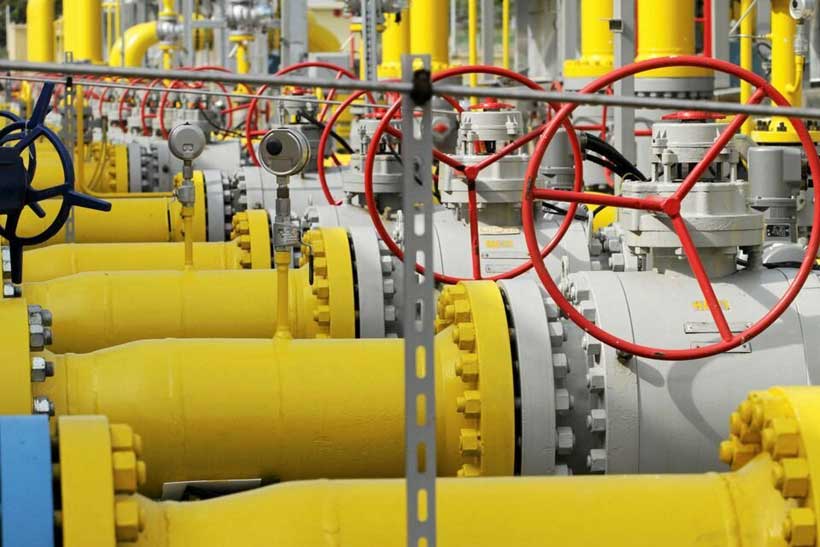
Poland was at the forefront of the revolution of the legacy European energy model which occurred in early 2022. The legacy European energy model had been based upon a long-term dependency on Russian hydrocarbon products. However, after Moscow weaponised gas deliveries in response to its invasion of Ukraine when a rapid decoupling from Russian hydrocarbon-based energy production was required.
One of the key pillars of the new Polish foreign policy strategy is the formation of a “strategic axis” with Azerbaijan. At one time the “B” alternative in a two-country energy supply strategy in which Poland would be dependent upon natural gas supplied via the Nord Stream pipeline and then also obtain natural gas delivered via the SGC. Currently the SGC and TRIPP are the main energy infrastructure connecting Central and Eastern Europe to the global energy market. Therefore today Azerbaijan serves as a logistical centre as well as a green battery that supports Central and Eastern Europe’s energy needs.
Engineering the 20 BCM Target
At the heart of this connection will be the SGC, a massive 3,500 km pipeline that connects the Caspian Sea to the heart of the EU. In addition to its previously elevated status, the SGC has become even more significant because of 2022 energy crisis which led to its ability to supply 13 bcm of gas to the EU in 2024, which is 57 percent increase over 2021.
Stay ahead of the geopolitical week.
MD Briefing delivers expert analysis across five global fronts — the Indo-Pacific, energy, geoeconomics, European security, and the Middle East — every Monday morning. Free.
In order to reach the goal of increasing exports to 20 bcm by 2027 with an amount double what was exported in 2021, the SGC will undergo large-scale technological updates. To date, through early 2026, these include expanding the Trans-Adriatic Pipeline at the Kipoi and Bilisht compressor stations which is completing SCPX looping to support increased volume and investing $2.9 billion in a new offshore compressor platform at the Shah Deniz field.
As a country of origin Azerbaijan will be viewed by Poland as key partners in this matter. The Interconnector Greece-Bulgaria and the Vertical Corridor are two of the key components allowing Caspian gas to reach farther than Southern Europe. Of particular importance the Poland-Slovakia Interconnector permits Warsaw to receive Azerbaijani gas on a direct basis in their own grid for the purpose of meeting high-demand peaks, or to bolster the region’s supply. Basically the above-mentioned infrastructure can act as an “insurance” policy to grant Poland full control of its energy needs.
The TRIPP Initiative: A Vision for Transit Sovereignty
In addition to securing the flow of immediate energy, the partnership between Poland and Azerbaijan is closely related to the TRIPP project. The TRIPP project was signed into reality in 2025 globalizing the old Zangezur Corridor, and as such represents a way to bypass the old influence of Russia and Iran.
The TRIPP project is important to Polish strategists because it provides a way to solve the “threats to independence” associated with traditional Eurasian corridors. Under a new deal the route to be managed by a US-led coalition which ensures that the route is built according to trusted Western safety standards. Beyond this, the TRIPP project is more than just a transit route, when in addition to providing rail and road links that will reduce cargo transit time to the Sławków terminal in Poland by up to 20%, the corridor also contains the 330 kV high voltage Zangezur Power Line. This 1-gigawatt power line is currently being constructed and will provide a method for a direct link for moving Caspian renewable energy directly to the European grid. With the US providing a security buffer through TRIPP, Polish state companies such as ORLEN SA and PGE are able to develop the Middle Corridor.
Corporate Diplomacy in the “Great Return”
The partnership grew even stronger with Poland’s active contribution to Azerbaijan’s “Great Return” which is Azerbaijan’s State Programme for the reconstruction of the liberated Karabakh and East Zangezur areas. This is not just a political gesture from the Polish side which is also an economically valuable area.
Poland has the chance to use its technical expertise and physical building power to support Azerbaijan in creating the “Green Energy Zones” it has created. Polish information technology and cyber security companies have assessed urban management systems that they can roll out in Aghdam’s “15-minute city” project. Also, as part of efforts to meet EU standards for municipal services, Polish biomass companies are bidding on waste-to-energy projects.
In the world of green energy, Azerbaijan’s Renewable Energy Agency (AREA) will capitalise on the regions large potential for wind and solar. As part of the broader effort to export the “green electrons” of Karabakh to Europe, at the 2025 Warsaw Business Forum, several Polish entities, including PGE and PAIH indicated that they intend to build medium-sized solar parks in this area. This corporate diplomacy is supported by the Polish state, especially as KUKE has created a variety of special insurance products to reduce risk for Polish SMEs for projects in these rapidly growing sectors.
Securing the Strategic Axis
The dependence of Azerbaijan on Poland’s involvement in Azerbaijan’s energy sector and reconstruction, can be seen as a very mutually beneficial partnership. To gain and maintain this dependency for Poland through the sovereign development of infrastructure for Baku will allow Warsaw to become the number one supplier of energy.
Poland needs to formalise its position with respect to Azerbaijan. Poland could achieve this by changing its state-owned companies to sign fixed-term deals lasting 15-20 years as opposed to relying on the volatile spot market. This would give Baku the confidence it needs to complete the 2027 expansion of the SGC. Warsaw should also use its close ties with D.C. to push for the TRIPP corridor through the EU’s Global Gateway Strategy. Securing co-funding for Poland would enable Poland to establish itself as the main logistical hub in Eastern Europe. At the same time, Warsaw should set up a dedicated investment fund to support Polish green tech and cyber security SMEs venturing into the Caucasus.
This will secure a long-term pioneer advantage for Poland in the region. Through this bold move of Poland’s strategic partnership with Azerbaijan, Poland is not only ensuring its own energy independence rather it is changing the geopolitical landscape in Central and Eastern Europe.
