


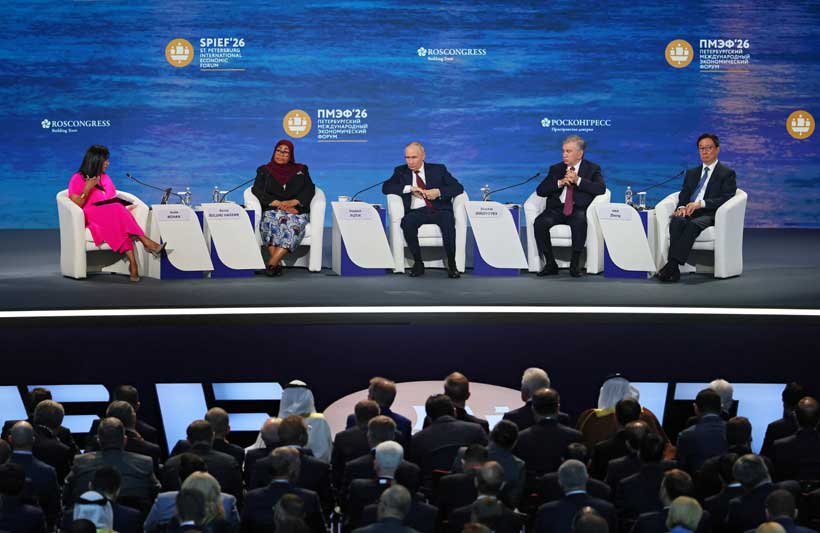
After the Soviet collapse, the republics have created the Eurasian Union with the primary aim of integrating their economies. Creating a common single currency, a common single market, and facilitating the free movement of citizens and goods. As a unique replica of the European Union, the Eurasian Union (with Armenia, Belarus, Kazakhstan, Russia, Kyrgyzstan, Tajikistan, and Uzbekistan as members) has faced multiple challenges in attaining its basic objectives. Deliberating and reviewing some of these objectives, challenges, and future perspectives dominated the 29th St. Petersburg International Economic Forum (SPIEF).
Basic Questions Still Remain
At present, a multipolar world order is briskly taking shape that will result in the reformatting of the global economy. And in the Greater Eurasia space, this process can be seen with the emergence of new economic players and growth points, as well as the reformatting of familiar logistics routes. The role of existing economic players and integration associations could also change. What place should the Eurasian Union and Russia take in the new multipolar economy with its integration projects and structures in which it participates in the post-Soviet space? What principles should the new economic system be based on, and how can Russia facilitate the smoothest and most painless transition to this new system with members of the Eurasian Union? What will be the rules for interaction between key and non-key economic players? What place should the post-Soviet space occupy in the multipolar economy?
Putin on Greater Eurasia’s Sovereignty
Stay ahead of the geopolitical week.
MD Briefing delivers expert analysis across five global fronts — the Indo-Pacific, energy, geoeconomics, European security, and the Middle East — every Monday morning. Free.
President Vladimir Putin, during the plenary session of the 29th St. Petersburg International Economic Forum (SPIEF), and with Uzbekistan’s Shavkat Mirziyoyev, Tanzanian Samia Suluhu Hassan, and Chinese Han Zheng, emphasized that “a new global economic order and architecture is emerging: one that is more diverse, more contested, but also more representative.”
At the same time, independence is not easy. Strategic autonomy comes with costs. So the SPIEF’s plenary discussion is not merely about geopolitics. And it is about a new world order, where countries no longer want to be spoken for but want to speak for themselves. It is about the price of sovereignty—something President Putin has emphasized time and time again.
Sovereignty means being stronger and smarter—managing resources more precisely and investing more effectively, including in technological and other aspects of development. In these tense and challenging conditions, Russia continues to strengthen its sovereignty—not by isolating itself, but by expanding its circle of partners.
True sovereignty demands efficiency. It is not a license to do things expensively, slowly, or inconveniently. On the contrary, we must act with maximum initiative and maximum efficacy across all areas of work. We must produce faster, thereby increasing revenues for the state, for business, and for citizens.
Russia envisions a new world order driven by the “Global Majority” of the Global South and East. It is actively shaping this multipolar architecture through key mechanisms like the Greater Eurasian Partnership and BRICS. These initiatives are designed to decentralize global power and establish economic and security systems independent of Western influence.
Key elements defining this emerging architecture include:
The Greater Eurasian Partnership: Championed by Moscow, this initiative seeks to unite Eurasian states—from BRICS partners to ASEAN members—into an interconnected web of trade and security. Central to this is shifting Russia’s primary economic and energy transit routes eastward, bypassing traditional Western markets.
Eurasian Security Architecture: In tandem with Belarus and the Shanghai Cooperation Organisation (SCO), Russia is advocating for a regional, indigenous security framework. This is highlighted by proposals like the Eurasian Charter of Diversity and Multipolarity, which aims to replace Euro-Atlantic-centered defense pacts with an inclusive continental system.
Decoupling Economic Infrastructure: Russia is heavily pushing for the de-dollarization of global trade. Working alongside BRICS partners, Moscow is focusing on using national currencies for bilateral trade, creating alternative cross-border payment systems, and building parallel financial exchanges to avoid Western sanctions.
Diplomatic Strategy: Multilateral forums are vital to cementing this architecture. Platforms like the Saint Petersburg International Economic Forum (SPIEF) are utilized to align policies with representatives from over 130 countries in the Global South and East, focusing on supply chain localization, new transport corridors, and regional technology transfers.
For a closer look at the diplomatic frameworks guiding these changes, explore the president of Russia transcripts or review the Russian International Affairs Council analysis on the shift from multipolar ideology to implementation. The EAEU encourages the free movement of goods and services and provides for common policies in the macroeconomic sphere, transport, industry and agriculture, energy, foreign trade and investment, customs, technical regulation, competition, and antitrust regulation.
In the 1990s, Russia and the Central Asian republics were weakened economically and faced declines in GDP as a result of the collapse of the Soviet Union. The day-to-day work of the EAEU is currently done through the Eurasian Economic Commission, the executive body of the Union. The Eurasian Economic Union (EAEU), alternatively referred to as EurAsEC, is an economic union of five post-Soviet states located in Eurasia. The EAEU has an integrated single market. As of 2025, it consists of 183 million people and a gross domestic product of over $2.4 trillion.
