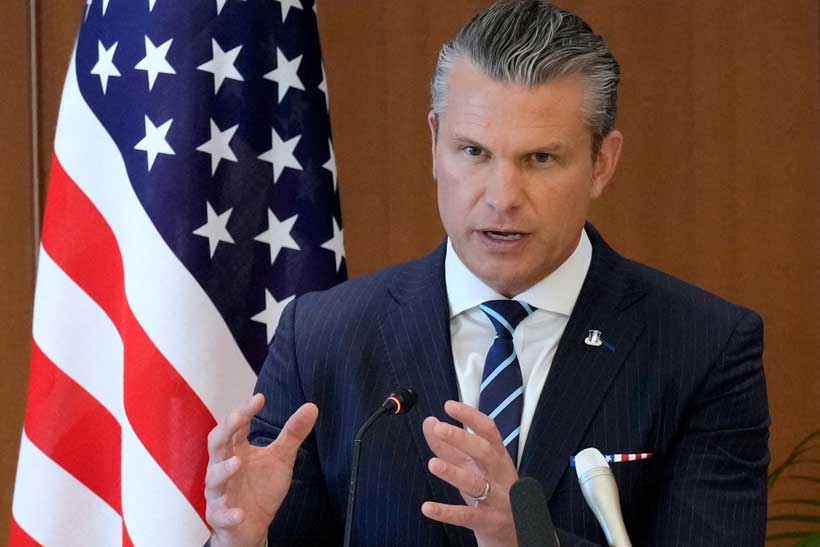
On 30 May 2026, speaking at the Shangri-La Dialogue in Singapore, US Defense Secretary Pete Hegseth told an audience of mostly Asian defense officials that durable partnerships rest not on idealistic values but on the concrete alignment of national interests. Where those interests diverge, he added, the United States adjusts pragmatically, without the drama or the moralizing, and Western Europe might take note. The remark was received as one more instance of the burden-sharing complaint that every American administration since Eisenhower has made in some version, the standing demand that Europe spend more and depend less. Read that way, there is little in it worth dwelling on.
But the burden-sharing reading misses what the sentence is actually doing, because Hegseth issued two distinct demands in a single breath, and only the first concerns spending. The demand for more capability is a claim about contribution, and a claim about contribution can in principle be answered with a budget. The demand to stop moralizing is a claim of an entirely different kind. Its target is the language in which Europe speaks, the register of rules, norms, and lessons that has organized the Atlantic relationship since 1949. And a register, unlike a level of defense spending, is not something an ally can be appropriated into abandoning. The speech itself is mostly an argument about spending and burden-sharing, and the line about moralizing passes quickly. But the move it gestures at is set out in full elsewhere, in the document this administration had published six months earlier, and it is there that the substitution becomes legible.
It would be natural to read the instruction to stop moralizing as a demand that Europe drop moral language altogether and confine itself to the calculus of interest. That is the move from norms to power that realism has always pressed on states it judges to have mistaken their preferences for principles. That reading is available, and it is at most half of what is happening, because the administration issuing the request has not itself gone quiet in the moral register; it has, if anything, grown louder in it. What changed is not that Washington stopped speaking the language of values but which values it now speaks, and the burden-sharing frame, by treating the whole dispute as a quarrel over money, is precisely what keeps that substitution out of view.
The Two Demands
Stay ahead of the geopolitical week.
MD Briefing delivers expert analysis across five global fronts — the Indo-Pacific, energy, geoeconomics, European security, and the Middle East — every Monday morning. Free.
The distinction matters because the two demands behave differently under pressure. Under-spending is a condition that money corrects, and on the spending question, Europe has in fact begun to move, which is why the spending complaint, taken alone, is losing its purchase. The demand for registration cannot be met the same way. It does not ask for a different quantity of effort. It asks for a different account of why the effort is owed, and an ally cannot purchase its way out of the charge that the language in which it understands the alliance is itself a symptom of weakness.
The register demand is the one that does the work, and though Hegseth only gestures at it, the strategy behind him states it plainly. To tell a partner to stop moralizing is not to make a neutral observation about tone. It is to rule that one register of justification, the appeal to rules, shared norms, and the obligations of a community of values, is no longer admissible between serious states. To keep speaking that way is treated as proof of weakness, not as a case to be answered. Rather than engage Europe’s arguments, the demand to stop moralizing disqualifies the language they are made in.
The classical realist tradition, less its later structural variant, which brackets questions of motive altogether, has always carried a version of this suspicion. Appeals to justice and law, it holds, are the recourse of states that lack the power to secure their interests by other means; morality between great powers is more often than not interest wearing better clothes. Read against that tradition, Hegseth’s instruction looks like a return to candor, a demand that Europe abandon the pretense and speak plainly about what it wants and what it can enforce. But this reading credits the demand with a renunciation it does not actually perform, because the administration delivering it is not itself speaking the spare language of interest. It is speaking, with considerable intensity, the language of value. And the values it is speaking are not the ones it is telling Europe to drop.
Hegseth made the distinction himself, in the same speech and almost in the same breath. The spending complaint was plain enough: partners rather than protectorates, shared responsibility rather than dependency, and the era of subsidizing the defense of wealthy nations declared over. But alongside it ran a charge of a different order. The old course, he said, was not merely underfunded but toothless, utopian, and globalist, headed for disaster, to be replaced by what he called a flexible, practical realism that sees the world clear-eyed while European capitals throw open their borders and hollow out their militaries. The first half is an argument about budgets. The second is an argument about how a serious state is permitted to see the world, and the two are not the same complaint.
The two charges do not belong to the same register. Hollowed-out militaries are a matter of contribution, the stuff of budgets. But the rules-based order recast as a distraction, placed next to open borders where a spending complaint would not belong, is not a complaint about how much Europe pays. That recasting is a complaint about what Europe believes, and it places the proceduralist creed and the migration question in the same indictment, which is the civilizational register and not the fiscal one.
The Rival Creed
If the speech is the surface, the National Security Strategy is the foundation, and it is worth dwelling on what the document actually says because it makes the substitution in its own voice. The objection to calling this a creed is that an indictment is not a doctrine, and a catalogue of insults, weak, decadent, and dependent, does not by itself amount to a positive vision that one could be asked to convert to. The answer is that the same terms recur, in the same configuration, across different speakers and different venues, which is what distinguishes a creed from a mood.
Consider the vocabulary Vance brought to Munich in February 2025. Europe’s gravest threat, he told the conference, was not Russia or China but the retreat from its own fundamental values, the suppression of free speech, and uncontrolled migration; he asked how the continent might take its shared civilization in a new direction. That is the same vocabulary the National Security Strategy committed to paper later that year, and the same vocabulary Rubio carried back to Munich a year later, where, in a deliberately gentler register, he still placed Western civilization and Western values at the center. Observers noted that the calmer tone left the underlying policy untouched.
The strategy does not leave this vocabulary implicit. Its statement of principles is organized under headings, “Primacy of Nations,” “Sovereignty and Respect,” and “Peace Through Strength,” that name the creed directly. And it names the disposition it rejects as well, declaring that the United States will no longer tolerate free-riding and the other impositions on its historic goodwill that disadvantage its interests. Across these statements the positive content is stable and connected: sovereignty exercised rather than pooled, national cohesion in preference to multicultural pluralism, demographic and cultural confidence, industrial and military self-sufficiency, and civilizational continuity understood as something a people can forfeit through neglect. These are the elements of a single account of what makes a society strong, and it is their recurrence across the administration, more than any one statement of it, that makes it reasonable to speak of a creed rather than a sequence of rebukes.
The content of that creed was set down most fully in the National Security Strategy released in December 2025, roughly six months before Singapore and before the drawdown of American forces in Europe that has since given the argument its edge. The document, which European commentators quickly read as the written form of the speech Vance had given in Munich, does not describe Europe as a weak ally in the ordinary sense of a partner that contributes too little to a shared undertaking. The section devoted to Europe, titled “Promoting European Greatness,” begins by setting the old frame aside: American officials, it says, are used to thinking about Europe in terms of insufficient military spending and economic stagnation, but Europe’s real problems are even deeper. That sentence is the substitution announced in the document’s own voice, the spending frame acknowledged and then demoted, a civilizational one put in its place. The section is short, two and a half pages in a strategy concerned mostly with the Western Hemisphere and China, but its brevity is not carelessness; the frame it sets is deliberate, and it has been echoed in every venue since.
It describes Europe as a civilization in decline, and it does so in frankly moral terms. The continent’s economic troubles, it argues, are eclipsed by the real and more stark prospect of “civilizational erasure,” a phrase it attaches to migration that is transforming the continent, the censorship of free speech and suppression of political opposition, cratering birthrates, and a loss of national identities and self-confidence. The president supplied the unguarded version, describing the continent as “weak” and “decaying.” These are not statements about burden-sharing arithmetic. They are statements about vitality, identity, demography, and faith, and they constitute a moral indictment at least as comprehensive as anything the rules-based order ever pronounced.
What Washington now wants from its allies is not only money but also a change of creed, a turn toward governing by sovereignty and strength rather than by rules, and toward treating the old multilateral faith as the decadence it has become. The United States has not exchanged a moral register for a transactional one. It has exchanged one morality for another, replacing a liberal and proceduralist creed, organized around rules, institutions, multilateral obligation, and the formal equality of allies, with a civilizational and nationalist one, organized around strength, cultural cohesion, demographic vigor, and the will to act. This is the substitution: not morality traded for interest but one morality traded for another.
The demand to stop moralizing is issued from within the new creed and directed at the old, and it presents itself as a move out of morality and into realism only because the morality being abandoned is the one everyone had learned to recognize as such. What is being demanded is not that Europe stop believing in things but that it stop believing in these things and begin, if it can, believing in the others. The strategy’s stated aim of helping Europe correct its current trajectory is the language of conversion, not of accounting, and it should be read that way.
Among the policy aims the strategy sets out for Europe is, in its own words, cultivating resistance to Europe’s current trajectory within European nations, which is to say the deliberate encouragement, from Washington, of domestic opposition to the governments of allied states. A creed that proposes to make converts inside the partner’s own borders is not merely a description of decline. It is a program. The strategy files all of this under the heading “Promoting European Greatness,” the language of restoration laid over the language of decline, which is precisely the grammar of a creed that presents its judgments as concerns.
The language of creed and conversion is used here as a figure for a shift in political theology in the normative framework through which a state understands its own purposes. The structure of what has happened is genuinely closer to a change of faith than to an adjustment of policy, and the register Europe is being told to abandon was never Europe’s invention.
The rules-based order, the community of democracies, and the vocabulary of shared values that made the postwar alliance more than a coincidence of interests were authored and propagated from Washington. For seventy years it functioned as the moral grammar of American primacy, the language that allowed the exercise of preponderant power to present itself as the maintenance of a common order. Europe learned that grammar from the power now, penalizing its fluency in it.
The strangeness of the present moment is therefore not that a hegemon has grown tired of an ally’s moralizing, which is ordinary, but that the hegemon has changed creeds and left the congregation it had converted still reciting the old liturgy. Europe sounds, to American ears, as though it is moralizing because it is still speaking the official language of an order whose author has changed his confession and now regards the old devotion as evidence of decline.
Four Ways to Pay
If this is right, then the European responses to the pressure should diverge not only in policy but also in their relation to the discarded creed, and they do, though the divergence tracks each state’s position in the field more closely than it tracks any settled conviction. France, in effect, already speaks much of the language. Macron has argued for the better part of a decade that Europe must build the capacity to act without American permission. His formulation that to remain free, Europe must be feared, and to be feared, it must be powerful, is spoken in the same register of strength and will that the new American creed prefers.
For Paris the present rupture is less a crisis than a vindication: the arrival of the autonomy it could not sell to its partners while the American guarantee still seemed unconditional. The irony, noted on more than one occasion, is that the patron’s withdrawal is accomplishing what French persuasion never could. France does not mourn the proceduralist register. France grants that the register was a form of dependence and disputes only whether the power replacing it should be American or European.
Germany cannot convert on the same terms because the proceduralist register is closer to constitutive of the Federal Republic than it is for any other European state. Multilateral restraint and the moral community of the West are elements of the postwar identity Berlin was rebuilt around, not policy preferences it adopted. The result is a posture that looks like hesitation and is better understood as the strain of being asked to abandon a constitutive language.
Merz has conceded the material charge without reservation, acknowledging that Europe had been a free rider and now intends to do more, and he has matched the words with figures that are difficult to dismiss, some €108 billion earmarked for defense in 2026 and a commitment to reach 3.5 percent of GDP by 2029. What he will not do is follow the concession into the creed that frames it. So he pays the bill while continuing to plead, in the older language, for the repair of transatlantic trust and approaches Paris about a nuclear guarantee for a state whose postwar settlement places weapons of its own beyond reach. The hedge is what compliance looks like when the price of compliance is the surrender of a language one cannot give up without ceasing to be what one is.
Poland refuses the indictment outright and has the strongest grounds for doing so since, at above 4 percent of GDP, it is the alliance’s highest spender and the administration’s own designated model ally. Its register is the old, hard language of survival, not the proceduralism of Berlin or the sovereign ambition of Paris. Its governing fear is abandonment.
Tusk has questioned aloud whether the United States would honor Article 5 and pressed the case for the European Union to become a defensive alliance in its own right. After the drawdown of American forces from Germany, he warned that the alliance was disintegrating. Poland turns toward European self-reliance not because it has been persuaded by the new creed but because it fears the guarantor is leaving, and it would keep the guarantor if it could. It needs precisely the institutional commitment the new strategy is dissolving, and it has no register left in which to demand it that Washington still credits.
Rutte, finally, occupies the position of the one who must keep all of these in the same room, and he does so by translating. To Washington, he speaks the language of strength and burden, presenting European rearmament as proof that the alliance is becoming a stronger Europe within a stronger NATO, less reliant on a single ally. To the Europeans, he preserves the institutional form, narrating an American drawdown as a planned maturation rather than a withdrawal. His function is to ensure that the parties do not hear how far apart their languages have drifted, which is a useful office and a precarious one, since it depends on no one examining the translation too closely.
It is tempting to describe the cumulative effect as a ratchet, a discourse in which every European response, whatever its motive, is read in Washington as further license to leave: concession confirms the charge, autonomy proves Europe can manage alone, model-ally spending vindicates the pressure, and the secretary-general’s translation supplies the cover. But this credits the discourse with a power it does not have, and the more accurate account is less flattering to the words. The decision to draw down was taken on other grounds, the constraints of the defense budget and the strategic preference for Asia, and taken before the European responses were in; the creed does not produce the exit so much as supply its justification after the fact.
This is why no European answer can disconfirm it. A power that has already resolved to leave will hear assent in whatever its ally says. The creed does not create that resolve; it makes it narratable as something other than abandonment. None of this makes the creed mere pretext. A legitimating language need not have caused a decision in order to reshape the relationship once it becomes the official account of it; a creed can be useful to the exit and a genuine moral vocabulary at once. The substitution does its work further downstream, in the terms on which
The alliance can, afterward, be spoken about at all.
Conclusion
What the shared vocabulary of burden-sharing conceals, then, is not only the substitution of one creed for another but also the absence on the European side of any agreement about where the pressure leads. The four capitals concur entirely on the diagnosis that Europe spent too little for too long and not at all on the prescription. French-led autonomy, German hedging, Polish insistence on continued American presence, and the Brussels narrative of seamless continuity are not one position but four incompatible ones, held together only by a common willingness to speak of the past in the same terms. Consensus on the diagnosis conceals dissensus on the destination, and that is the condition under which a departure becomes safe to take, because a counterparty that cannot agree on where it is going cannot organize a refusal of the terms on which it is being left.
That the divergence tracks position so closely is worth pressing, though not to the point of determinism. It is tempting to say that posture follows structural location, that the frontline state clings to the guarantee, the nuclear power reaches for autonomy, and the constitutive multilateralist is trapped in the hedge, and there is real explanatory force in the observation. Britain shows both its reach and its limit. On the two variables that should matter most, it resembles France, nuclear and insulated from the Russian land threat, and it too has begun to loosen its hold on the American alliance. But it cannot travel as far. Its deterrent is leased from Washington, its intelligence and its forces wired into American systems, and a state whose independence is that heavily mortgaged cannot take the Gaullist road however much its instincts pull that way. France can offer Europe an umbrella because the umbrella is its own; Britain hedges toward Europe while remaining tethered to Washington, not from a deeper Atlantic faith but because the tether is real. Position does not determine posture, but it sets how far each capital can move, and tradition and dependency fill in the rest.
The alliance, in the end, is not being dismantled by a dispute over money, and it is not being abandoned by a power that has lost interest in morality. It is being decoupled by a power that has changed its creed and reclassified the previous one as decadence, while the ally that learned that creed from it continues to profess it, audibly, in a room where it has ceased to be the official language. Each capital is settling the same account in a different faith and discovering, as the settlement clears, what a settled account has always permitted: that the house which issued it is now free to close the branch and leave.