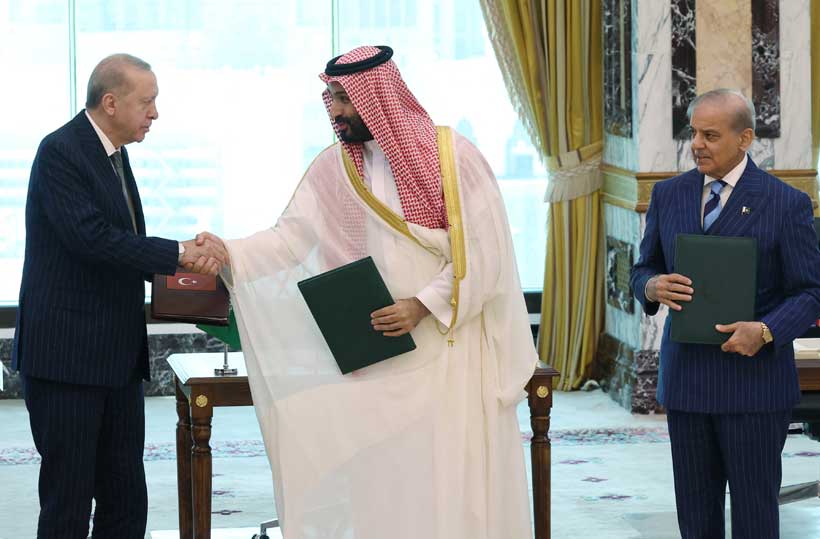
The Mecca Joint Defence Agreement is not really a well-organised military alliance. Instead, it looks more like a backup plan, in which three middle powers are essentially preparing for a situation where they can no longer fully depend on the security guarantees of the major powers. Moreover, the agreement is written in vague language, and none of the three countries would necessarily be forced to go to war if one of the others were attacked.
The agreement states that an attack on one member is considered an attack on all three — language similar to Article 5 of NATO. The purpose of such a commitment is to deter an adversary from attacking in the first place, through the promise of a collective response. Applied to the Mecca pact, however, the picture looks very different, because the three countries face different security threats, different strategic interests, and different relationships with the major powers. Simply declaring that “an attack on one is an attack on all” does not, on its own, create a strong deterrent. Instead, it reads more like a political statement — one vague enough to let each country decide for itself how far it is willing to go if another member comes under attack.
A Pact With No Enforcement Mechanism
Saudi officials stated soon after the agreement was signed that the pact is not a “military axis” or a “sectarian bloc,” and is not related to any nuclear ambition — a statement confirmed in Saudi and regional reporting. Turkish officials likewise described the pact as purely defensive and not directed at any specific actor. This kind of diplomatic language matters: states often describe an agreement as purely defensive when they want to project solidarity without committing to a clear military obligation.
Stay ahead of the geopolitical week.
MD Briefing delivers expert analysis across five global fronts — the Indo-Pacific, energy, geoeconomics, European security, and the Middle East — every Monday morning. Free.
If a mutual defence agreement does not clearly explain what counts as aggression, what exactly triggers a military response, and how the three countries would coordinate their forces, then the promise of collective defence remains largely rhetorical.
Turkey’s Article 5 Problem
Turkey is a full NATO member and is often described as fielding the alliance’s second-largest military. But consider a scenario in which Turkey is attacked by a country not considered a direct NATO adversary, but drawn into a wider war between Iran and the Gulf states. In theory, Turkey could try to invoke NATO’s Article 5 — but NATO members have so far shown limited appetite for direct involvement in conflicts between Iran and the Gulf states. That raises an unanswered question: if NATO were to respond to an attack on Turkey, how would the Mecca Pact fit into that response? The agreement offers no answer.
Rather than providing extra protection, then, the overlap between NATO and the Mecca Pact could just as easily create confusion over which alliance takes priority and who commands the response.
Pakistan’s Selective Solidarity
Pakistan’s own record under its existing defence commitments raises questions about how much weight the new trilateral pact can really carry. Islamabad signed a bilateral Strategic Mutual Defence Agreement with Riyadh in September 2025, and during the 2026 Iran war it did activate that pact — reportedly deploying several thousand troops, a fighter jet squadron, and Chinese-made air defence systems to Saudi Arabia. That deployment was real and substantial, not merely symbolic.
But it is also worth being precise about what it was not: by most accounts, the Pakistani forces sent to Saudi Arabia did not engage Iran directly, and much of the deployment appears to have followed rather than preceded the ceasefire. In other words, Pakistan was willing to demonstrate solidarity through troop presence, but stopped well short of entering the fight against Iran itself, even as Iran struck Saudi territory repeatedly. If an explicit bilateral mutual-defence commitment produced a defensive deployment but not direct military engagement, there is little reason to expect a looser trilateral agreement — one that now also has to account for Turkey’s separate strategic priorities — to produce anything firmer.
For Islamabad, the real value of the Mecca Pact may lie elsewhere. The agreement gives Pakistan leverage against India by deepening its regional partnerships, a stronger diplomatic profile — especially after its mediating role in US-Iran talks — and, not least, continued financial support from the Gulf at a time when Pakistan’s economy remains under severe strain.
Saudi Arabia’s Hedging Strategy
Amid the US-Iran war, Riyadh has grown more doubtful about the durability of US security guarantees. Several developments have fed that doubt: Iranian missile strikes on Gulf oil infrastructure exposed how vulnerable Saudi Arabia’s critical infrastructure remains, even under the US security umbrella. Riyadh has also signed a civil nuclear cooperation agreement with Washington that notably does not include the IAEA’s Additional Protocol, the mechanism that provides for the most rigorous international inspection of a country’s nuclear activities.
Together, these developments suggest Riyadh is building its own backup options rather than relying solely on US security guarantees.
So, What Do the Two Agreements Tell Us?
Read side by side, the nuclear deal and the Mecca Pact tell a similar story. The nuclear cooperation agreement gives Riyadh a looser non-proliferation framework and access to US enrichment-related technology. The Mecca Pact gives Riyadh access to Pakistan’s military capabilities and an informal connection to a nuclear-armed state. Both allow Riyadh to diversify its options without a formal break from Washington — a relationship it still depends on heavily.
Riyadh, in other words, is not abandoning the United States. It is hedging: keeping its relationship with Washington intact while quietly diversifying its security options through partners such as Pakistan and Turkey.
Conclusion
The Mecca Agreement will likely be projected as a historic shift in the regional balance of power. It is not. What it brings together are three governments with different strategic priorities, dressed in the language of “collective security” to appear stronger than it is.
The assumptions behind this pact will hold only until they are tested by a real crisis. The real question, then, is not what the member states said when they signed the pact, but how they will actually respond when one of them is attacked.