North Korea’s succession has followed a patrilineal pattern, but Kim Jong Un’s teenage daughter’s unprecedented public elevation suggests this may be changing. However, both the Korean People’s Army and North Korea’s political culture are male-dominated institutions, leading many skeptics to believe that a female heir is impossible. But this framing focuses on the wrong variable. Succession in Pyongyang is governed not by gender norms but by the Mount Paektu Bloodline doctrine, under which hereditary legitimacy is the only non-negotiable criterion for supreme leadership.
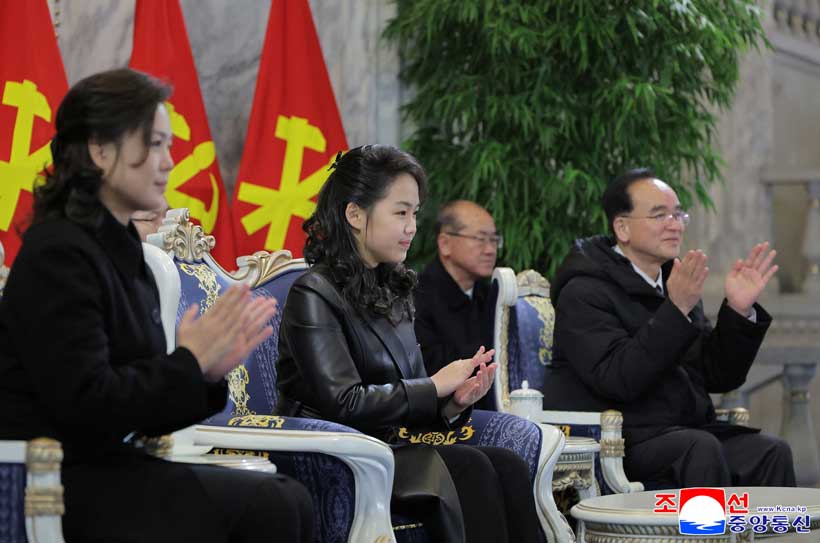
In late February 2026, Kim Jong Un’s daughter, widely known as Kim Ju Ae, appeared at the North Korea Workers’ Party Congress, a high-level event occurring once every five years, despite not being old enough to hold any official title in the Party. Her unprecedented public elevation challenges the assumption that North Korean succession would inevitably follow a patrilineal path.
Skeptics point to the politics’ and military’s patriarchal structures as the biggest barrier. North Korea’s military-first system makes the Korean People’s Army the central pillar of regime survival, and the country’s aging generals may struggle to accept a young woman as their supreme leader. Women have been structurally excluded from the political upper ranks for decades. Between 1945 and 2000, only around six of 260 Cabinet members were women, and female legislative representation today sits at just 18 percent. In a state that functions much like a Neo-Confucian monarchy, the idea of a young female supreme leader seems implausible. However, this framing misreads how succession actually works in Pyongyang.
The Paektu Bloodline and Women in the Kim Dynasty
Stay ahead of the geopolitical week.
MD Briefing delivers expert analysis across five global fronts — the Indo-Pacific, energy, geoeconomics, European security, and the Middle East — every Monday morning. Free.
North Korea’s succession logic is primarily based on the Mount Paektu Bloodline doctrine, rather than an explicit prohibition against a female ruler. Article 10, Paragraph 2 of the “10 Principles for the Establishment of the Party’s Unitary Leadership System” states that “the Party will be kept alive forever by the Paektu bloodline.” Primogeniture is not a strict rule in Pyongyang, meaning leadership has not always gone to the first son. Neither Kim Jong Il nor Kim Jong Un was a firstborn. As former South Korean Unification Minister Jeong Se Hyun observed, “In a system where bloodline is everything, competence may come second to heredity.”
Moreover, North Korea’s political ideology relies heavily on the concept of a “Mother Regime,” where leaders from Kim Il Sung to Kim Jong Un are mythologized as nurturing parental figures who care for their infantilized population. A female leader would embody this image. Women have long served as power brokers within the Kim dynasty. Kim Jong Suk, Kim Il Sung’s wife, was honored as the “Women General of Mt. Paektu,” becoming the first woman to be elevated to a leadership position. Kim Kyong Hui, Kim Jong Il’s sister, wielded immense institutional power. Kim Jong Il trusted her deeply, once saying, “Kim Kyong Hui is me; the words of Kim Kyong Hui are my words, and instructions issued by Kim Kyong Hui are my instructions.” She became a full Politburo member and general of the KPA and even climbed to the rank of secretary of the Central Committee of the Workers’ Party of Korea. Today, Kim Yo Jong, the current leader’s sister, holds an important political position and accompanies her brother on several diplomatic trips. In early 2026, she was appointed one of the 17 directors at the first plenary meeting of the new Workers’ Party of Korea Central Committee.
What makes Kim Ju Ae’s case distinctive is how the state media depicted her through honorifics. In North Korea, state media is a national political and propaganda tool. Kim Ju Ae is consistently placed beside her father in contexts that communicate command authority. Since her 2022 debut alongside her father during the test launch of the Hwasong-17 intercontinental ballistic missile, state media have elevated her from “beloved” and “respected” to “revered,” “Shining Star of Korea,” and “Great Person of Guidance.” These later terms are historically reserved for the leadership of North Korea. The phrase “Shining Star” carries particular symbolic weight, tracing back to her great-grandfather Kim Il Sung being called a “morning star” in films portraying his role in “liberating” the nation. Similarly, the word “guidance” is a term traditionally associated only with those at the very pinnacle of North Korean power. Beyond symbolic gestures, Kim Ju Ae’s trajectory suggests a deliberate and accelerating grooming process.
The Military Obstacle and the Unclear Future
The military obstacle is real, but Kim Ju Ae’s public propaganda appears to be actively managing it. Over 70 percent of Kim Ju Ae’s documented public appearances have taken place at military events. Andrei Lankov, a Russian expert on North Korea and professor at Kookmin University, analyzed that Kim Ju Ae’s frequent presence at military events aims to overcome potential internal resistance within North Korea’s leadership in the future. Cracks in this military wall are possibly showing. On September 9, 2023, the 75th anniversary military parade marking North Korea’s founding, Pak Jong Chon, marshal of the Korean People’s Army and Kim Jong Un’s close military aide, was seen kneeling before Kim Ju Ae, saluting, and whispering to her. Pak Jong Chon is a political survivor who has navigated multiple purges. His public deference is viewed as a calculated political gesture, aligning him with a possible future leader.
North Korea is a system where hereditary legitimacy is the only non-negotiable criterion for supreme leadership. Ultimately, the choice of the future North Korean regime heir depends on Kim Jong Un’s will. The coming years will be critical: whether she is granted an official party title or military rank will serve as the clearest indicator of her designated successor status. Whether Kim Ju Ae will eventually become the Supreme Leader is still in question. However, if Kim Ju Ae is Kim Jong Un’s preferred choice, her gender becomes a secondary variable in a system that has already demonstrated that it can accommodate powerful women within the Paektu lineage.