


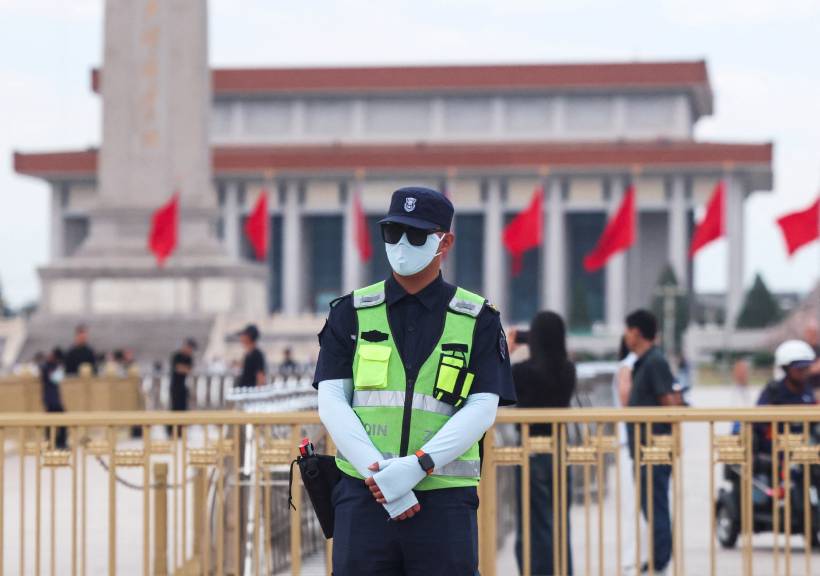
China and the United States have exchanged sharp criticism over remarks marking the 37th anniversary of the Tiananmen Square crackdown, as Taiwan called on Beijing to confront its past.
The diplomatic row was triggered after US Secretary of State Marco Rubio commented on the 1989 events, prompting a strong response from Beijing, which accused Washington of “smearing” China’s political system.
China Rejects US Comments on Tiananmen Anniversary
Chinese Foreign Ministry spokesperson Mao Ning said Beijing “firmly opposes” US statements on the Tiananmen Square events and accused Washington of distorting historical facts.
She reiterated that China has already reached what it considers a “clear conclusion” on the 1989 protests and defended the country’s political system and governance model.
Stay ahead of the geopolitical week.
MD Briefing delivers expert analysis across five global fronts — the Indo-Pacific, energy, geoeconomics, European security, and the Middle East — every Monday morning. Free.
The Chinese government does not publicly commemorate the anniversary, and discussion of the crackdown remains heavily restricted within mainland China.
US Reaffirms Call for Memory and Accountability
In his statement, Rubio said censorship cannot erase public memory of the military action against pro democracy protesters in Beijing in 1989.
He said those who supported peaceful expression and assembly would ultimately be “vindicated,” continuing a longstanding US practice of marking the anniversary with official statements.
The United States has repeatedly criticized China’s handling of the Tiananmen events and broader human rights issues.
Taiwan Calls on China to Face History
Separately, Taiwan used the anniversary to call for historical reflection in mainland China.
President Lai Ching-te said that a strong nation should not rely on military force or militarism and urged China to acknowledge the truth about the 1989 crackdown.
He said facing historical events honestly would help open the door to reconciliation and dialogue.
China, which views democratically governed Taiwan as part of its territory, did not immediately respond to his remarks.
Tiananmen Square Crackdown Remains Sensitive Topic
The events of June 4, 1989, when Chinese troops moved into Beijing’s Tiananmen Square to end student led pro democracy protests, remain one of the most sensitive topics in modern Chinese history.
Authorities have never released an official death toll, though rights groups estimate that hundreds or possibly thousands of people were killed.
The Chinese government has consistently described the protests as political unrest aimed at destabilizing the country.
Overseas Vigils Mark the Anniversary
While public remembrance is restricted in mainland China and largely absent in Hong Kong following the introduction of a national security law in 2020, commemorations continue abroad.
Candlelight vigils and remembrance events are expected in cities including Germany and Australia, reflecting continued international attention to the anniversary.
Hong Kong, once known for large scale public vigils in Victoria Park, now sees heavy police presence and limited public gatherings on the date.
Analysis: Memory, Politics and Geopolitical Rivalry Intersect
The renewed exchange between China and the United States shows how historical events continue to shape present day geopolitical tensions.
For Washington, references to Tiananmen form part of a broader narrative on human rights and political freedoms. For Beijing, external commentary on the event is viewed as interference in domestic affairs and a challenge to its political legitimacy.
Taiwan’s involvement adds another layer, as its leadership frequently uses the anniversary to highlight differences with mainland China and reinforce its democratic identity.
The continued sensitivity surrounding Tiananmen underscores how unresolved historical memory remains tightly linked to contemporary disputes over governance, sovereignty and global influence.
Conclusion
The 37th anniversary of the Tiananmen Square crackdown has once again sparked diplomatic friction between China and the United States, with Taiwan urging Beijing to confront its past. As commemorations continue abroad but remain suppressed in mainland China, the legacy of 1989 continues to shape international political narratives and tensions.
With information from Reuters.
