


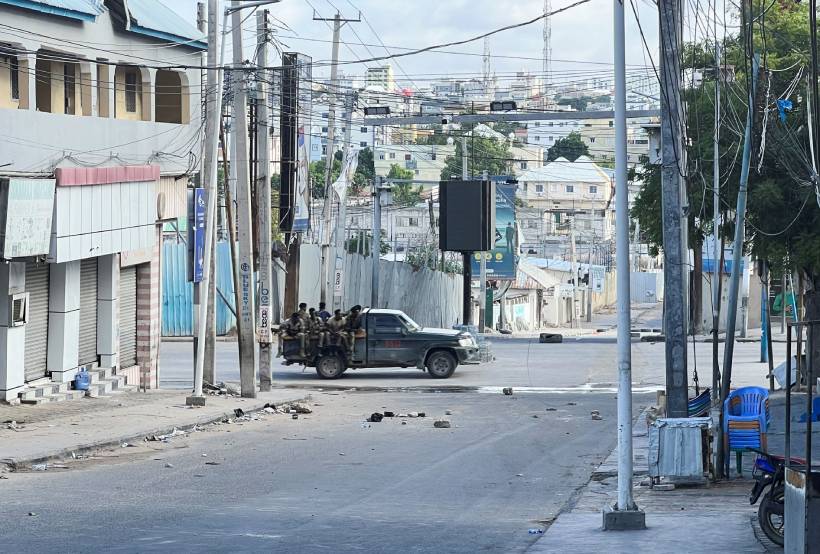
Government forces and opposition aligned militias exchanged heavy fire overnight and into Thursday morning in Somalia’s capital Mogadishu, causing damage to property and forcing civilians to flee, according to residents.
The violence erupted ahead of planned anti government protests triggered by political tensions over President Hassan Sheikh Mohamud remaining in office after his constitutional term ended.
Fighting Spreads Across Mogadishu Districts
Witnesses reported intense clashes beginning around 5 pm on Wednesday and continuing into the following morning.
Heavy fighting was concentrated in Mogadishu’s Howlwadag and Abdiasis districts, where thousands of government troops were deployed and engaged in exchanges of fire with militias supporting opposition figures.
Stay ahead of the geopolitical week.
MD Briefing delivers expert analysis across five global fronts — the Indo-Pacific, energy, geoeconomics, European security, and the Middle East — every Monday morning. Free.
Residents described scenes of panic as mortar shells and gunfire struck residential areas, damaging homes and vehicles.
Civilians Forced to Flee as Explosions Rock City
Local residents said families fled their homes overnight as fighting intensified.
One resident reported that a mortar shell landed on a neighbour’s house, injuring a mother, while another building was set ablaze during the exchanges.
Witnesses described injured civilians being carried through the streets as residents attempted to escape the violence with children in their arms.
At least two armoured vehicles were reportedly destroyed during the clashes, according to eyewitness accounts.
Political Tensions Trigger Street Violence
The clashes come amid escalating political tensions over the extension of President Mohamud’s time in office.
Parliamentary changes earlier this year were seen as potentially allowing the president to extend his term by one year and delay elections, prompting strong opposition criticism.
Former president Sharif Sheikh Ahmed accused government forces of targeting his residence and said the administration had illegally altered the constitution.
Former prime minister Hassan Ali Khaire also alleged that government troops used heavy weapons in densely populated areas and described the attacks as indiscriminate.
Government officials did not respond to requests for comment.
Residents Describe Fear and Chaos
Eyewitnesses said the situation in Mogadishu deteriorated rapidly as fighting escalated between the two sides.
Many civilians were forced to leave their homes in the middle of the night, with reports of burning buildings and destroyed infrastructure across affected districts.
Residents said the intensity of the fighting made it difficult to distinguish between military targets and residential areas.
International Community Reacts
The United States embassy in Mogadishu described the violence as reckless and urged all sides to avoid further escalation.
It called on Somali political leaders to resolve their differences through peaceful dialogue and warned against actions that could destabilize the capital.
The United Kingdom also urged restraint, stating that the violence was unacceptable and calling for immediate de escalation.
Background
Somalia has faced decades of instability following the collapse of its central government in 1991.
The country continues to experience clan based conflicts, political disputes and an ongoing insurgency led by the al Qaeda linked group Al Shabaab.
Mogadishu has frequently witnessed outbreaks of violence during periods of political tension, particularly around elections and constitutional disputes.
Analysis: Political Crisis Risks Further Destabilization
The latest clashes highlight how fragile Somalia’s political environment remains as disputes over presidential terms and constitutional authority spill into street violence.
The involvement of both government forces and opposition aligned militias signals a serious breakdown in political consensus, increasing the risk of prolonged instability in the capital.
With protests planned and political accusations escalating, there is a significant risk that localized clashes could expand into broader confrontations if dialogue mechanisms fail.
International actors have repeatedly urged restraint, but limited institutional trust and Somalia’s history of fragmented authority make de escalation difficult.
Conclusion
Clashes between Somali government forces and opposition aligned militias in Mogadishu have left civilians fleeing their homes and raised fears of further instability ahead of planned protests. As political tensions deepen over presidential authority and constitutional changes, the situation remains highly volatile with urgent calls for dialogue and restraint.
With information from Reuters.
