


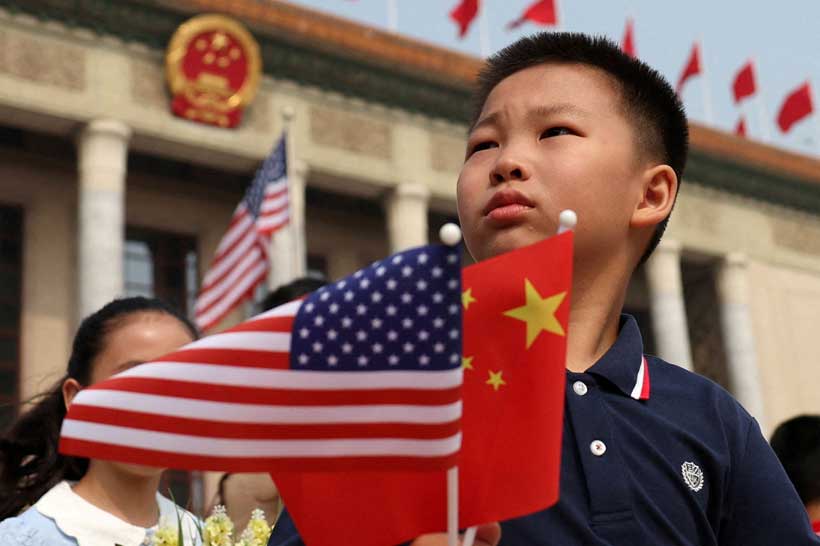
A major new defence assessment has warned that any military conflict between the United States and China over Taiwan could rapidly escalate into a nuclear crisis, highlighting growing fears about strategic instability in the Asia Pacific region.
The warning came from the International Institute for Strategic Studies, a leading London based defence research organisation, ahead of the Shangri La Dialogue security summit in Singapore. The annual gathering brings together defence ministers, military leaders, intelligence officials, diplomats, and security experts from around the world to discuss emerging geopolitical threats.
According to the report, the world is approaching a new nuclear arms race, with tensions in the Asia Pacific increasingly becoming the center of global strategic competition.
The assessment pointed to rising military capabilities, expanding nuclear arsenals, and the absence of effective communication mechanisms between major powers as key factors increasing the risk of conflict.
Stay ahead of the geopolitical week.
MD Briefing delivers expert analysis across five global fronts — the Indo-Pacific, energy, geoeconomics, European security, and the Middle East — every Monday morning. Free.
Taiwan Remains the Most Dangerous Flashpoint
Taiwan continues to be the most sensitive issue in relations between Beijing and Washington. China considers Taiwan part of its territory and has repeatedly stated that it prefers peaceful reunification but will not rule out the use of force if necessary.
Taiwan’s government rejects China’s sovereignty claims and continues to strengthen its defence partnerships with the United States and regional allies.
The report stated that in the event of a conflict, China would likely attempt to isolate Taiwan and keep United States forces away from the region. In response, Washington and its allies would focus on protecting Taiwan and maintaining military access in the Pacific.
Analysts warned that such a confrontation could quickly spread across multiple military domains including naval warfare, cyber operations, satellite systems, intelligence infrastructure, and missile strikes.
Nuclear Risks Raise Global Alarm
One of the most concerning findings in the report is the possibility that attacks on military communication and command systems could unintentionally trigger nuclear escalation.
The assessment explained that both the United States and China would likely target each other’s command, control, intelligence, surveillance, and reconnaissance systems during a conflict. These systems are essential for military coordination and nuclear deterrence.
Without clearly established communication channels or rules of engagement, military actions could easily be misinterpreted, increasing the danger of a wider nuclear confrontation.
The report stressed that there is little public evidence showing that both countries have developed effective safeguards to prevent escalation during a major crisis.
Concerns Over Lack of Strategic Communication
Experts involved in the study highlighted the absence of serious nuclear dialogue between Washington and Beijing.
Daniel Salisbury, a senior fellow at the research institute, noted that unlike the United States and the Soviet Union during the Cold War, China and the United States do not have a long history of arms control negotiations or risk reduction talks.
He explained that the lack of trust and transparency between the two powers makes meaningful communication much more difficult. China’s nuclear program remains highly secretive, making it harder for outside powers to understand its capabilities and intentions.
This absence of established crisis management mechanisms has become a growing concern among defence analysts and policymakers.
China Expanding Nuclear Capabilities
The report also highlighted concerns about the rapid growth of China’s nuclear arsenal.
According to recent Pentagon estimates, China could possess one thousand nuclear warheads by 2030. While China still has a significantly smaller arsenal compared to the United States and Russia, experts say Beijing is modernising its capabilities at a faster pace than any other nuclear power.
Current estimates suggest Russia possesses around four thousand four hundred active warheads, while the United States has approximately three thousand seven hundred. China is estimated to have more than six hundred active warheads.
The expansion of China’s strategic forces is viewed by many analysts as part of Beijing’s broader effort to challenge United States influence in the Indo Pacific region.
Regional Tensions and Strategic Uncertainty
The Shangri La Dialogue summit comes at a time of heightened uncertainty across Asia. Concerns about Washington’s long term commitment to regional allies have increased following recent diplomatic engagements between President Donald Trump and Chinese President Xi Jinping.
Some officials in Taiwan reportedly worry that changing political dynamics could affect United States support for the island during a future crisis.
At the same time, China has increased military activity around Taiwan, including air and naval operations designed to pressure Taipei and test regional responses.
These developments have intensified concerns among neighbouring countries about the possibility of a broader military confrontation involving major powers.
Analysis
The latest assessment from the International Institute for Strategic Studies reflects growing global anxiety over the changing balance of power in the Asia Pacific region. Taiwan has become more than a territorial dispute. It now represents the central point of strategic competition between the world’s two largest powers.
The danger lies not only in the possibility of conventional war but also in the absence of effective communication systems capable of preventing escalation during a crisis. History has shown that misunderstandings, miscalculations, and rapid military reactions can push rival powers toward dangerous outcomes even when neither side seeks full scale war.
China’s expanding nuclear arsenal and military modernisation are reshaping regional security calculations, while the United States continues to strengthen alliances and military deployments in the Pacific. This has created an increasingly fragile environment where both powers are preparing for deterrence but simultaneously increasing the risks of confrontation.
The report also underlines a critical reality. Unlike the Cold War era, there are currently very few established mechanisms between Washington and Beijing for managing nuclear tensions. Without direct and sustained dialogue on strategic stability, future crises involving Taiwan could become far more unpredictable and dangerous.
As military competition intensifies, the need for diplomatic engagement and crisis management frameworks may become as important as military strength itself in preventing a catastrophic conflict.
With information from Reuters.
