


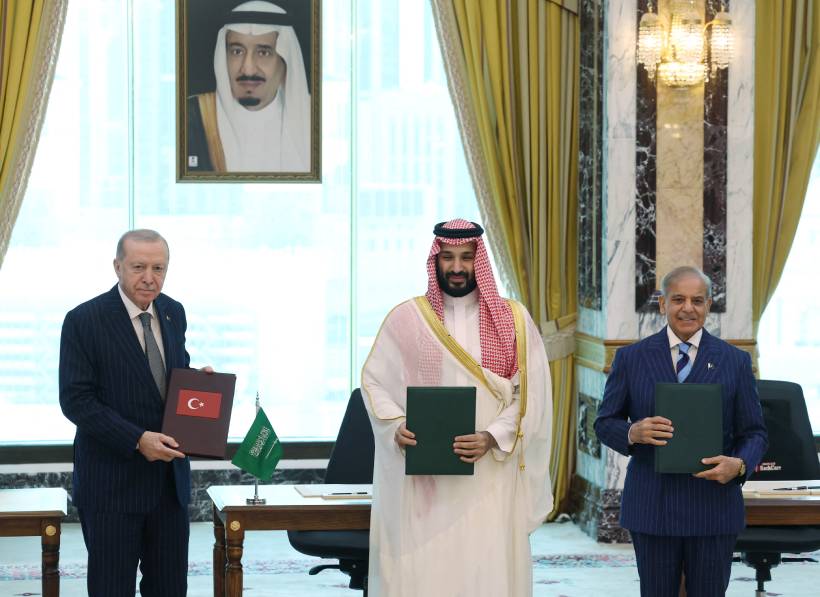
Three Regional Powers Strengthen Security Cooperation
Saudi Arabia, Turkey and Pakistan are set to sign a landmark joint defence agreement on Friday, deepening military cooperation among three of the Muslim world’s most influential powers at a time of heightened instability across the Middle East.
Regional sources familiar with the negotiations said the agreement comes as Gulf states reassess their security strategies following the conflict involving Iran, the United States and Israel, which has exposed vulnerabilities across the region and disrupted critical energy supply routes.
Although officials have confirmed the signing ceremony, the precise military commitments under the agreement have not yet been publicly disclosed.
Leaders to Formalize Agreement in Jeddah
The agreement will be signed during a high level meeting in Jeddah attended by Turkish President Recep Tayyip Erdogan, Pakistani Prime Minister Shehbaz Sharif and Pakistan’s Chief of Army Staff Field Marshal Asim Munir, alongside Saudi Crown Prince Mohammed bin Salman.
Stay ahead of the geopolitical week.
MD Briefing delivers expert analysis across five global fronts — the Indo-Pacific, energy, geoeconomics, European security, and the Middle East — every Monday morning. Free.
A Turkish official confirmed that the agreement will be finalized during the summit.
The three countries bring significant strategic weight to the partnership. Turkey is a NATO member with one of the alliance’s largest militaries. Saudi Arabia is the Gulf’s leading military and economic power, while Pakistan remains the world’s only nuclear armed Muslim state.
Regional Security Environment Drives Cooperation
Negotiations on the defence pact have reportedly continued for nearly a year but gained urgency following the regional fallout from the Iran war.
The conflict has disrupted shipping through the Strait of Hormuz, one of the world’s most important maritime trade routes for crude oil and liquefied natural gas, raising concerns among Gulf countries about protecting regional security and maintaining energy exports.
Growing uncertainty has encouraged regional powers to strengthen defence coordination outside traditional Western security frameworks.
Building on Existing Defence Relationships
Saudi Arabia and Pakistan already maintain close military relations through an existing bilateral security agreement that reportedly treats an attack on either country as an attack on both and provides for military cooperation.
Turkey has also expanded defence ties with both countries in recent years through joint military exercises, defence exports and intelligence cooperation.
The new trilateral framework is expected to institutionalize cooperation among the three states, although details regarding collective defence obligations, intelligence sharing or joint military planning have yet to be announced.
Broader Vision for Regional Security
Earlier this year, Turkish Foreign Minister Hakan Fidan advocated the creation of a broader regional security platform aimed at promoting stability and cooperation among Middle Eastern countries.
The new agreement appears consistent with Ankara’s broader effort to diversify regional security partnerships while reducing dependence on external powers for regional stability.
For Saudi Arabia, the pact comes as Riyadh seeks stronger regional security arrangements following months of heightened tensions across the Gulf.
Pakistan, meanwhile, continues to strengthen its strategic partnerships across the Middle East while expanding its diplomatic and military influence beyond South Asia.
Analysis
The emerging Saudi Arabia, Turkey and Pakistan defence partnership reflects a significant shift in regional security dynamics. Rather than relying exclusively on traditional Western security guarantees, key regional powers are increasingly pursuing indigenous defence cooperation to address shared threats. While the exact provisions of the agreement remain unknown, the political symbolism is considerable. Bringing together the Gulf’s largest economy, NATO’s second largest military and the Muslim world’s only nuclear power signals an effort to build a more coordinated regional security architecture. Whether the pact evolves into a formal collective defence arrangement or remains focused on military cooperation and strategic coordination will determine its long term geopolitical significance.
With information from Reuters.
