


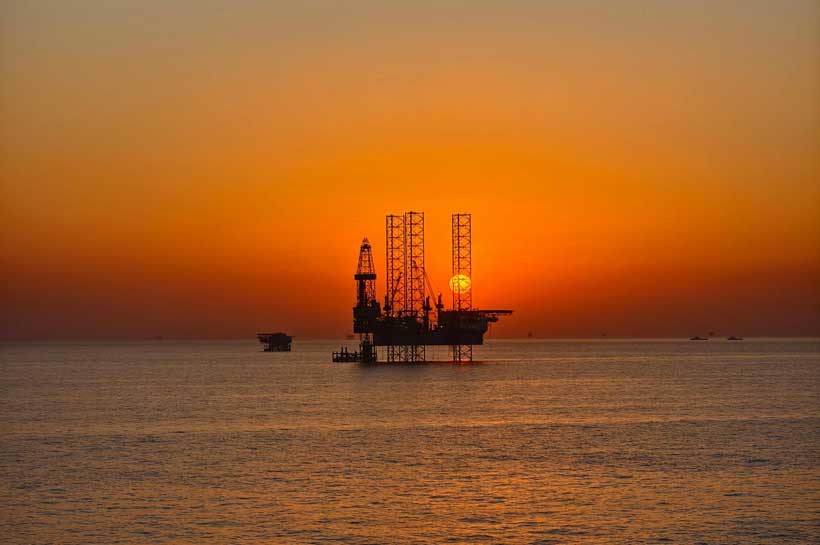
The South-North axis of the Ionian Sea offers Europe one of its few immediate pathways for structural energy reinforcement without requiring colossal new infrastructure investments. Within this corridor, Block 2 on the Greek side holds immense strategic importance. It is far more than an isolated geological prospect. It serves as the critical, direct link connecting Greece’s deepwater potential with the highly mature, established energy networks of the Adriatic Sea.
The pre-Apulian carbonate ridge extends from the Italian Adriatic into the Greek Ionian Sea. It forms a continuous, deepwater carbonate play characterized by thicknesses of 900 to 1,600 meters, intense fracturing, and a southeastward, dipping thermal maturity profile. On the Italian side, the ridge remains relatively shallow. This places the petroleum system firmly within the oil window. This segment hosts major producing fields such as Rospo Mare and Aquila, located within offshore blocks primarily operated by Eni.
As this same continuous carbonate platform descends southeastward into the Greek Exclusive Economic Zone, it plunges to depths exceeding 4,000 to 5,000 meters. At these depths, reservoir temperatures reach 150 to 170 degrees Celsius and fluid pressures climb to 12,000 to 14,000 psi. This environment drives the organic matter past the oil window and into the liquid, condensate, and dry gas windows.
Consequently, this creates a distinct dual-model petroleum system across the Ionian Sea. Italy represents the shallow, updip, oil prone segment of the ridge. Greece represents the deep, downdip, gas and condensate prone segment. Exploration of this highly anticipated Greek frontier is currently spearheaded by a consortium of ExxonMobil, Energean, and Helleniq Energy.
Stay ahead of the geopolitical week.
MD Briefing delivers expert analysis across five global fronts — the Indo-Pacific, energy, geoeconomics, European security, and the Middle East — every Monday morning. Free.
Capital Expenditure Realities and Deepwater Infrastructure Economics
The true financial scale of deepwater exploration becomes starkly clear when looking at the cost of the drill bit itself. Even in moderate water depths, a deep high pressure carbonate exploratory well like the upcoming Asopos-1 in the Ionian’s Block 2 should cost between $65 million and $100 million. Ultra-deepwater frontiers elsewhere easily double that figure.
The transition from a tapped reservoir to a commercial asset requires capital expenditure on a significant scale, though the region’s existing infrastructure footprint drastically lowers the barrier to entry. Developing a standard deepwater gas field in the Eastern Mediterranean via an FPSO requires an initial investment of $1.5 billion to $2 billion, while even larger regional anchor projects like the first phase of Israel’s Leviathan field cost roughly $3.6 billion to $4 billion. The true decisive factor in transforming a discovery into a producing asset is the deployment of complex, multi-million-dollar subsea production trees, localized export pipelines, and offshore processing units.
The decisive factor in transforming a discovery into a producing asset is the deployment of complex, multi-billion-dollar infrastructure. This includes deepwater subsea production trees, long distance export pipelines, offshore processing or compression facilities, and given the depths of the Ionian, potentially Floating Production Storage and Offloading vessels. Ultimately, molecules in the ground hold zero economic value. Real value is unlocked only when the infrastructure is built to bridge the deep, water reservoirs of the Ionian and Adriatic directly to the European market.
Market Paralysis, Regulatory Headwinds, and Past Consortium Disruption
While this dual model geology had been recognized within HEREMA’s strategic framework since 2018, the critical operational transition from regional 2D mapping to high resolution 3D seismic acquisition stalled. The abrupt exits of Total and Repsol from the Ionian Sea fundamentally disrupted the project’s momentum. This operational freeze was compounded by a tightening global capital market, as rigid ESG, driven investment mandates, rapidly depleted the funding pool for frontier fossil fuel exploration.
Observing this cascading exit of European majors, a complete lack of fresh data, and the steep technical risks inherent to the ultra, deep carbonate plays, ExxonMobil strategically derisked its portfolio. The company slowed its deployment in the highly demanding blocks west and southwest of Crete. The confluence of these factors resulted in a prolonged period of stagnation. During this time, Greece’s immense geological upside remained entirely untested, leaving its most valuable geopolitical asset, its proximity to mature ready to plug European infrastructure, deeply underutilized.
The Geopolitical Shockwaves and Supply Diversification
This impasse persisted until 2022, when the geopolitical shock of the invasion of Ukraine and the subsequent sanctions on Russian gas fundamentally rewrote Europe’s energy narrative. Security of supply was instantly elevated to an absolute priority. This triggered an aggressive re, evaluation of indigenous hydrocarbons and thrust Block 2 back into the core of Greek and European energy strategy.
With Europe facing an urgent mandate to secure non-Russian gas, the deep carbonate ridge of the Ionian Sea underwent a major shift. The formation evolved from a perceived environmental liability into an indispensable strategic asset. This momentum was further accelerated by the shift in the U.S. administration in 2024. The refined American energy policy placed a heavy emphasis on bolstering European diversification via regional gas and liquefied natural gas hubs. This alignment provided both the technical legitimacy and political air cover necessary to advance Block 2. Ultimately, it dismantled the regulatory and political headwinds that had frustrated earlier investors. The region transitioned from a period of paralysis into a highly synchronized phase where geology, geopolitics, and continental energy security aligned.
The Active Downstream Integration and Cross Border Infrastructure Interconnections
More decisive than geology is the cost and complexity of the infrastructure needed to bring gas to market. The structural continuity of the pre-Apulian carbonate ridge becomes even more important when placed within the broader Adriatic energy system. Italy possesses highly mature downstream infrastructure. This includes the Taranto refinery, major storage and distribution facilities in Brindisi and Bari, and the critical TAP compression station at Melendugno.
Offshore blocks such as D80F.R,CS and D79F.R,CS sit directly on this identical carbonate trend. They form the Western anchor of the entire Ionian-Adriatic system. Production from established fields like Rospo Mare and Aquila already flows seamlessly into these networks. This firmly establishes Italy as the natural downstream destination for future Greek gas volumes. Crucially, this cross border geological system is mirrored by corporate continuity. Energean, following its landmark acquisition of Edison E&P, holds a dominant position on the Italian side. The company operates the Rospo Mare field with a 100 % working interest and partners with Eni across adjacent Adriatic concessions. The company is uniquely positioned as the industrial bridge. It acts as a producer on the mature Italian shelf and as the active exploration operator in Greece’s Block 2.
Albania, though smaller in scale, provides vital supporting infrastructure through the Ballsh refinery, the facilities at Fier, and the port of Vlora. Vlora already handles major petroleum cargoes and is well, positioned to evolve into a future LNG hub. This creates a functional Eastern infrastructure chain that perfectly complements the Italian networks.
The presence of the Trans-Adriatic Pipeline further reinforces this corridor. TAP is far more than a pipeline carrying Caspian gas westward. It is a fully bidirectional system capable of moving gas via reverse flow from Italy back into the Balkans and Greece. Its immediate proximity to Block 2 means that any future Ionian production can plug directly into a continental network. It eliminates the need to build costly new mega-pipelines from scratch.
Furthermore, Southern Italy serves as a massive Western gas hub. It imports vast volumes from Libya via the Greenstream pipeline and from Algeria via the TransMed pipeline. These massive conduits terminate in the exact geographic zone where the Italian carbonate blocks are located. This creates a highly strategic energy triangle where North African imports, Italian Adriatic production, and potential Greek Ionian production naturally converge into a single system. Italy’s existing LNG terminals, storage fields, and trunklines are fully capable of absorbing new volumes immediately.
The existence of this entire Adriatic ecosystem turns the region into a mature downstream environment. It is ready to absorb the emergence of a new gas province in the Ionian Sea. Production from Block 2 in Greece will not need to develop expensive infrastructure in isolation. It will simply plug into an established network linking Italy, Albania, Greece, and North Africa. This forms a unified Ionian, Adriatic energy corridor where geology, extraction, and transport operate as a continuous loop. Ultimately, this South to North transit axis offers Europe one of its few realistic pathways for rapid energy reinforcement without the burden of colossal new capital investments.
