America’s record services surplus and China’s quiet AI exports tell adifferent story than tariff politics
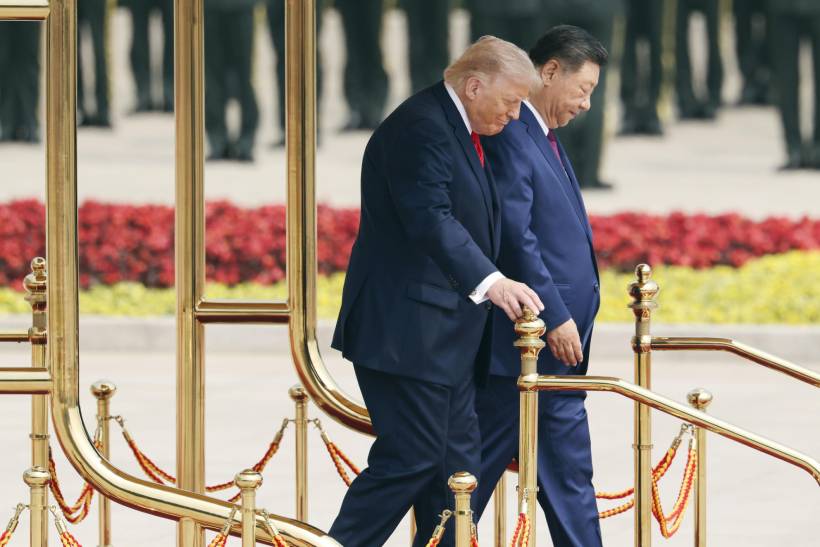
On the morning of 14 May 2026, Xi Jinping and Donald Trump shook hands inside the Great Hall of the People in Beijing under what the Chinese foreign ministry readout described as a constructive China-United States relationship of strategic stability. Behind Trump stood a delegation that said as much about the future as anything either leader announced. Tesla’s Elon Musk and Nvidia’s Jensen Huang stood alongside other technology and finance executives, a choreography reported across the global press. By the next morning, the cable news cycle had compressed everything back to soybeans, Boeing, and rare earth licenses. The most consequential trade story of 2025 was missed again.
America’s Record Surplus Almost Nobody Noticed
The single most important trade statistic released by either capital this year was not a tariff line. It was a service balance. On 19 February 2026, the United States Bureau of Economic Analysis confirmed that America posted a record services trade surplus of 339.5 billion dollars in 2025, an 8.9 percent increase from the previous year. Services exports jumped by 82.1 billion dollars to 1,234.9 billion, the largest single-year gain on record. The drivers were intellectual property royalties, other business services, and financial services, an unmistakable signature of an economy selling cloud computing, consulting, software, and frontier artificial intelligence to the world.
For its part, China posted a services trade deficit of 238.1 billion dollars in 2025 according to the State Administration of Foreign Exchange in its March 2026 final release, modestly wider than the revised 229.0 billion deficit recorded in 2024. The headline gap between the two countries on services trade alone exceeded half a trillion dollars. No tariff trim agreed in Beijing can rewrite that arithmetic in 2026. The summit produced the optics of agricultural purchases. The services reversal underneath is the real story.
Stay ahead of the geopolitical week.
MD Briefing delivers expert analysis across five global fronts — the Indo-Pacific, energy, geoeconomics, European security, and the Middle East — every Monday morning. Free.
What China Did Not Have in 2018 and Now Sells Across the Global South
The deeper story sits inside the Chinese numbers. Services exports out of China hit 384.7 billion dollars in 2025, also a record. The composition has changed in ways that did not exist when the first Trump trade war began in 2018. There was no DeepSeek. There was no large open-source Chinese reasoning model competitive with American frontier systems. There was no 240-hour visa-free transit program. Chinese services were a chronic structural deficit driven by outbound tourism, royalty payments to Hollywood and Silicon Valley, and a shipping sector losing money on every container leaving port.
The picture in 2025 is visibly different. On 20 January 2025, a Hangzhou laboratory released DeepSeek R1, an open source reasoning model under the MIT license. Within twelve months, a Microsoft AI for Good Lab study published on 8 January 2026 found that DeepSeek had captured 89 percent of the Chinese artificial intelligence market, 56 percent of Belarus, 49 percent of Cuba, 43 percent of Russia, and between 11 and 14 percent across Ethiopia, Zimbabwe, Uganda, and Niger. Microsoft described DeepSeek as a geopolitical instrument extending Chinese influence into regions where Western platforms cannot easily operate. Huawei devices ship it as the default chatbot. This is a Chinese services export. It barely existed in 2024.
Inbound tourism is the other pillar. According to the Chinese government, more than thirty million foreign nationals entered the country visa-free in 2025, an increase of nearly fifty percent year on year. The unilateral visa-free program now covers fifty source countries. Inbound tourism spending crossed 130 billion dollars. Every Korean influencer arriving in Shanghai for a weekend of hotpot and every European backpacker buying a high-speed rail ticket in Yunnan now generates a Chinese services export that did not exist at scale five years ago.
The Stickiest Export the United States Has Ever Built
Across the Pacific, the American services surplus rests on a longer history. Higher education, financial services, intellectual property licensing, and consulting have been pillars for thirty years. In 2025, they were joined by a category that scaled faster than any technology export in modern memory.
On 6 April 2026, Anthropic, maker of the Claude assistant, disclosed that its annualized revenue run rate had crossed 30 billion dollars, up from approximately 9 billion at the end of 2025. Its principal rival, OpenAI, was reported to be at roughly 25 billion. Anthropic disclosed at its February 2026 Series G announcement that more than 1,000 enterprises pay over 1 million dollars a year for its services and that eight of the Fortune 10 are Claude customers. These are recurring service revenues, billed through credit cards and enterprise contracts in Mumbai, São Paulo, Lagos, and Jakarta. None ships in a container. None pays duty at any port.
Education complements the artificial intelligence story. The Office of the United States Trade Representative reports that American travel services exports to China alone reached 24.3 billion dollars in 2024, of which 14.6 billion was education. Every Chinese alumnus of a top-tier American university carries decades of soft power compounding. Every law firm and consultancy with a Shanghai office books service fees that never leave New York or London. The American services export is also stickier than the goods one. A patent expires. A subscription renews. A graduate returns home with a network and a habit. The discount is that no recent president has campaigned on any of it.
Beijing’s Counter Offensive Through Visas and Code
The Beijing summit on 14 May 2026 produced the familiar choreography of agricultural purchases and tariff trims. Beijing did not need to bring its strategic services response into the room. The response is already deployed in the visa office, the cloud data center, and the Huawei phone factory.
When Beijing warned its citizens in April 2025 against travel and study in the United States through dual advisories from the Ministries of Culture and Tourism and Education, it was not retaliating against a steel tariff. It was striking that the largest single American services export to China. When DeepSeek shipped as the default chatbot on Huawei handsets across African markets, China was not exporting a phone. It was exporting an artificial intelligence services platform that American firms could not reach for regulatory and political reasons. When Shanghai and Hainan piloted regulated cross-border data flow zones during 2024 and 2025, the move was not a tariff matter. It was the plumbing for the next decade of Chinese digital services exports. These are service moves. They sit outside the conventional tariff toolkit. They are working.
The Rule Book Vacuum
The bigger risk for the American services advantage is not Chinese imitation. It is the absence of global rules. The General Agreement on Trade in Services came into force in 1995, when streaming meant a fax. It barely speaks to cross-border cloud computing, frontier artificial intelligence, or remote professional services. The country that drafts the revision will set a comparative advantage for a generation.
Brussels has produced early ideas through its Digital Services Act and a forthcoming Artificial Intelligence Act regime. Beijing drafts standards inside the BRICS grouping and the Shanghai Cooperation Organization, where the United States is absent. Washington, the country with the most to lose from a poorly written rulebook, has produced no coherent multilateral proposal under either of the last two administrations. The vacuum is being filled.
A Quiet Opening for Middle Powers
Countries that are neither Washington nor Beijing have an opening that the headlines have ignored. Indonesia, Vietnam, and Brazil run services trade deficits with the United States and have growing service trade relationships with China in selected digital categories. They have leverage they rarely use. A coordinated push for clearer rules on data localization, professional credential recognition, and intellectual property licensing could give the Group of Twenty something useful to do.
The Association of Southeast Asian Nations (ASEAN) has begun work on a Digital Economy Framework Agreement that, if finalized carefully, could shape services trade more than another Trump-Xi summit. Jakarta, Hanoi, and Brasília should treat the services agenda as their natural opening. It is the one arena where their regulators have credible standards to offer and where neither superpower has yet locked in the global default.
Reframing the Contest
The story of the United States and China rivalry has been told for too long as a contest of containers and chips. The 2025 services data, released by both governments within ninety days of each other, quietly reframes the contest as one of contracts, classrooms, code, and cloud. America still sells the future. China is learning to. The handshake in Beijing on 14 May 2026 will not change that arithmetic. What might change it is whether either capital can articulate, in language voters can grasp, what the services trade fight actually means, and whether the rest of the world can claim a seat at the rule writing table before the defaults are set.