


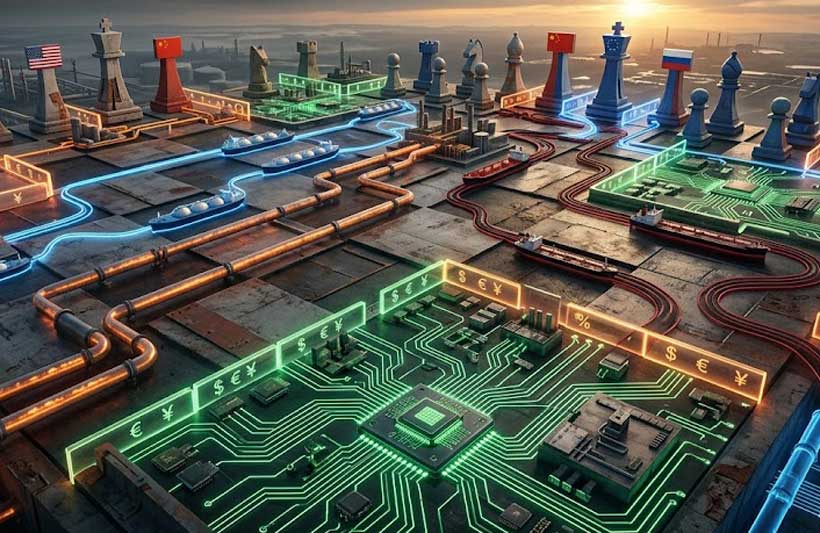
The global system no longer snaps back after crises, it drifts, it thickens, it carries its shocks forward. The world behaves less like a market and more like a material under pressure, a structure that remembers every hit. Elasticity fades, anelasticity takes over, recovery becomes partial, and each disturbance sets the stage for the next. The energy chessboard is no longer a field of reversible moves, it is a hardened surface where pipelines, LNG flows, oil routes, semiconductor chains and tariff regimes carve new lines of power.
Under this process, Europe has been pushed into a new map. The old east–west axis is gone, the Russian backbone was erased, and the continent turns for now south and west. Supplies come from Algeria, Libya, the Eastern Mediterranean at a lesser extent, and from the Atlantic, where United States LNG has become Europe’s stabilizing flank. Oil follows the same logic. Crude from the Gulf, West Africa and the United States now enters Europe through a network of ports that did not matter a decade ago and now hold the continent together. Cargoes land in Spain, Portugal, France, Italy, Croatia, Greece and Albania, forming a chain of entry points that has become the new geometry of European security.
Instability in the Suez–Red Sea corridor, tension around Hormuz, drone attacks in Bab el Mandeb, all tighten global oil and gas availability. When the Red Sea becomes unsafe, ships reroute around Africa, days are added, capacity shrinks, freight rises, and Europe leans harder on the Atlantic and on the Mediterranean corridors that now act as its lungs. Asia feels the same pressure. China, Japan and South Korea depend on flows through Hormuz and Malacca, and any disruption there rebounds into Europe’s market. The system has become circular, not linear, and shocks travel fast.
This shift reveals a deeper truth. The global oil and gas system has entered a phase of limits. Every new pipeline, every floating regas unit, every interconnector, every refinery upgrade is a long‑term commitment, a structural choice, a bet that cannot be undone without cost. New crude routes, new blending hubs, new storage sites, all lock in patterns of dependence. Africa’s new producers, from Mozambique and Tanzania to Senegal, Mauritania, Namibia and Angola, offer diversification, but only if investment frameworks hold and infrastructure is built at scale. In this context, Europe simply exports its volatility southward.
Stay ahead of the geopolitical week.
MD Briefing delivers expert analysis across five global fronts — the Indo-Pacific, energy, geoeconomics, European security, and the Middle East — every Monday morning. Free.
The world’s chokepoints amplify these constraints. Hormuz remains the hinge of Gulf exports, a narrow passage between adversaries where a single incident reshapes Asian demand and global pricing. Bab el Mandeb forces detours around Africa whenever conflict flares. Suez shows how a single blockage can freeze global logistics. Malacca remains the Indo‑Pacific’s weak point, crowded, strategic, contested. The Turkish Straits tighten whenever Black Sea tensions rise. Panama reveals how climate stress becomes energy stress. The Taiwan Strait links semiconductor fragility to energy fragility, because chips now determine the pace of electrification and the load on grids. Gibraltar, the western lock of the Mediterranean, absorbs the redirection of Atlantic LNG and crude whenever the Red Sea falters, concentrating flows into a narrow gate that now carries a disproportionate share of Europe’s energy security. The Danish Straits (Skagerrak, Kattegat and Øresund) play the same role for northwestern Europe, regulating access to the Baltic and the North Sea basin and shaping the industrial balance of Germany, Poland, Sweden and Denmark.
These straits are no longer transit points, they are structural constraints, and they shape investment, naval posture and industrial planning. Oil, gas, containers, chips, all pass through the same narrow gates, and each gate carries the memory of past crises.
Asia remains the center of global energy demand, but its centrality now extends to the digital sphere. China dominates batteries, solar modules, grid equipment and nuclear construction. The United States has responded not only with tariffs and export controls but also with a new phase of business diplomacy. Treasury officials, Commerce delegations, semiconductor executives and clean‑tech manufacturers have travelled to Beijing and Shanghai, seeking to stabilize supply chains, reduce tariff escalation and avoid a rupture that neither side can afford. The visits do not erase rivalry, but they acknowledge interdependence.
Meanwhile, electrification accelerates. Mobility, heating, industry, logistics and data infrastructure push electricity demand upward faster than firm capacity can be added. AI clusters and hyperscale data centers create concentrated loads that grids cannot absorb without reinforcement. The semiconductor bottleneck, anchored in Taiwan and South Korea, links digital security to energy security. A disruption in the Taiwan Strait would hit chips, AI, data centers and electricity systems at the same time. Physical and digital infrastructures now reinforce each other’s vulnerabilities. This is layered anelasticity, the slow hardening of a system that cannot forget.
Under these conditions, technologies evolve toward modularity, redundancy and geographic dispersion. They are designed to be movable rather than fixed, reconfigurable rather than permanent, and capable of operating under stress rather than optimized for ideal conditions. Investment follows the same logic. Capital is deployed in smaller, distributed increments, across multiple corridors and suppliers, with built‑in optionality and the ability to reroute or repurpose assets as shocks accumulate. Infrastructure is no longer planned as a single bet but as a portfolio of survivable nodes, each able to absorb pressure without collapsing the whole.
Capital has adapted to this environment. Investors now price the memory of shocks, not just the risk of the moment. Projects exposed to single routes or single suppliers face higher financing costs. Optionality becomes a premium. Floating regas units, modular reactors, multi‑fuel plants, carbon corridors with diversified clients, all gain value. Carbon transport networks and grid reinforcements shape industrial geography for decades, creating advantages for early movers but exposing them to policy reversals. The shift from volume to value is clear. Reliability, flexibility and strategic positioning matter more than raw output.
Energy policy has merged with national security. Gulf states juggle short‑term security, OPEC coordination and long‑term industrial diversification. Iran’s demographic and industrial weight makes it unavoidable in any future Gulf architecture. Europe’s cohesion depends on Mediterranean corridors, the United States on LNG and the durability of its sanctions regime. Asia’s exposure to Hormuz and Malacca forces continuous hedging. States converge around three imperatives: diversify corridors, secure influence over chokepoints and semiconductor chains, and build firm, dispatchable capacity near demand centers. Alliances face the same challenge: coordinate without creating new rigidities. The world that emerges from this slow drift is not a world of cycles but a world of accumulated pressure. Power now lies in the ability to manage this pressure, to stabilize corridors, to secure digital and physical chains, to keep options open when the system tightens. The recent United States–China business outreach shows that even rivals seek controlled interdependence, not rupture. In this landscape, resilience becomes strategy, and strategy becomes the art of navigating a system that no longer resets.
