


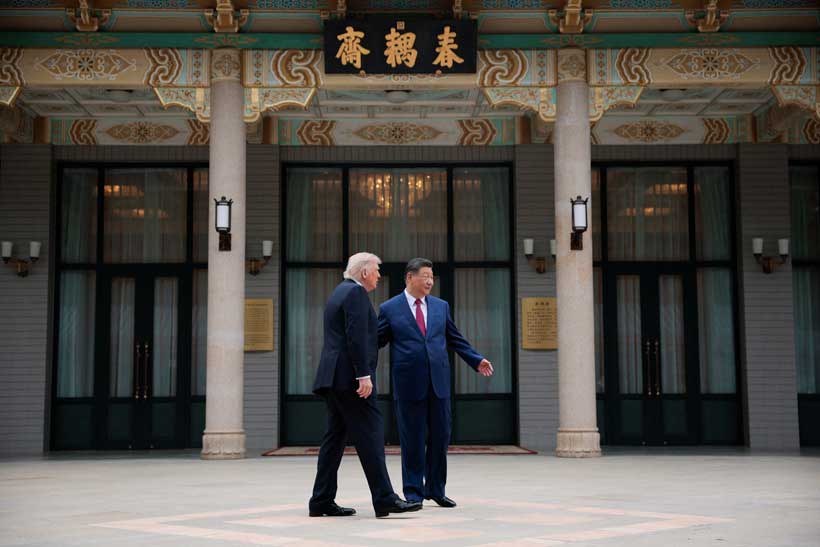
On May 13, 2026, U.S. President Donald Trump visited China at a time when Beijing had increasingly become a leading force among countries reacting against America’s global leadership position. As China possessed significant geopolitical leverage through its relations with Russia and Iran, Washington’s chances of achieving a diplomatic breakthrough had already appeared unlikely from the outset, while also revealing deep differences in perspectives and strategic approaches between the two powers.
Fundamental but Difficult Issues
On May 13, 2026, President Donald Trump and a senior U.S. delegation arrived in Beijing for talks with Chinese President Xi Jinping. The visit attracted considerable international attention due to two major issues.
Firstly, the conflict in the Middle East involving Iran showed no signs of ending. In 2026, the Trump 2.0 administration initiated military confrontation with Iran. Despite overwhelming military superiority, the United States appeared increasingly bogged down as Tehran employed asymmetric warfare tactics to offset Washington’s expensive military capabilities.
In addition, Iran used the Strait of Hormuz as a bargaining tool. Tehran imposed a blockade on the strait and demanded a payment of one million USD for every vessel passing through the area. The Strait of Hormuz accounts for approximately 20% of global energy supplies. The blockade caused severe economic consequences for the United States, sharply increasing energy prices and triggering fuel inflation across American gas stations. It also threatened to raise fertilizer prices, directly affecting food supplies and potentially leading to a broader crisis lasting into 2027.
Stay ahead of the geopolitical week.
MD Briefing delivers expert analysis across five global fronts — the Indo-Pacific, energy, geoeconomics, European security, and the Middle East — every Monday morning. Free.
Secondly, the Russia–Ukraine conflict showed little significant progress. Since returning to the White House, Donald Trump has repeatedly called on both sides to negotiate. Trump initially expressed support for Russian President Vladimir Putin but later criticized him for prolonging the conflict in order to rebuild Russian military strength. Trump’s and Putin’s official meeting in Alaska in August 2025 also failed to fundamentally resolve the war.
Iran and Russia were both widely viewed as receiving support from China. The Iran–Russia–China triangle became a “hard” strategic linkage with “soft” influence based on energy, trade, and arms cooperation. Iran and Russia remain among the world’s top energy exporters, while China has reportedly supported their economic resilience against Western sanctions and quietly assisted military cooperation. Meanwhile, numerous reports suggesting a possible Chinese move against Taiwan by 2027 have raised concerns, particularly as Beijing has continued expanding infrastructure and stockpiling wartime resources.
Negotiations with an Expectation of Failure
Negotiating with China represented a difficult challenge for the Trump administration in its effort to separate Beijing’s influence from the above-mentioned crises. Since returning to office, Trump has repeatedly pressured China over tariffs to reduce the U.S. trade deficit. This strategy also aimed to distract Beijing from other geopolitical regions and allow Washington to restore its influence.
However, China’s close relations with Iran and Russia strengthened Beijing’s leverage at the negotiating table. In international relations, negotiations rarely succeed when one side possesses substantial geopolitical advantages—especially when involving the United States, the dominant superpower since World War II, and China, a rising challenger openly contesting American leadership. Therefore, the outcome of the Trump–Xi meeting appeared largely predictable beforehand.
Throughout the visit, Donald Trump appeared cautious and somewhat restrained during official diplomatic ceremonies with Xi Jinping. Observers contrasted Trump’s demeanor in Beijing with his notably enthusiastic meeting with Vladimir Putin the previous year. This suggested that Trump held limited expectations for the talks with Chinese leaders.
During the negotiations, Trump reportedly displayed relaxed body language, including lowering his shoulders—often interpreted in high-level diplomacy as a sign of weakness rather than dominance in equal-level negotiations. The episode highlighted the remaining gaps in mutual understanding between the two leaders. In contrast, Xi Jinping appeared more attentive and engaged, frequently leaning forward during discussions. Trump’s statements throughout the visit largely remained formal and symbolic.
Taiwan and the “Thucydides Trap”
A key issue in the 2026 U.S.–China negotiations was Xi Jinping’s direct reference to the possibility of Washington and Beijing falling into the “Thucydides Trap.” The concept, developed by Professor Graham Allison, describes the danger of conflict between a ruling power and a rising challenger.
Xi’s reference to the Thucydides Trap was not merely an attempt to promote mutual understanding but also a public challenge to the United States. During the talks, Xi described Taiwan as a “red line” and the “most important and sensitive issue” in U.S.–China relations, warning that mishandling the issue could push both countries toward confrontation or even conflict.
The remarks demonstrated Beijing’s demand for Washington to recognize China as an equal power in global governance. Implicitly, Xi suggested that America’s status as the world’s leading superpower could be altered if Washington continued supporting Taiwan. When questioned by reporters, Trump declined to comment.
“Constructive Strategic Stability” in U.S.–China Relations
Xi Jinping also promoted the vision of a “constructive strategic stability” in U.S.–China relations. According to the Chinese Foreign Ministry, both leaders agreed on improving bilateral relations under the Trump 2.0 administration and beyond. The term “stability” reflected the turbulent international environment, while “strategic” implied long-term direction.
China’s leadership appeared to seek a mutually beneficial relationship based on overcoming past disagreements through mutual understanding and constructive engagement.
However, the United States did not adopt similar language. Instead, the White House focused on issues such as preventing Iran from obtaining nuclear weapons, ensuring stability in the Strait of Hormuz, addressing the Russia–Ukraine conflict, and discussing tariffs and trade commitments.
The contrasting official statements demonstrated that substantial disagreements remained unresolved. No agreements were signed during the visit, reinforcing perceptions that Trump’s participation in the summit was largely symbolic and that the outcome had been anticipated in advance. Trump, nevertheless, invited Xi Jinping to visit the United States in September 2026 to continue discussions on unresolved issues.
Overall, Trump’s visit to China revealed Washington’s recognition of deep differences in strategic perspectives between the two countries. These differences were reflected clearly in both diplomatic language and nonverbal communication during the negotiations. Xi Jinping’s reference to the Thucydides Trap served as a warning to the United States over its support for Taiwan, while China’s proposal for a “constructive strategic stability” relationship signaled a possible framework for continued negotiations in Washington later in 2026.
