


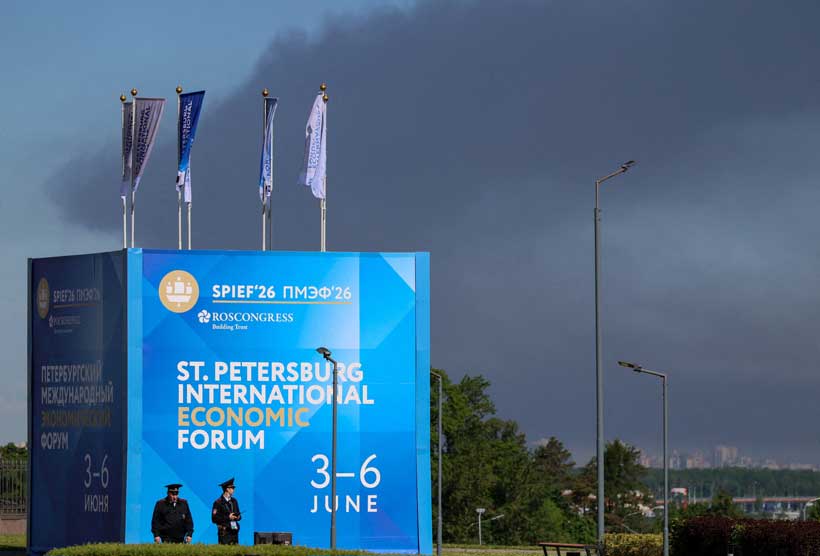
China and Russia are seemingly leaders in the emerging new economic architecture, underlining the end of unipolarity. But while China has set its economic presence worldwide, Russia faces limitations due to its own restrictive and discriminatory policy. As President Vladimir Putin rightly described it in his official message, Russia’s economic ties are plagued by unprecedented challenges, fragmentation, and disruption of supply and technological chains. It really needs a new approach, full of pragmatism and forms of dialogue, with the Global South and the East, to make its business world.
The Saint Petersburg International Economic Forum 2026, held under the motto “Pragmatic Dialogue: the Path to a Stable Future,” was published on the official website, reflecting the themes for discussions and the place of origin of participants, who express readiness to engage in the forum’s extensive business programs. According to reports, representatives from more than 130 countries hope to engage in pragmatic results-oriented discussions, hoping to contribute to new and effective business solutions across all areas of economic and social life.
United States Representation
Despite the multifaceted disagreements and confrontations these several years, U.S.-Russia relations are undergoing some kind of renewal; bilateral cooperation has entered a moment of correction. At least, Russia now has a Special Presidential Envoy for Investment and Economic Cooperation with Foreign Countries, the CEO of the Russian Direct Investment Fund, Kirill Dmitriev, whose main task is to work on reshaping and normalizing bilateral relations.
Stay ahead of the geopolitical week.
MD Briefing delivers expert analysis across five global fronts — the Indo-Pacific, energy, geoeconomics, European security, and the Middle East — every Monday morning. Free.
With regards to the forum, it was not surprising that the United States President Donald Trump has chosen Rodney Mims Cook, Jr., Chairman of the US Commission of Fine Arts, as his representative at SPIEF 2026. That was well-appreciated, that, at least, Rodney Cook Jr. was to be in St. Petersburg and be supported by the American Chamber of Commerce in Russia (AmCham) and the Roscongress Foundation to hold an exclusive panel group discussion under the theme “Russia–United States Business Dialogue,” highlighting the prospects for (re)engagement between Russian and American businesses and potential joint projects in the context of the new global economic reality.
Members of the European Union at SPIEF 2026
Members of the European Union and Russia have consistently been experiencing a number of difficulties in their economic cooperation and political sphere, mostly embedded in deadlocks over the Russia-Ukraine war, which began in late February 2022. Following Soviet’s collapse, Russian Foreign Minister, Sergey Lavrov, was committed in developing trade and economic cooperation, dreamed of establishing trade routes ‘Lisbon to Vladivostok’ which, as at now, remains as an illusive policy. The Kremlin has expressed anger over former Soviet republics’ connectivity with Europe.
That, however, the SPIEF 2026 is still considered a key global space for building partnerships, sharing experiences, and shaping new directions for cooperation. Ahead of the St. Petersburg forum, on May 21, Foreign Minister Sergey Lavrov held a special meeting with the leadership and members of the Association of European Businesses in Russia. During the meeting, the minister shared his assessment of the current international situation, with a focus on the risks arising from the growing geopolitics of trade and economic relations. The participants also discussed a number of current foreign economic issues, including certain aspects of foreign companies’ operations in the Russian Federation.
Africa’s Economic Engagement and Solidarity
For Africa, which has also been in close working partnership collaborations with Roscongress at SPIEF. It has established the Russia-Africa Business Dialogue since 2016 as a platform for discussions. The historical leadership of Africa is well-recognized, consistent praise for accelerating multifaceted aspects of high-quality collaboration, while soliciting political and strategic support for Africa’s development.
As Moscow prepares to hold the third Russia-Africa Summit in October, St. Petersburg stands very significant. Director of the Department of Africa at the Russian Foreign Ministry Anatoly Bashkin stressed that Moscow had very good relations with Africans. As a result, economic issues should be in the focus of the Russia-Africa forum and the economic agenda, Director of the Department of Africa at the Russian Foreign Ministry, Anatoly Bashkin, noted ahead of the forum.
“Expectations are huge. I am very happy in the first instance that the economic agenda will prevail there,” the diplomat said. “This is because we have very good political, humanitarian, military, military-technical, and security relations with Africans, but our trade, economic, and investment ties chronically lag behind,” Bashkin said. “We need to pay as much attention as possible exactly to this aspect of our cooperation now,” the diplomat. “Economy is actually the basis of politics. We need to develop it by all the efforts, all the ways.”
On 15 May 2026, the Roscongress Foundation, together with TISEZA and the Russian Export Centre, and with the support of the Russian Ministry of Economic Development, held the Russian-Tanzanian Business and Investment Forum in Arusha, Tanzania, on the sidelines of the session of the Intergovernmental Commission on Trade and Economic Cooperation, giving fresh impetus to the development of bilateral ties. Previously, in December 2025, TISEZA participated in the “Strengthening Trilateral Cooperation” Dialogue on the sidelines of the Second Ministerial Conference of the Russia–Africa Partnership Forum in Cairo, affirming its interest in systematic engagement with the Russian business community.
“On 15 May 2026, we successfully held the Russian-Tanzanian Business and Investment Forum, which gave a powerful boost to trade and economic cooperation between our countries. Just a few weeks later, on the sidelines of SPIEF 2026, the Tanzanian delegation will have a unique opportunity to advance its agenda, strengthen bilateral relations, and present Tanzania’s investment potential to the Russian business community. Relations between Russia and Tanzania are flourishing and developing dynamically today. I am confident that the Roscongress International Cooperation Area will prove an effective platform for negotiations, finding new partners, and launching joint projects,” said Gilead J. Teri, Director General of the Tanzania Investment and Special Economic Zones Authority (TISEZA).
And Friends from Latin America…
The SPIEF 2026 is equally valuable for Russian companies and potential partners from Latin American region seeking reliable foreign counterparts: its comprehensive programmes enable a series of negotiations to be conducted, projects to be presented, partners to be found for joint initiatives, and concrete steps towards entering foreign markets to be discussed.
“I would like to express particular gratitude to our international partners. We value the trust they place in us and cherish the opportunity to build long-term relationships with them. It is important that our collaboration does not end with a single project: joint initiatives continue across other Foundation platforms in Russia and abroad. Around the Roscongress international cooperation area, a genuine international community of like-minded partners is taking shape, united by a common goal: developing mutually beneficial business cooperation. I would also emphasize that Russian companies and regions will be able to find foreign partners here without unnecessary barriers and receive first-hand expert guidance on entering the markets of Asia, Africa, the Middle East, and Latin America. We invite everyone with an interest in international cooperation to visit our area,” said Alexandra Ogneva, Deputy CEO and Head of the International and Regional Cooperation Directorate of the Roscongress Foundation.
Guests and partners from Asian-Pacific regions
As it has traditionally been, the presence of an unprecedented number of Asian-Pacific guests and participants vividly sends a special message; it carries the tectonic friendship and solidarity in the geopolitical developments and current diplomacy between Russia and Asian-Pacific regions.
The Roscongress Foundation has for many years maintained a successful partnership with the Russia-ASEAN Business Council, both in enriching the business agenda of events in Russia and in organizing events abroad. The Business Council has served as a partner of Foundation forums in Malaysia and Indonesia. At SPIEF 2025, the Russia-ASEAN Business Council was already a partner of the Area, co-organizing a joint stand with the ASEAN Business Advisory Council (ASEAN-BAC). Work is underway to promote the Business Forum on the sidelines of the Russia-ASEAN Summit in June 2026, and a joint business event in the Philippines is also being explored.
“Cooperation with the ASEAN countries is strategic in nature: this is one of the most dynamic regions in the world, and we see significant potential for developing trade, economic, and investment ties. This year we mark the 35th anniversary of relations between Russia and ASEAN. Last year’s experience confirmed that the Roscongress International Cooperation Area at SPIEF enables entrepreneurs to find partners, establish cooperation, and discuss joint initiatives. We expect the Forum to serve as a natural continuation of our shared agenda and an important event in this anniversary year,” said Ivan Polyakov, Chairman of the Russia–ASEAN Business Council.
“The success of the Roscongress International Cooperation Area in 2025 confirmed its strategic significance as a unique ecosystem for international dialogue. In 2026, we look to the future with confidence and are delighted to welcome our partners, with whom we share a track record of successful collaboration. Their continued participation in the project confirms that our format is in demand for building relationships of trust,” said Alexander Stuglev, Chairman of the Board and CEO of the Roscongress Foundation.
The partners of the Roscongress International Cooperation Area at SPIEF 2026 are the Russia–ASEAN Business Council, the Russian-Thai Business Council, the TV BRICS International Media Network, and the Tanzania Investment and Special Economic Zones Authority. The SPIEF 2026 has, in practical terms, offered foreign countries, particularly from the Global South and the East, the golden chance for expanding the horizons of entrepreneurial collaboration.
