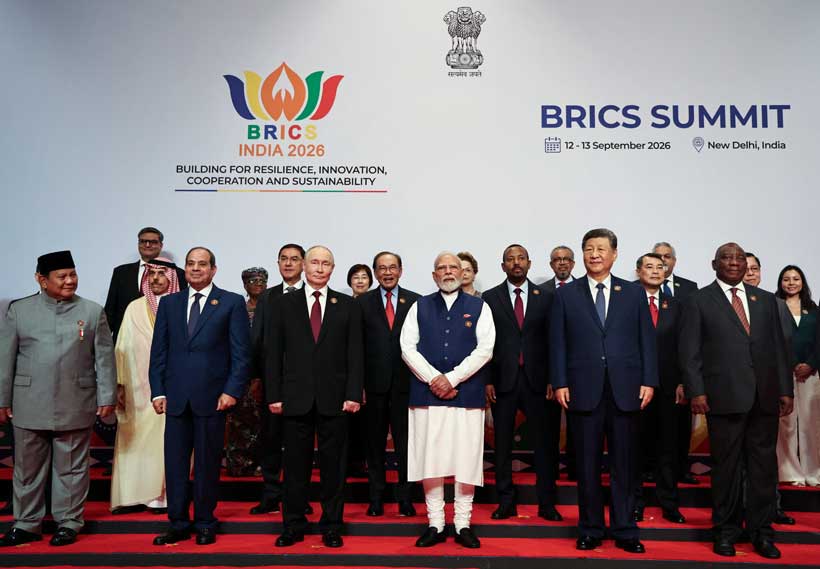
BRICS is no longer just a diplomatic club for emerging economies. Its 11 members represent approximately 49.5% of the world’s population, 40% of global GDP, and 26% of global trade. Meanwhile, India’s economy continues to grow at a rapid pace. The question before New Delhi is no longer whether India has a platform. It is about whether it has the power to use that platform to influence outcomes. The 18th BRICS Summit, held in New Delhi on September 12-13, comes at an unusually significant time. India’s 2026 chairmanship focuses on “Building for Resilience, Innovation, Cooperation, and Sustainability.” However, the summit is taking place amid renewed conflict in West Asia, disruptions to maritime commerce and energy markets, and increased competition over the shape of the global order. On September 12, BRICS leaders adopted the New Delhi Declaration, expressing serious concern over the escalation in West Asia and calling for maximum restraint, dialogue, consultation, and diplomacy. The declaration demonstrates that the BRICS can speak together about a crisis. The more difficult question is whether India can use its presidency to help the grouping become more capable of taking action.
India’s Untapped Leverage
India enters this moment with more than just diplomatic presence. In FY2024-25, its total exports amounted to around $825 billion, with services accounting for approximately $387 billion. Few developing countries can match New Delhi’s economic leverage, which stems from its large domestic market, expanding digital economy, and sustained growth. India is also a major provider of digital public infrastructure, and its demographics position it to play an increasingly important role in global consumption, production, and services.
The Gulf dimension makes this leverage especially important. In FY2024-25, India-Gulf Cooperation Council trade totalled approximately $178.56 billion, accounting for more than 15% of India’s global trade. Nearly ten million Indians live in GCC countries, and the Gulf region accounts for a significant portion of India’s remittance inflows. For New Delhi, West Asian instability is therefore a strategic, economic, and human-security issue.
Stay ahead of the geopolitical week.
MD Briefing delivers expert analysis across five global fronts — the Indo-Pacific, energy, geoeconomics, European security, and the Middle East — every Monday morning. Free.
India’s geography provides an additional layer of leverage. Its location on the Indian Ocean brings it close to the maritime routes that connect the Gulf, Arabian Sea, Indian Ocean, and Red Sea. When the Strait of Hormuz or Red Sea shipping is threatened, India is not an observer from afar. Its trade, energy supplies, citizens, and maritime interests are all directly affected.
From Diplomatic Voice to Strategic Leverage
India’s foreign policy has long combined assertion and accommodation. It positions itself as a leading voice for the Global South while maintaining relationships with competing power centers. It collaborates with the United States and its Indo-Pacific partners while maintaining strategic ties with Russia; it is a member of the Quad and also operates within BRICS and the Shanghai Cooperation Organization.
This is not always strategic ambiguity. It refers to strategic flexibility. However, flexibility gains influence only when it produces results. India’s challenge is to shift from presence to leverage. It has already appeared in almost every major multilateral discussion. The next step is to establish itself as a country that other actors rely on when dealing with difficult issues.
Why West Asia Is India’s Strategic Opening
India has an unusually large network of relationships throughout West Asia. It maintains close ties with the Gulf states while retaining diplomatic relations with Iran. It has close ties with Israel, the United States, and Russia, as well as increasingly institutionalized ties with the rest of the Arab world.
That does not make India capable of ensuring West Asian security. New Delhi should not seek such a role. A security guarantor is responsible for protecting an order. A security convener creates spaces for competing actors to communicate, negotiate, and reduce the risk of escalation. India is better suited for the second role. The distinction is especially important given the current crisis. India has already engaged multiple parties. Prime Minister Narendra Modi’s meeting with Iranian President Masoud Pezeshkian on September 11 reaffirmed India’s preference for dialogue and diplomacy, emphasizing freedom of navigation, commerce, and seafarers’ safety. Modi and Russian President Vladimir Putin discussed regional conflicts and their impact on maritime trade.
BRICS: from declarations to problem-solving
Iran, the UAE, Egypt, and Saudi Arabia, as well as India, China, and Russia, form the expanded BRICS. This diversity makes consensus difficult, but it also creates a diplomatic space that few other groups can match. India should use that space to set up a BRICS-West Asia Contact and Mediation Mechanism. It does not have to be a military or treaty-based arrangement. Its initial mandate could include crisis communication, preventive diplomacy, humanitarian coordination, and maritime security. First, the BRICS could create a permanent channel for consultations during major West Asian crises. Second, India could promote a BRICS Maritime Resilience Initiative that includes the Strait of Hormuz, Gulf of Oman, Red Sea, and western Indian Ocean, with a focus on maritime information sharing, emergency communications, search and rescue, commercial shipping protection, and crisis coordination. Third, the BRICS could create mechanisms to coordinate emergency energy and protect critical infrastructure. Fourth, it could establish a humanitarian framework for emergency evacuation and medical care during conflicts. The logic is deliberately modest. BRICS should not seek to replace the United Nations, Gulf institutions, or existing maritime security arrangements. It should add another channel for states with different relationships to communicate when existing channels are blocked or insufficient.
The Market Dimension of Indian Leadership
India’s case for increased global influence is not solely based on diplomacy. It is becoming a market proposition. Its export base, services economy, digital infrastructure, and large consumer market give it negotiating power with energy producers, investors, and supply chain partners. The BRICS are becoming a significant economic network, but internal asymmetry is important. According to recent data, China dominates BRICS trade, while India is much smaller within the bloc and has a significant trade deficit with BRICS partners. In the first half of 2026, India’s exports to BRICS were approximately $48 billion, while imports were around $178 billion. This is both a constraint and a policy signal. India cannot translate BRICS membership into leadership simply by declaring multipolarity. It needs to increase its high-value exports, technology partnerships, logistics connectivity, and investment ties. Behind diplomatic ambition, leadership requires economic capability.
China: Compete through Performance, Not Confrontation
China will remain central to India’s BRICS strategy. However, India should not allow China to define the organization or turn every BRICS initiative into a competition with Beijing. Instead, New Delhi should compete on institutional performance. If India can leverage BRICS for maritime security, crisis diplomacy, energy resilience, digital connectivity, and development cooperation, its influence will grow without forcing other members to choose between India and China. This would also give strategic autonomy a more modern interpretation. Strategic autonomy should not simply imply refusing to take sides. It should imply having enough capability and diplomatic room to influence the options available to others.
From “Pitching and Hitching” to Agenda Setting
India’s global strategy can be summarized in two words: pitching and hitching. “Pitching” refers to projecting India as a major global power and the voice of the Global South. “Hitching” refers to the pragmatic use of existing institutions and strategic partnerships. Both remain necessary. However, India’s next step should be agenda setting, identifying areas where it has national interests, capabilities, and power, and then forming coalitions and institutions around them. West Asian security is one of these areas. India does not need to become the region’s police force. It does not need to ensure peace in a region riven by complex rivalries. It must become one of the powers to which others turn when they require dialog, mediation, maritime coordination, or humanitarian aid.
The Larger Test of Indian Leadership
India’s BRICS presidency was built on resilience, innovation, collaboration, and sustainability. The West Asian crisis has created an opportunity to give those words strategic meaning. Resilience can include safeguarding energy and maritime supply chains. Innovation can entail developing new mechanisms for crisis communication and digital collaboration. Cooperation can entail bringing states with opposing interests into ongoing dialog. The New Delhi summit highlights why this is difficult. BRICS members have very different strategic relationships and interests, so reaching an agreement on West Asia required extensive negotiation. Despite their differences, the group’s joint declaration demonstrates India’s convening power. India’s leadership should be evaluated based on its ability to foster cooperation in a fragmented international environment, rather than its prominence in diplomatic photographs. The first phase of India’s rise was focused on scale. The following must be about capability. The subsequent phase must focus on leverage. The ultimate test of global leadership is agenda setting.
India does not have to guarantee West Asian security. It must become indispensable in the diplomacy that can make West Asia more secure.