


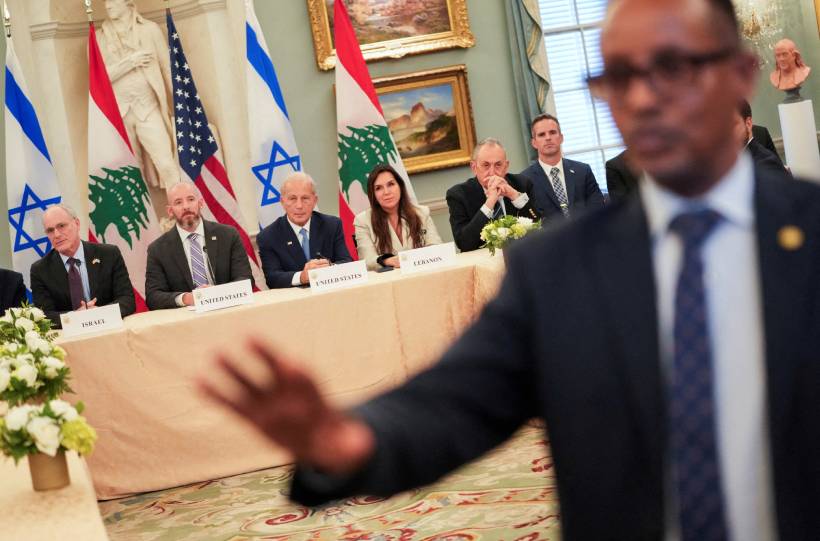
A newly announced ceasefire between Israel and Lebanon, brokered through U.S. mediation, has raised cautious hopes that broader diplomatic progress could emerge in efforts to end the wider conflict involving Iran.
The agreement, confirmed by the Trump administration, comes amid intensifying regional tensions and parallel negotiations linked to the ongoing confrontation between the United States, Israel and Iran.
Ceasefire Linked to Wider Regional Negotiations
The ceasefire between Israel and Lebanon is seen by analysts as more than a bilateral de escalation measure, with potential implications for broader Middle East diplomacy.
Tehran has reportedly linked any progress on a wider peace deal with Washington to the establishment of a ceasefire in Lebanon, highlighting how interconnected the conflicts have become.
Stay ahead of the geopolitical week.
MD Briefing delivers expert analysis across five global fronts — the Indo-Pacific, energy, geoeconomics, European security, and the Middle East — every Monday morning. Free.
Iran has also suggested it could intervene more directly in support of its ally Hezbollah if Israeli operations continue or escalate in Lebanon.
Conditions and Uncertainty Over Implementation
Lebanese President Joseph Aoun said the ceasefire would take effect within 24 hours of approval by all relevant parties, including Hezbollah.
However, Hezbollah itself has not officially confirmed its position on the agreement, raising questions over its durability.
Israeli Defence Minister Israel Katz added further uncertainty by stating that Israeli forces would continue operations in Lebanon for the time being and would not withdraw from southern areas.
Regional Fighting Continues Despite Diplomatic Moves
The ceasefire announcement follows a recent escalation in violence across the region.
Israeli strikes reportedly killed multiple people in southern Lebanon, while U.S. and Iranian forces exchanged attacks in the Gulf in one of the most serious confrontations since earlier ceasefire efforts.
The Strait of Hormuz, a critical global energy chokepoint, has remained largely disrupted for months, affecting global oil and liquefied natural gas flows.
Strait of Hormuz Remains a Flashpoint
The Strait of Hormuz, through which roughly one fifth of global oil and LNG shipments normally pass, remains only partially operational amid ongoing tensions.
Military activity and shipping disruptions have kept trade volumes well below normal levels, adding pressure to global energy markets and supply chains.
Oil markets have reacted strongly to developments, with prices fluctuating based on expectations of potential diplomatic breakthroughs.
U.S. Signals Possible Diplomatic Progress
U.S. President Donald Trump suggested that progress in negotiations involving Iran could come quickly, possibly within days, although he did not provide specific details.
Washington has indicated that efforts are being made to separate the Lebanon ceasefire process from negotiations over the wider regional conflict, including maritime security in the Gulf.
The U.S. has also carried out military operations in the region while continuing to push for diplomatic engagement.
Kuwait and Gulf Region Hit by Escalating Strikes
Recent fighting has also spread beyond Lebanon and Iran, with strikes reported in Kuwait that damaged airport infrastructure and injured civilians.
Kuwaiti authorities said one person was killed and dozens were injured, while Iranian officials denied responsibility for the attack and blamed other factors.
The United States rejected that account, stating that Iranian drones were involved in targeting the airport.
The incident highlights how quickly the conflict has expanded across multiple countries in the region.
Iran Sets Conditions for Any Final Agreement
Iran has insisted that any broader agreement must include an end to fighting in Lebanon as a key condition.
It has also called for access to frozen oil revenues, easing of sanctions, and restored access to international trade routes as part of any deal.
Iranian leadership has maintained that its nuclear program is peaceful, while the United States continues to demand assurances that Tehran will not develop nuclear weapons capability.
Supreme Leader Ali Khamenei has emphasized national unity and resistance to external pressure amid ongoing conflict.
Analysis: Ceasefire Offers Opening but No Guarantee
The Lebanon ceasefire represents a potential opening in a highly volatile regional conflict, but it does not yet signal a comprehensive diplomatic breakthrough.
While it may reduce immediate hostilities on one front, the broader confrontation involving Iran, Israel and the United States remains unresolved and highly unstable.
The situation is complicated by overlapping conflicts, shifting alliances and ongoing military operations across multiple theaters, including Lebanon, Gaza and the Gulf.
Energy markets remain particularly sensitive, as disruptions to the Strait of Hormuz continue to pose risks to global supply chains.
Conclusion
The Lebanon ceasefire has raised hopes of broader diplomatic progress involving Iran and the United States, but major uncertainties remain over implementation and long term stability. With fighting still ongoing in multiple regions and key strategic waterways disrupted, the path toward a lasting regional settlement remains highly uncertain.
With information from Reuters.
