


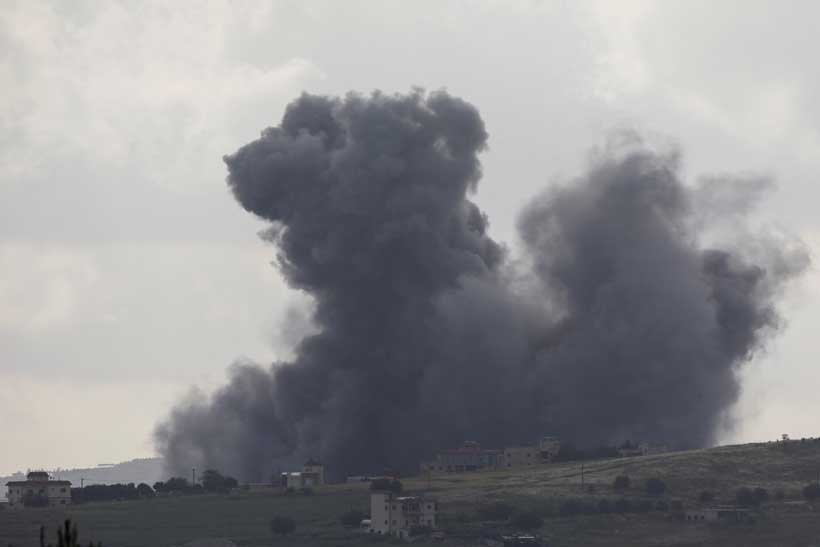
Israel and Lebanon have technically been in a state of war since 1948. No diplomatic relations. A shared border that has been a frontline, a buffer zone, an occupation corridor, and a negotiating point for most of the intervening seventy-eight years. The idea of their ambassadors sitting across a table in Washington discussing a peace agreement would have seemed far-fetched as recently as February 27, one day before the US and Israel struck Iran and changed everything.
Today, May 14, that is exactly what is happening. The third round of Israel-Lebanon talks is underway in Washington, led by Israeli envoy Ron Dermer and Lebanese delegate Simon Karam, as a ceasefire declared on April 17, extended on April 23, and violated repeatedly by both sides throughout its duration approaches yet another expiration point. Trump is in Beijing. Rubio is not in the room. The atmospherics are noticeably quieter than the first two rounds, which could mean the talks have matured into something more substantive, or that the urgency has drained out of them. Probably some of each.
This is not a simple bilateral negotiation. A government is sitting at the table on behalf of a country containing an armed group it cannot fully control, opposite an adversary with demands it knows will not be fully met, mediated by a country simultaneously running a Beijing state visit and an Iran ceasefire. The only way to read it accurately is to hold several perspectives at once.
How Israel and Lebanon Got to the Same Table for the First Time Since 1983
The road to Washington began with a war. When Hezbollah fired missiles into Israel on March 2, three days after US-Israeli strikes on Iran killed Supreme Leader Khamenei, Israel hit back with the largest wave of strikes on Lebanon since 2006. The fighting escalated fast, ground operations in the south, sustained bombing across the Bekaa Valley, strikes in Beirut’s southern suburbs. By mid-April, more than 2,000 people had been killed in Lebanon and over a million had been displaced.
Stay ahead of the geopolitical week.
MD Briefing delivers expert analysis across five global fronts — the Indo-Pacific, energy, geoeconomics, European security, and the Middle East — every Monday morning. Free.
The US-Iran ceasefire on April 7 is what shifted the equation. Before it, Israel had been operating in Lebanon with implicit American cover; Washington backed Israel’s refusal to extend the ceasefire to Lebanon, and Netanyahu used that space to conduct what he called a necessary security operation. Once the Iran ceasefire landed, that changed. The US needed Lebanon to quiet down so the broader Iran negotiations could proceed. Iran had made a lasting Lebanese ceasefire a condition for any durable settlement. Trump, running low on foreign policy wins ahead of November’s midterms, saw a Lebanon deal as part of the package he needed.
Netanyahu announced on April 9 that Israel would begin negotiations with Lebanon. The first round took place on April 14, the first direct diplomatic contact between the two countries since the failure of the May 17 Agreement in 1983. Lebanon’s President Aoun had expressed willingness for talks a week earlier. Israel initially rebuffed that offer, then changed its position once American pressure and the Iran ceasefire made engagement the more attractive option.
The Demands on the Table and Why They Don’t Add Up
The two sides are not negotiating over the same thing. They are not yet in the same conversation.
Israel wants Hezbollah’s disarmament and a peace agreement establishing normalized relations. Israeli Ambassador Leiter told the Lebanese people in April: “We want to live with you in peace and harmony, we have no interest in your land, only in our security.” Netanyahu said Israel wants “the dismantling of Hezbollah’s weapons, and a real peace agreement that will last for generations.” The Israeli government has also pressed Lebanon to sack Hezbollah ministers and indicated it wants Lebanon to eventually join the Abraham Accords.
Lebanon wants a ceasefire. Full stop. Culture Minister Ghassan Salameh said before the second round that a ceasefire was the only issue Lebanon’s envoy was authorized to discuss. President Aoun has refused to attend any summit with Netanyahu before Israeli strikes halt and a security agreement is reached. The government has pushed back on American pressure to move faster before those conditions are met.
The gap between those positions is not one that can be split. Israel is asking Lebanon to deliver Hezbollah’s disarmament , something Beirut does not have the capacity to deliver. Hezbollah still holds a powerful arsenal, retains deep support among Lebanon’s Shia community, and has rejected both the talks and any disarmament requirement outright. Asking a fragile Lebanese state to force that outcome risks triggering a civil war. The government has banned Hezbollah from military activities in law. Enforcing that ban against a group that has operated as a state within a state for decades is a different matter entirely.
The Hezbollah Variable That Makes Everything Harder
Hezbollah is simultaneously the reason these talks are necessary and the reason they face such a steep climb.
The group has been unambiguous: it opposes direct negotiations with Israel, rejects disarmament, and has said Israeli military presence in Lebanon justifies continued resistance regardless of what any ceasefire text says. A senior Hezbollah official told reporters the organization would not respect whatever Israel and Lebanon agree to. Ali Fayyad, a Hezbollah MP, said any political discussion must first be contingent on a ceasefire and Israeli withdrawal from Lebanese soil.
Lebanon’s government is negotiating in good faith. It has restricted Hezbollah’s military activities by law, sent delegations to Washington three times, and demonstrated a level of domestic opposition to Hezbollah’s armed status that has no recent precedent. But the party that controls the military reality in southern Lebanon is not at the table and has no intention of honoring what the table produces. Israel is being asked to make concessions , potentially withdrawing from the buffer zone it has established , in exchange for disarmament commitments from a government that may not be able to deliver them.
The 2024 ceasefire made this exact mistake. Lebanon committed to preventing Hezbollah from operating against Israel. Hezbollah rebuilt its military infrastructure anyway. Israel carried out airstrikes throughout the supposedly peaceful period. By March 2026, neither the letter nor the spirit of that agreement was intact. A new deal without a mechanism to address that pattern faces the same fate.
The Lebanese State’s Unprecedented Moment
Something is different about the Lebanese government sitting at the table right now, and it gets less attention than it deserves.
Under President Aoun and Prime Minister Nawaf Salam, Lebanon has moved against Hezbollah’s armed status in ways previous governments simply did not attempt. The government has approved plans to disarm the group. Salam has rejected Iranian proposals to negotiate on Lebanon’s behalf, insisting Lebanon speaks for itself. That is not a small thing. For years, Iran negotiated regional arrangements that treated Lebanon as a client state whose sovereignty was managed by Tehran through Hezbollah. Salam saying no to that arrangement marks a real break.
Samir Geagea of the Lebanese Forces has called for disarming Hezbollah and argued the country cannot stabilize under the current arrangement. Even Nabih Berri, Speaker of Parliament and leader of Hezbollah’s closest political ally, the Amal Movement, has expressed support in principle for the negotiations, pending Hezbollah’s position. The domestic political space for a settlement has opened in Lebanon in ways that simply were not there before this conflict.
Whether that opening is large enough to produce the outcome Israel is demanding is genuinely unclear. But the Lebanese delegation in Washington is not the politically paralyzed state that has historically been unable to act on its own sovereignty commitments. That matters, even if it is not yet sufficient.
The Iranian Thread Running Through Everything
These talks cannot be read without the Iran war running underneath them.
Iran has made a lasting Lebanese ceasefire a condition for any durable Iran-US settlement. That gives Tehran a lever over the Lebanon track, if Iran is unhappy with the Lebanon outcome, it has a ready-made reason to slow or block the broader negotiations. Hezbollah is Iran’s most direct instrument in that arrangement, which is part of why Hezbollah’s exclusion from the talks is both politically necessary for Israel and a vulnerability for any agreement that has to hold on the ground.
Tehran’s position has shifted since the ceasefire. Initially Iran insisted on a full Lebanese halt before Iran-US talks could proceed at all. As the Islamabad nuclear talks collapsed in April and the situation became more fluid, Iran has continued using Lebanon as leverage without treating it as an absolute precondition. The connection showed up vividly on April 17 , Iran announced the Strait of Hormuz was fully open when the Lebanon truce went into effect, then closed it again the next day when Washington refused to lift its naval blockade. These tracks are linked operationally, not just diplomatically, and the day-to-day coverage of individual negotiating rounds does not always make that visible.
More Time, or an Actual Framework: What the Talks Must Deliver
The three-week ceasefire extension Trump announced on April 23 is expiring. On that same day, Trump predicted he would welcome Netanyahu and Aoun to Washington for a historic summit within the ceasefire period. That summit has not happened. Lebanese officials have said Aoun will not attend before a security agreement is reached and Israeli strikes halt. On Wednesday, the day before this round of talks, Israel struck 40 locations in Lebanon’s south and east, killing 22 people including eight children.
The most likely outcome today is another ceasefire extension and a framework for the next stage of negotiations , which Lebanese officials say would address full Israeli withdrawal from southern Lebanon, border demarcation, prisoners, displaced persons, and reconstruction. Whether that framework produces anything binding depends on whether Israel offers concrete withdrawal commitments, whether Lebanon can credibly commit to disarmament it may not be able to enforce, and whether the US is prepared to apply the pressure on Netanyahu that moving him toward an acceptable position would require.
Washington’s attention is stretched thin right now. Trump is in Beijing. Rubio is not in the room. Every previous moment of genuine progress in these talks came with direct American political investment that this round is visibly lacking. That absence matters.
More than 2,800 people have been killed in Lebanon since March 2. About 1.2 million have been displaced. The ceasefire nominally in place has killed over 400 people since it went into effect. Whether what begins in Washington today eventually stops that count from rising is not a question anyone in the room can answer yet.
