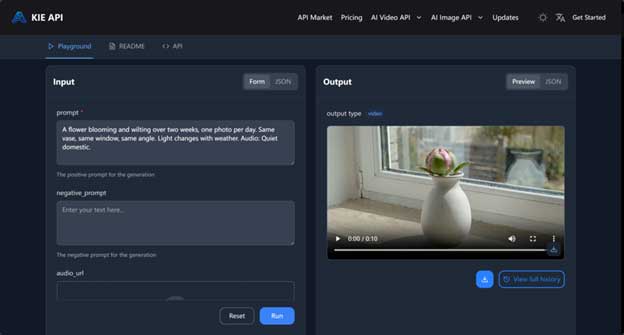
The evolution of generative AI in 2026 is defined by a transition from experimental visual effects to practical industrial applications. For media organizations and digital communicators, the challenge has moved beyond simply generating a video to achieving operational consistency and cost predictability. The emergence of the Wan 2.7 Video API ecosystem suggests a new standard where high-resolution output is integrated with a more sustainable economic framework.
The Economic Scalability of the Alibaba Wan 2.7 Video API
In a global landscape where video content is the primary vehicle for information, the barriers to entry remain high—not due to a lack of technology, but due to fluctuating compute costs and the complexity of professional production.
Predictable Wan 2.7 API Pricing via Kie.ai
The Wan 2.7 Text-to-Video API addresses this through a standardized and highly competitive pricing model. When accessed through platforms like Kie.ai, this technology becomes accessible at a base rate of $0.08 per second for 720P and approximately $0.12 per second for 1080P.
For high-volume users, the economic advantage is even more pronounced. Through Kie.ai’s advanced top-up options, which include a 10% bonus, the effective cost can be reduced to approximately $0.072 per second for 720P and $0.108 per second for 1080P. This level of transparency allows organizations to project budgets for large-scale projects without the financial volatility often associated with high-end AI inference.
Stay ahead of the geopolitical week.
MD Briefing delivers expert analysis across five global fronts — the Indo-Pacific, energy, geoeconomics, European security, and the Middle East — every Monday morning. Free.
Technical Precision of Wan 2.7 AI Video API
The technical distinction of Wan 2.7 AI Video lies in its architectural approach to spatial logic. Unlike traditional models that generate frames in a linear, predictive fashion, the 2.7 version utilizes a “Thinking Mode.” This reasoning step allows the API to analyze spatial relationships and semantic intent before the rendering process begins.
Advantages for the Wan 2.7 AI Video Generation API
For teams utilizing the Wan 2.7 AI Video Generation API, this technical shift results in:
- Enhanced Prompt Adherence: A more accurate translation of complex instructions into visual sequences, which reduces the need for repeated generations.
- Legible Text Rendering: The ability to generate stable, readable text within the video environment—a functional requirement for branding and instructional content.
- 3D Spatial Understanding: Support for 3×3 multi-reference grids allows the API to process subject structures from multiple camera angles, significantly enhancing visual fidelity during complex motion sequences.
A Multimodal Toolkit: Beyond Wan 2.7 Text-to-Video API
Beyond basic generation, the versatility of the Alibaba Wan series lies in its granular control mechanisms. These tools, integrated into the Kie.ai/wan-2-7-video interface, provide a comprehensive toolkit for controlled media production:
Wan 2.7 Image to Video API and Reference Control
The Wan 2.7 Image to Video API uses a reference image as a visual anchor to ensure the output maintains specific aesthetic details. Furthermore, the Wan 2.7 Reference To Video API supports “Character Locking” with up to five reference inputs, maintaining identity consistency across different scenes and angles.
Streamlining Workflows with Wan 2.7 Edit Video API
Perhaps the most resource-efficient tool is the Wan 2.7 Edit Video API. It enables instruction-based editing, allowing users to modify existing video assets via simple text commands—significantly streamlining the post-production workflow and reducing the necessity for full re-renders.
Concluding Observations on Wan AI API Integration
The trajectory of AI video in 2026 is moving toward a more mature, utility-focused phase. The significance of providing access to the Wan 2.7 Video API is not just in its ability to create cinematic visuals, but in its role in making high-quality communication more resource-efficient for global enterprises. As platforms like Kie.ai continue to bridge the gap between complex backend architectures and end-user requirements, the focus remains on how the Wan AI API can facilitate a more accurate, controllable, and visually coherent exchange of information worldwide.