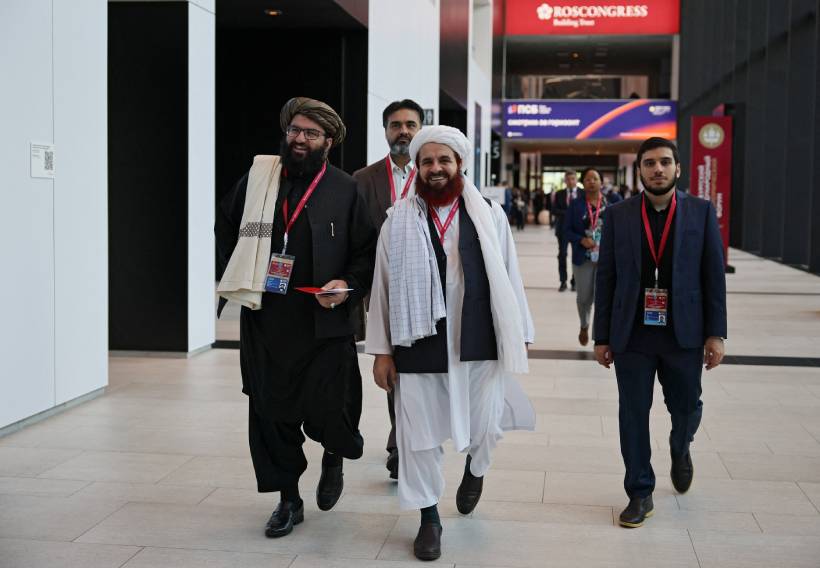
On 5 October, the eighth round of the Moscow Format consultations on Afghanistan ended without a joint statement for the first time since the forum was launched in 2017. The sticking point was not sanctions, recognition or aid. According to Russia’s special envoy Zamir Kabulov, the Taliban delegation objected to the draft’s repeated references to Afghanistan in connection with terrorism, even though similar wording had appeared in the statement adopted a year earlier. A regional mechanism created partly to manage threats emanating from Afghanistan could not agree on how to name them.
It would be easy to treat this as a diplomatic hiccup. It is better read as a measurement. Five years after the Taliban returned to Kabul, every major external actor that engages them has done so on its own narrow terms, and none has tied that engagement to the issue that most destabilises the region: the armed groups operating from Afghan soil. The Taliban have drawn the logical conclusion. If access, recognition and technical cooperation arrive regardless, there is little reason to concede even a sentence in a communiqué.
Three capitals, three narrow lenses
Russia has gone furthest. In 2025 it removed the Taliban from its list of banned organisations and became the first state to formally recognise their government. In May 2026, Security Council Secretary Sergei Shoigu described Moscow as building a “pragmatic” and “full-fledged” partnership with Kabul, and later that month he reportedly signed a military-technical cooperation agreement with the Taliban’s defence minister, Mullah Mohammad Yaqoob. Yet Russia’s own threat assessments sit uneasily with this policy. At the SCO security secretaries’ meeting in Bishkek on 14 May, Shoigu estimated that 18,000 to 23,000 militants from more than 20 groups were operating in Afghanistan. Moscow resolves the contradiction by focusing on the Islamic State’s Khorasan branch (ISKP) and the risk of spillover into Central Asia, threats the Taliban also fight. That framing allows Kabul to be cast as a counterterrorism partner; after the October round, Foreign Minister Sergey Lavrov praised the Taliban’s governance and their operations against the Islamic State. Groups the Taliban tolerate rather than fight simply fall outside the frame.
Stay ahead of the geopolitical week.
MD Briefing delivers expert analysis across five global fronts — the Indo-Pacific, energy, geoeconomics, European security, and the Middle East — every Monday morning. Free.
China’s engagement rests on a different calculus: stability, access to minerals and transit routes, and keeping Uyghur militants of the East Turkestan Islamic Movement away from Xinjiang. The calculus has not insulated it. The UN sanctions monitoring team has reported that the Taliban support the activities of groups including al-Qaeda, the TTP and ETIM inside Afghanistan. In November 2025, three Chinese workers at a gold-mining camp in southern Tajikistan were killed in a drone and gun attack launched from Afghan territory, the second deadly attack on Chinese nationals in that sector in a year. Beijing’s response was to order its citizens away from the border area, not to make its relationship with Kabul conditional.
Europe, which tends to see itself as the principled holdout, is following the same pattern by a different route. Under domestic pressure over migration, Germany has led a European push to negotiate with the Taliban to speed up deportations. Berlin has accepted Taliban-appointed consular staff, and the EU hosted a Taliban delegation in Brussels in June 2026 for talks on return and readmission. Chancellor Friedrich Merz insists that cooperation is limited to technical matters and does not amount to normalisation. But one European diplomat quoted in reporting on the talks expects Kabul to extract further concessions as pressure for deportations grows, and the agenda of these talks concerns whom Europe can send back, not what the Taliban permit on their territory. The contrast with Europe’s stated principles is sharp. On the very day of the Moscow round, the International Criminal Court unsealed four arrest warrants concerning senior Taliban figures, and UN human rights experts have since warned that engagement without clear red lines risks normalising the Taliban’s abuses. Security concerns about the groups Afghanistan hosts barely feature in the European conversation at all.
The threat the forums leave out
The UN’s own monitoring leaves little room for ambiguity. The Monitoring Team’s 37th report, covering July to December 2025, found that the Tehreek-e-Taliban Pakistan (TTP) was accorded greater liberty and support by the de facto authorities, and that its attacks on Pakistan increased as a result. Kabul maintains that no terrorist groups operate in Afghanistan; the report noted that no UN member state supported that assessment. An earlier report put the TTP’s strength at around 6,000 fighters, roughly double the 3,000 or so that Russian officials attribute to ISKP. The same report found that al-Qaeda had blended itself with the TTP, providing training and advisory support. The arithmetic is awkward for a selective approach: the largest militant formation on Afghan soil is the one that Moscow’s framework addresses least.
Pakistan is where this gap has turned into war. A Qatar-mediated ceasefire after border clashes in October 2025 did not hold, and talks facilitated by Turkey and Saudi Arabia failed to produce a durable settlement. In February 2026 Pakistan struck Kabul and other cities, with its defence minister speaking of “open war”; a renewed round of airstrikes and border fighting was entering its third week when delegations gathered in Moscow. Pakistani officials say the Taliban have offered verbal assurances on the TTP but refused the written, verifiable guarantees Islamabad seeks. At the forum, Pakistan’s special representative Mohammad Sadiq argued that terrorism remained at the heart of Afghanistan’s problems. Islamabad is not a neutral party, and its own conduct, from cross-border strikes to the mass expulsion of Afghan refugees, is widely contested. But the claim at the centre of its case is one the UN’s monitors now broadly corroborate.
Why unconditional engagement fails on its own terms
The case for engagement is not frivolous. Isolation in the 1990s did not moderate the Taliban; their hold on power is not seriously contested from outside; and influence generally requires presence. EU Migration Commissioner Magnus Brunner has put it simply: not engaging means it does not get better. The flaw lies less in engagement itself than in its sequencing and fragmentation. Each capital has extended its principal concessions, whether recognition, consular access or security cooperation, before securing anything verifiable in return, and each has done so separately. That allows Kabul to deal with Moscow, Beijing and Berlin in parallel, while no single interlocutor holds enough leverage to make counterterrorism a condition.
The approach also undermines the goals that motivate it. The regional connectivity projects that animate engagement, from the CASA-1000 power line and the TAPI gas pipeline to the proposed Uzbekistan-Afghanistan-Pakistan railway, depend on security in the same borderlands where militant groups operate with official tolerance. Investment cannot be ring-fenced from violence that the host government declines to restrain. And threats do not stay where they are pointed. The UN monitors have warned that the TTP could deepen cooperation with al-Qaeda-aligned groups and become an extra-regional threat. A group tolerated today because it targets someone else becomes tomorrow’s shared problem, as the attacks on Chinese workers in Tajikistan already suggest.
None of this argues for a return to isolation. It argues for coordination. A common baseline among Moscow Format participants, the EU and the Gulf mediators could tie the next round of concessions, such as upgraded diplomatic presence, security cooperation or investment guarantees, to verifiable steps: the relocation or disarmament of named groups, assessed through the UN monitoring mechanism whose mandate the Security Council renewed in February. That would be difficult to assemble, given how differently Moscow, Beijing and European capitals define their interests in Afghanistan, and how little appetite any of them has to subordinate its bilateral agenda to a collective one. Some analysts argue that the Moscow Format still has value precisely because it keeps regional states in one room, and that a missing statement is not the same as a failed forum. That is fair, but a forum that cannot name the region’s central security problem has limited use as an instrument for addressing it. The alternative to coordination is already visible.
The silent end of the Moscow round suggests that, for now, the Taliban hold more leverage over their interlocutors than their interlocutors hold over them. Until that balance changes, engagement will keep delivering access and legitimacy to Kabul, and communiqués to everyone else, or, as in October, not even those.