


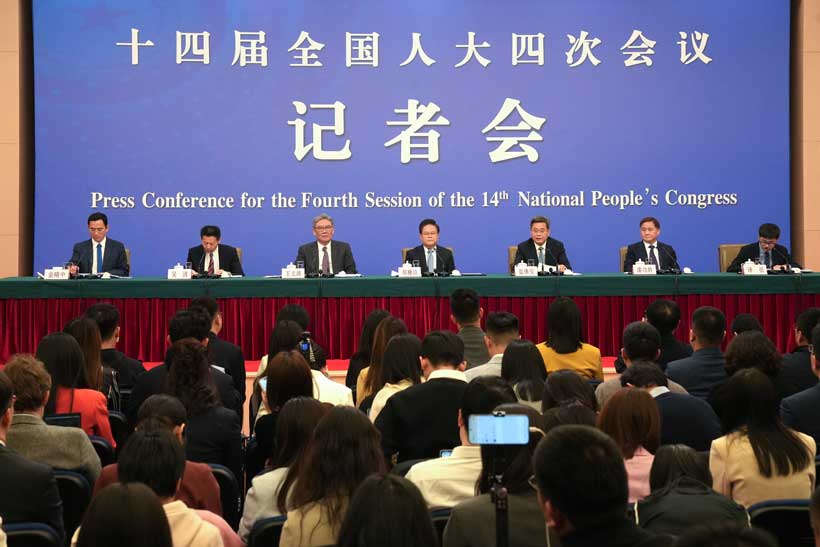
The 2026 Two Sessions in China (the Chinese People’s Political Consultative Conference and the National People’s Congress) serve as a strategic platform for consolidating the “community with a shared future for mankind” by advancing the Belt and Road Initiative and strengthening cooperation with Arab states. This aims to counter foreign interference, reject the use of force to change political systems, and promote a Chinese model of development based on peaceful development and mutual benefit. Accordingly, this year’s Two Sessions in China will address a number of emerging issues on both the international and domestic agendas, most notably strengthening the development model and partnerships. The meetings will focus on “jointly building high-quality” through the Belt and Road Initiative and enhancing cooperation in the fields of digital economy, infrastructure, and energy, thus providing development alternatives independent of Western hegemony.
The Two Sessions will focus on the “high-quality joint construction” of the Belt and Road Initiative and elevating cooperation in the areas of digital economy, infrastructure, and energy, thereby providing development alternatives that are less reliant on Western hegemony. TheAccordingly, the “2026 Two Sessions” (the joint sessions of the National People’s Congress and the Chinese People’s Political Consultative Conference) in China hold exceptional significance in shaping Chinese foreign policy, particularly in promoting an international model that rejects military intervention and regime change. This is achieved through opposition to the use of force and the principle of sovereignty. Through the “Two Sessions” in March 2026, China reaffirms its consistent principles in international relations, such as rejecting hegemony and the use of force to change existing regimes. Speakers at the current 2026 session emphasized that China strongly opposes the use of force in international relations, considering it a violation of the sovereignty and security of states. Furthermore, (respect for development paths): The meetings of the Two Sessions this year, 2026, promote the principle of “modernization with a Chinese style” as an alternative to models imposed from abroad, affirming the right of every country to choose its own political and social system without external interference.
Therefore, China calls for the implementation of the “Global Security Initiative” adopted by President “Xi Jinping,” which advocates resolving conflicts through dialogue and negotiation. This was evident in China’s recent stances regarding the escalation in the Middle East, such as the attacks on Iran in early March 2026. China focuses on the China-Arab Cooperation Forum as a platform for implementation, and the Forum serves as the executive instrument for these principles in the Arab region. This is especially true given China’s official announcement that it will host the second China-Arab Summit in 2026. The summit aims to deepen mutual political trust and build a closer community with a shared future. China also welcomes joint coordination on a number of pressing issues with the China-Arab Cooperation Forum. The Forum provides a platform for Arab states and China to speak with one voice against regime change by force, emphasizing support for justice in the Palestinian cause and regional stability free from external dictates.
Within this framework, China is working to promote the principle of “a shared future for mankind” by encouraging the Two Sessions meetings this year in China in 2026. This principle represents the philosophical umbrella uniting the outcomes of the Two Sessions and cooperation with the Arab states through advocating for a multipolar international system. Through the 2026 meetings, China seeks to strengthen an international system based on equality, where no single state has the right to determine the fate of others. China also emphasizes the principle of “partnership with dignity.” Chinese reports for 2026 describe cooperation with the Arab states as a “partnership with dignity” that rejects exploitation and believes that “there is room for everyone at the round table,” thus strengthening resistance to attempts at political hegemony by a number of major powers in the global system.
Stay ahead of the geopolitical week.
MD Briefing delivers expert analysis across five global fronts — the Indo-Pacific, energy, geoeconomics, European security, and the Middle East — every Monday morning. Free.
To that end, the 2026 meetings of the Two Sessions will establish a principled stance by China to garner support from the Global South against the use of force or regime change by force in international relations. In line with statements from the Chinese Foreign Ministry, the meetings will emphasize opposition to the use of force in international relations and advocate for resolving disputes through dialogue, thus sending a political message rejecting the forced change of political systems. This year, China will focus on activating the China-Arab Cooperation Forum. The meetings will discuss deepening strategic partnerships with Arab states to enhance stability and address shared security challenges in the Middle East. The recommendations will reflect China’s vision of a more equitable global governance based on respect for the sovereignty of states and non-interference in their internal affairs, reinforcing President Xi Jinping’s principle of a shared future for mankind. These discussions come at a time when China seeks to strengthen cooperation with countries of the Global South to create an international balance in the face of current security and political challenges.
From this, we understand that the “2026 Two Sessions” meetings in China represent a strategic milestone in consolidating China’s policy of “high-level opening up, both domestically and internationally.” These meetings will focus on advancing the joint construction of the Belt and Road Initiative, strengthening economic and infrastructure cooperation, and providing joint political support to countries of the Global South and the Arab world. This will ensure the stability of supply chains, achieve common development, and reject external interference aimed at forcibly changing regimes. The meetings will emphasize the advancement of high-quality Belt and Road projects while strengthening ties in transportation, energy, and the digital economy to enhance cooperation. Furthermore, the 2026 meetings will focus on strengthening the Arab-Chinese partnership. The sessions will contribute to enhancing ties and exchanges between China and Arab states, aiming to achieve mutual benefit, stability, and prosperity in the Middle East region, and to overcome current regional challenges. With a focus on development and cooperation, the meetings of the Two Sessions serve as a window to follow China’s development trends for the next five years. They strengthen cooperation with developing countries and work with the international community to resolve issues through dialogue, thus underscoring the importance of international openness and cooperation, particularly between China and the Global South. Through these meetings, China will work to uphold peace and stability, oppose the use of force, and promote understanding and cooperation with other countries.
The National Committee of the Chinese People’s Political Consultative Conference (CPPCC) convened on March 4, 2026, while the National People’s Congress (NPC) session began on March 5, 2026, featuring extensive discussions attended by senior officials. The 2026 “Two Sessions” meetings (the National People’s Congress and the Chinese People’s Political Consultative Conference), held in early March, focused on launching the 15th Five-Year Plan (2026-2030), promoting “new qualitative productive forces,” such as artificial intelligence, and achieving sustainable economic growth (around 4.5%) while emphasizing deepening reform and opening up, stabilizing employment, and developing a “dual circulation” model. The main topics of discussion at the 2026 Two Sessions included discussing the 15th Five-Year Plan (2026-2030), formulating a roadmap for sustainable development, and focusing on quality rather than speed alone. This included a focus on “new qualitative productive forces,” with extensive discussions on integrating artificial intelligence into industries, developing advanced technologies, and promoting a “smart economy.”
The 2026 “Two Sessions” meetings focused on strengthening China’s economic policy and growth, discussing the Chinese government’s work report, with the aim of boosting economic growth to 4.5%, promoting investment, supporting businesses, and stabilizing the real estate market. Emphasis was placed on the values of openness and international cooperation through strengthening the Belt and Road Initiative and the China-Arab Cooperation Forum while committing to high-level openness, opening new markets, and managing trade relations (especially with the United States). Attention was also given to green development and security, focusing on a low-carbon green transition and ensuring economic and food security amidst global uncertainties. A number of social issues were discussed, such as addressing demographic pressures (aging population), stabilizing employment, and improving quality of life.
In short, the 2026 “Two Sessions” provide the legislative and political framework for China’s global vision, while the China-Arab Cooperation Forum serves as a platform for implementing this vision by building a bloc that rejects military intervention and defends the sovereignty of national political systems, in accordance with the Chinese principle of a shared future for mankind.
