


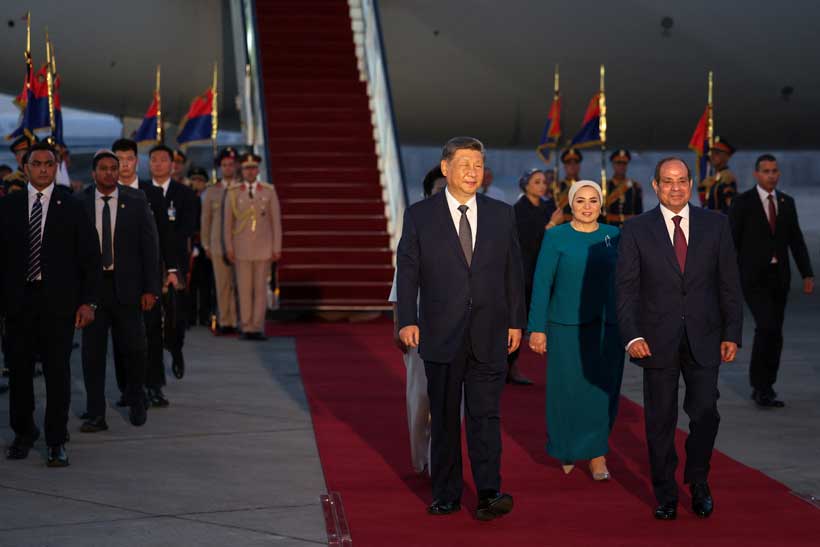
With President Xi Jinping’s anticipated visit to Egypt in late August and early September, coinciding with the Shanghai Cooperation Organisation (SCO) summit in Bishkek (August 30 – September 3) and the Chinese president’s visits to Kyrgyzstan and Egypt, several questions arise: How can Sino-Egyptian cooperation unfold within the framework of the SCO and the evolving Eurasian connectivity architecture? Furthermore, how can Egypt, as a key regional partner, engage with China through multilateral platforms such as the SCO and China’s Belt and Road Initiative? What does this mean for South-South cooperation, regional stability, and a more balanced global governance system?
Egyptian-Chinese cooperation within the framework of the Shanghai Cooperation Organisation (SCO) and the Eurasian connectivity architecture is embodied in the two countries’ pursuit of balanced, multipolar strategic partnerships that support sustainable development and regional security for the benefit of development and the issues of the Global South. Here, China benefits from Egypt’s partnership in the Shanghai Cooperation Organisation (SCO) as a dialogue partner since September 2022. China views Egypt’s membership in the SCO as a pivotal platform for enhancing security, political, and economic coordination with Asian and emerging powers. China supports this role, considering Egypt a crucial strategic link connecting the Middle East, Africa, and Asia. This reinforces Egypt’s pivotal role with China in the Eurasian framework and the Chinese Belt and Road Initiative. The SCO’s objectives and the concepts of Eurasian connectivity align with the Chinese Belt and Road Initiative, which sees Egypt and the Suez Canal as a key trade and logistics corridor. This is especially true given the expanding cooperation between Egypt, China, and SCO member states in Eurasian connectivity, encompassing local industries, infrastructure projects, transportation, and renewable energy. This serves to integrate the Chinese Belt and Road Initiative with Egypt’s Vision 2030 for Sustainable Development.
Herein lies the significance of Chinese President Xi Jinping’s visit to Egypt and the Shanghai Cooperation Organisation (SCO) summit in Bishkek (August 30 – September 3, 2026) in strengthening the comprehensive strategic partnership and building a more balanced global governance system. Cooperation within the SCO framework and Eurasian connectivity is particularly important given Egypt’s unique strategic position in the Middle East and the Global South. Egypt’s participation as a dialogue partner in the SCO allows for enhanced security and political coordination. Furthermore, the Eurasian connectivity structure contributes to the logistical linking of the North-South Corridor with the Suez Canal axis and its importance to China. Logistical connectivity between Eurasian corridors, such as the International North-South Transport Corridor (INSTC) and the Suez Canal axis, represents a strategic shift in global trade, amidst Chinese and Russian efforts to diversify supply routes. Here, the Eurasian connectivity structure and logistical linkage emerge in a fully integrated multimodal framework. The North-South Corridor integrates rail, road, and sea transport networks to connect Russia, Iran, and South Asia to the heart of Eurasia, which intersects with the pivotal importance of the Suez Canal in Egypt. This geopolitical structure converges with the Suez Canal as a global trade crossroad linking East and West. Egypt seeks to connect the Canal Zone with rail and road transport networks to enhance distribution efficiency. China benefits from this in terms of risk diversification and reduced dependence. China leverages the diversification of trade routes, including the Eurasian land routes and the Arctic sea route, to ensure the continuity of supply chains, bypassing geopolitical bottlenecks in traditional straits. This serves the integration of China’s Belt and Road Initiative. Eurasian logistical convergence allows Beijing to enhance export movement and provide flexible access to European and Asian markets via alternative and scheduled routes.
Thus, this Egyptian-Chinese-Eurasian partnership plays a role in supporting regional and international stability, overcoming energy security challenges, and the challenges posed by the Strait of Hormuz. Egyptian engagement through multilateral platforms such as China’s Belt and Road Initiative and the Eurasian Corridors allows for the integration of major development projects in Egypt with the Chinese Belt and Road Initiative, which benefits Egypt’s economic development. Here, Egypt plays a crucial strategic role in enhancing regional stability and protecting global energy security by linking its vital interests to major international initiatives. This safeguards energy security and maritime routes, as China relies on Egypt’s pivotal role in securing global navigation in the Red Sea, Bab El-Mandeb, and the Suez Canal, thus supporting the stability of energy supplies amidst the security challenges associated with the Strait of Hormuz following the Iran War. This also strengthens Egypt’s position as a regional energy hub through the liquefaction and re-export of natural gas. This important Egyptian role complements the Chinese Belt and Road Initiative by linking major infrastructure projects in Egypt, such as the Suez Canal Corridor Development Project, to the Chinese Belt and Road Initiative. China is cooperating with Egypt to develop Egyptian ports on the Red Sea and the Mediterranean to serve Asian and European trade routes and to establish joint Egyptian-Chinese trade, industrial, and logistics zones. This will increase the flow of goods, boost developmental and economic returns, and attract foreign direct investment to Cairo’s renewable energy, transportation, and logistics sectors. Furthermore, China is transferring expertise and modern technologies to support local manufacturing and Egyptian infrastructure, creating new job opportunities and bolstering sustainable development in the Egyptian economy.
Stay ahead of the geopolitical week.
MD Briefing delivers expert analysis across five global fronts — the Indo-Pacific, energy, geoeconomics, European security, and the Middle East — every Monday morning. Free.
This Egyptian partnership contributes to regional stability amidst the challenges of energy security and the Strait of Hormuz. Egypt’s engagement through multilateral platforms, such as China’s Belt and Road Initiative, allows for the integration of major development projects in Egypt with the initiative. This benefits Egypt’s economic development by expanding trade and attracting diverse Chinese investments in renewable energy and industry. This, in turn, has implications for developing countries, global governance, and South-South solidarity, promoting multipolarity and a multipolar world in the face of US unilateral hegemony. Therefore, the Egyptian-Chinese partnership presents a successful model of South-South cooperation based on mutual respect and equality. It advocates for global governance reform, and Egypt supports joint efforts and the voices of small and medium-sized countries in international institutions to demand reform of international and UN institutions in favor of the issues of the Global South, with China’s assistance and support.
Accordingly, Egypt and China play a pivotal role in supporting multipolarity and global governance by demanding the reform of international and UN institutions to represent the voices of developing countries and the Global South. They also strengthen solidarity among the Global South to counter American unilateral hegemony. Egypt and the Global South support China’s position on Taiwan as part of the Chinese mainland, in accordance with the One China principle, and reject foreign interference in the internal affairs of China and other countries. In return, China supports the issues of the Global South and contributes to achieving development without political conditions, unlike other Western and American institutions such as the World Bank and the International Monetary Fund.
