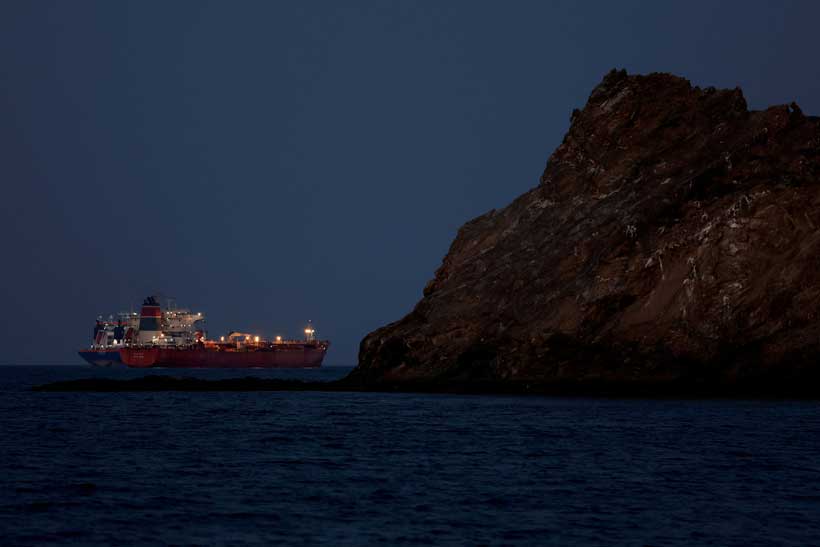
On 31 August, two supertankers carrying Saudi crude were struck by unknown projectiles within minutes of one another as they sailed out of the Strait of Hormuz near Oman. Each carried about two million barrels, and no casualties were reported. The attacks were followed the next day by a new wave of American strikes on Revolutionary Guard targets around the waterway. Two days earlier, American forces had destroyed two Iranian launchers on Larak Island as Revolutionary Guard personnel prepared to launch rockets carrying sea mines into the shipping lanes. Iran retaliated hours later with ballistic-missile attacks on two US bases in Jordan. The military exchange had resumed, but the central problem around Hormuz had not changed.
The sea lane itself remained barely used. On 31 August, Kpler recorded only five commodity vessels through Hormuz, none of them a liquid tanker, against a ten-day average of about fourteen. Before the war, roughly 130 to 140 vessels transited daily. Some vessels now sail with their transponders switched off, so visible tracking does not capture every transit. The gap between physical access and actual use is where the larger contest has settled. A waterway does not reopen simply because a navy declares it navigable. Shipowners, charterers, insurers, banks, and cargo interests have to decide that passage is worth the risk, and those decisions sit outside any military chain of command. A tanker operator still has to consider war-risk premiums, sanctions exposure, contractual obligations, crew safety, and the possibility that conditions will change again before the vessel completes its passage. Physical access can therefore be restored before commercial confidence follows.
Iran cannot match American air power, has absorbed extensive damage to its military infrastructure, and lost its supreme leader in the opening strikes. What it retains is a position that cannot be removed by air strikes. Before the war, volumes equivalent to around a fifth of global petroleum-liquids consumption passed through Hormuz, together with more than a fifth of global LNG trade. The geography placing Iran along its northern shore has survived everything that has happened since February.
American capability reaches the water without much difficulty. What it cannot settle so easily is the network of decisions around the water. Washington can make particular transits physically possible, but it cannot order a shipowner to sail, an underwriter to write the risk, an Asian refiner to accept the cargo, or a bank to finance a transaction carrying sanctions exposure. Iran cannot alter the military balance between the two sides. What it has been able to do is exploit a position where that balance converts poorly into the wider result Washington needs.
Stay ahead of the geopolitical week.
MD Briefing delivers expert analysis across five global fronts — the Indo-Pacific, energy, geoeconomics, European security, and the Middle East — every Monday morning. Free.
For Washington to turn military success into a durable political outcome, commercial traffic would also have to return, maritime arrangements would have to function under sanctions and insurance rules, Gulf exporters would have to recover confidence in their routes, and the Strait could not require indefinite American military management. Continued success against Iranian targets does not by itself create any of those conditions.
Tehran does not therefore need to prevent American tactical success for Hormuz to remain useful. It needs only to ensure that tactical success remains narrower than the political and commercial condition Washington is trying to restore. What makes Hormuz especially difficult, however, is that this problem does not stop with Washington. Once a passage depends simultaneously on military security, diplomatic agreement, insurance, sanctions compliance, and commercial willingness, no actor involved can determine the outcome on its own.
This is the Hormuz trap. Washington encounters it first because military superiority cannot restore the system around the water. Iran encounters the same limit when it tries to turn control of the position into authority over everyone who depends on it.
The Conversion Problem
Whether Iran conceived this logic in full at the beginning of the war is harder to establish. Its behavior increasingly appears organized around it. Once Tehran had little prospect of contesting American capability directly, maintaining enough uncertainty around Hormuz offered another way to preserve leverage. The United States could continue winning the military interactions while finding that those victories did not close the political contest.
The problem is familiar even if the terrain is not. In Afghanistan and Iraq, American forces repeatedly solved military problems without thereby controlling the political systems in which those victories had to acquire meaning. Governments could be removed, hostile formations destroyed, and particular areas secured, while the eventual political outcome depended on local bargains, neighboring states, patronage networks, legitimacy, and institutions outside American command. Hormuz presents the same conversion problem in a very different setting, with military success entering a wider system whose response cannot be determined through force alone.
The difficulty does not arise because the United States cannot understand complex environments. It arises partly because American capability continues to provide effective answers to the immediate problems it encounters. Those responses can be entirely rational and successful at the level at which they are applied, while their accumulation still fails to produce the political condition for which the force is being used.
Iran cannot make American superiority disappear. The effect of its strategy is instead to direct that superiority towards problems American power can solve. The stronger actor continues to act effectively, but discharge and resolution begin to separate.
The diplomatic evolution of the war has reinforced the effect. In early May, Washington did not accept an Iranian proposal that would have reopened Hormuz and ended the American blockade of Iran while leaving the nuclear issue for later. By June, the sequencing had changed significantly. The Islamabad Memorandum of Understanding committed Iran to use its best efforts to provide safe commercial passage without charge for sixty days, while the United States began removing its naval blockade, and both sides entered a broader negotiation. The document also committed Iran to discuss the future administration and maritime services of Hormuz with Oman and other Gulf states, in line with applicable international law and the sovereign rights of the Strait’s coastal states. An agreement written to restore free passage accepted in the same clause that the Strait would have an administration and that coastal-state rights would bear on it.
For a state that had lost its supreme leader and absorbed substantial damage to its conventional military infrastructure, this mattered. Iran had not restored the capabilities it lost. It had made its remaining position sufficiently important that the organization of the Strait had become part of the political settlement itself.
From Disruption to Administration
Tehran’s answer was to try to organize the space that American power could not settle. On 5 May, Iran announced a new mechanism to manage vessel transit, which took institutional form in the Persian Gulf Strait Authority, sanctioned by the United States on 27 May. Washington linked the Authority to the Revolutionary Guard and warned that companies dealing with it could face sanctions exposure. The timing matters because the Authority did not arise as a response to the June memorandum. It was already part of the structure into which that agreement would later have to fit.
Two days after the 17 June memorandum, the Authority announced the procedures under which ships would actually cross. Vessels were expected to submit transit requests forty-eight hours in advance and coordinate their route and scheduled passage with Iran. Security, safety, and environmental services, together with associated Iranian insurance, would be provided without charge during the sixty-day period. Iran was also requiring vessels to carry insurance approved by the Authority, initially free but with the possibility of charges once the temporary window ended.
Iran had therefore complied with the central toll-free provision while inserting an administrative relationship into the passage itself. A vessel no longer faced only the question of whether Iranian forces would attack it. It also had to decide whether to submit information to a sanctioned Iranian authority, coordinate its movement through that authority, and accept the insurance arrangements Tehran required.
The diplomatic framework began to unravel within weeks. Trump declared the Islamabad memorandum over on 8 July after Iranian attacks on commercial vessels in the Strait. The sixty-day negotiating period had been due to run until 17 August, when the deadline passed without a final agreement. Tehran nevertheless continued to invoke the framework after that deadline. On 1 September, President Masoud Pezeshkian said Iran would reciprocate immediately if Washington returned to its commitments under the interim deal.
The problem became sharper when the insurance market responded. On 23 July, the Lloyd’s Market Association published a model Strait of Hormuz Transit Fee Condition addressing payments made to enable vessels to pass through Iranian territorial waters or transit Hormuz. Under the wording, insurers are irrevocably discharged from obligations relating to the vessel where a prohibited payment or other consideration has been provided, whether directly or indirectly and whether financial or otherwise. The clause preserves an exception for charges relating only to specific maritime or navigational services that are legally permissible under UNCLOS.
Iran has framed its proposed charges around maritime, environmental, insurance, and security services, which is the shape of the exception the clause preserves. Both claims turn on the same legal boundary, and the dispute between them runs through the insurance market rather than being settled by the two governments.
Governments could agree that ships should move, and Iran could promise safe passage without charge. Tehran could then build that passage into an administrative process of its own, while Western sanctions and emerging insurance restrictions made participation difficult for the commercial actors whose return was needed for the agreement to mean anything.
The outcome did not require any single actor to design it. Iran sought to preserve a role in administering the position it controlled. Washington was seeking reopening while simultaneously sanctioning the IRGC-linked authority through which Iran sought to administer it. Insurers had to consider sanctions and terrorism legislation. Shipowners had to decide whether the resulting voyage was commercially and legally acceptable. A state agreement could therefore exist while normal commerce remained elusive.
Iran continued to develop the administrative machinery during the summer. On 24 August, the Strait Authority blacklisted 45 vessels it said had violated Iranian transit rules, among them ships belonging to Saudi Arabia’s Bahri and to ADNOC Logistics and its Navig8 subsidiary, and warned that listed vessels could face fines, detention, or cargo confiscation. At least three Indian refiners and a global energy company subsequently said they planned to stop using listed vessels, including for ship-to-ship transfers. Iran’s rules did not need universal recognition to alter commercial behavior. The threat that Tehran could enforce them was enough to enter the calculations of firms operating around the Strait.
This fragmentation has served Iran in the immediate contest because Washington cannot solve Hormuz merely by dominating Iran militarily. Normal commerce depends on cooperation from actors that American force cannot compel. But the same feature that makes the Strait difficult for Washington limits Tehran as well, because Iran cannot determine how those actors respond once the costs of dependence become clearer.
The Cost of Leverage
The first responses were improvised. Gulf exporters increased ship-to-ship transfers and developed shuttle arrangements that moved cargo towards vessels waiting beyond the most exposed waters. Iranian blacklisting then made some of those workarounds more complicated, prompting companies to reconsider which ships they used and how transfers were organized. The interaction is recursive. Iran changes the conditions of passage, commercial actors adjust, and Tehran tries to extend its influence to the adjustment.
Infrastructure is slower, but here too the calculation has changed. Saudi Arabia has pushed more trade towards its Red Sea ports, while the UAE has accelerated capacity around its eastern ports and Fujairah. Across the Gulf, projects involving pipelines, ports, and inland logistics that once looked like expensive contingencies have acquired a different strategic value. Governments are committing billions of dollars to infrastructure intended to reduce their exposure to Hormuz after six months in which the Strait has been virtually blocked for long periods.
These alternatives do not create independence. They relocate dependence. Saudi crude reaching Yanbu avoids Hormuz but still enters a Red Sea exposed to another set of military and political risks. Fujairah removes one maritime bottleneck while making pipelines, terminals, and other routes more important. The region is not escaping positional power so much as changing where some of that power sits.
The adjustment is taking place at more than one speed. Commercial practices can change in days or weeks. Pipelines and ports take years. Buyers can alter their behavior somewhere in between. Asian refiners have already purchased more non-Gulf crude, including additional American barrels, when uncertainty around Hormuz made future supplies difficult to secure. Those purchases need not all become permanent for the experimentation to matter, because refiners are learning what alternatives cost and how easily they can be incorporated into existing operations.
That accumulated dependence is what gives Hormuz much of its value. Asian reliance on Gulf energy was built over decades through refinery configurations, long-term contracts, tanker schedules, financing, and insurance practice. The dependence is also uneven. Saudi crude can increasingly move west. Emirati oil has an outlet at Fujairah. Qatar’s LNG remains much harder to redirect because pipelines designed for crude cannot solve its maritime geography. The existence of an alternative therefore matters less than the cost of using it.
Iran does not have to make Hormuz irrelevant for its future leverage to weaken. It is enough for important users to acquire alternatives that are more credible, cheaper, or easier to activate than they were before the war.
Tehran appears to understand that danger. The Saudi East-West pipeline, which had become the kingdom’s only crude export route after Hormuz closed, was struck on 8 April, hours after a ceasefire was agreed. The attack cut throughput by roughly 700,000 barrels a day, and Riyadh restored full capacity on 12 April. Infrastructure that reduces dependence on the Strait also reduces the value of the position from which Iran bargains.
But attacking alternatives changes the investment calculation behind them as well. A route designed to insure against disruption in Hormuz becomes more valuable when disruption actually occurs, and the case for additional redundancy becomes stronger when existing alternatives are themselves exposed. Iran can punish attempts to reduce dependence on the node, but it cannot remove the incentive that its own strategy creates to build around it.
This does not mean Tehran has simply miscalculated. Iran may understand perfectly well that weaponizing Hormuz encourages diversification and still consider the trade worthwhile. The time horizons are different. The regime is trying to preserve its political position now, while much of the infrastructure capable of reducing Hormuz’s value will take years to complete. If exploiting the Strait improves the terms on which the war ends, keeps Iran inside negotiations, or prevents military defeat from turning into political capitulation, some loss of future leverage can be a rational price.
The same search for additional options is appearing in regional security relations. The joint defense agreement signed by Saudi Arabia, Turkey, and Pakistan in Mecca in August should not be read as a replacement for existing alliances, including the countries’ deep security ties with the United States. It extended a collective-defense principle Saudi Arabia and Pakistan had already adopted bilaterally in September 2025. By the end of August, the three states had held the pact’s first committee meeting and agreed to establish a permanent secretariat in Saudi Arabia. Turkish officials have described the arrangement as defensive and not directed against Iran or any other country. Its significance lies instead in regional governments adding another relationship to an architecture whose limits the war has made more visible. The logic resembles the infrastructure response. States are not abandoning the existing system so much as reducing the amount they are willing to ask any single route or security provider to carry.
Iran’s success and its limit therefore come from the same feature of the system. Hormuz frustrates Washington because military superiority does not give it authority over all the decisions required to restore normal passage. But occupying the pivotal position does not give Tehran that authority either. Hormuz allows Iran to keep presenting the United States with military problems that can be solved without those solutions necessarily producing political closure. The system in which those problems sit is not passive. Commercial workarounds become familiar, contingencies acquire funding, insurers rewrite clauses, buyers test different suppliers, and governments add infrastructure and security relationships.
Iran’s attempt to institutionalize its role through the Persian Gulf Strait Authority can be read partly as an effort to preserve some of the political value created during the war. If vessels eventually came to treat Iranian permits, recognized services, and security guarantees as an ordinary part of crossing Hormuz, Tehran could carry part of its wartime leverage into whatever order follows. The difficulty is that establishing the ability to impose a rule and establishing general acceptance of that rule are different things. Iran can compel individual actors to reckon with its authority without compelling the other authorities around the Strait to ratify it.
A state can force others to acknowledge the position it occupies without being able to determine the order that eventually forms around it.
When more normal traffic returns, Hormuz will still be one of the world’s most important energy corridors. Qatar will remain heavily exposed, and Gulf oil will continue to pass close to the Iranian coast, and using the Strait will probably remain cheaper than most alternatives whenever passage is secure. Some of the adaptations made during the war are likely to fade as insurance premiums fall and familiar routes become attractive again. Others are already becoming embedded in infrastructure, contracts, insurance practice and security relationships that cannot be unwound as quickly as a ceasefire can be signed.
Iran has drawn considerable political value from the dependence accumulated around Hormuz, and it has done so partly by exploiting a recurring weakness in the conversion of American military superiority into political outcomes. That leverage has helped keep Tehran relevant to a settlement after losses that would otherwise have left it negotiating from a much weaker position. But each successful use of the Strait has also made the costs of depending on it more visible to everyone else. What Iran is spending is therefore not the geography itself, which will remain where it has always been, but part of the accumulated dependence that made that geography such a powerful instrument in the first place.