


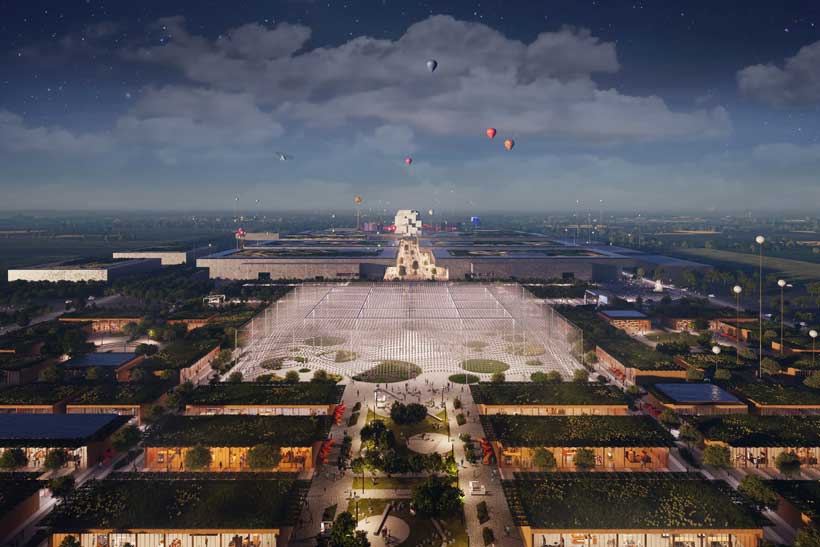
Expo isn’t usually seen as a platform for international diplomacy. Conceived as a world’s fair to showcase the achievements of nations, it has traditionally been treated as an economic or cultural forum. In truth it’s all of these things at once but it also offers certain advantages over other multilateral platforms. Expo is unique among international summits in that it brings governments together and opens up opportunities for dialogue that aren’t complicated by the usual pressures of high-stakes diplomacy and geopolitics.
There aren’t any ceasefires to negotiate, no procedural constraints to navigate, nor an expectation that every encounter needs to produce some sort of political outcome. Instead, Expo brings together state officials, business figures and foreign publics in an environment where public and economic diplomacy can thrive: nations build relationships with international partners, promote trade and investment, and project their national image in order to build soft power. The ethos is more collaborative than adversarial.
Forums like the UN General Assembly are indispensable, but these are largely focused on addressing immediate crises and difficult political questions. Expo creates more space for countries to build relationships, promote themselves, and pursue commercial opportunities in a way that few other international meetings can match at such a scale.
A broad-based multilateral platform
Stay ahead of the geopolitical week.
MD Briefing delivers expert analysis across five global fronts — the Indo-Pacific, energy, geoeconomics, European security, and the Middle East — every Monday morning. Free.
As geopolitics has become more divided, traditional multilateral diplomacy has become harder to manage. Institutions are either deadlocked or simply bypassed, sanctions regimes limit contact between governments, and diplomats increasingly spend their time managing who cannot be in the room.
Expos are a rare exception; next year’s event will gather more than 140 members of the international community in the Serbian capital Belgrade on non-confrontational terms. There are no resolutions, no votes, no vetoes, and no requirement for anyone to agree about anything. That makes participation relatively low-risk and gives countries more room to keep talking across political divides.
States that need to keep channels of communication open despite their political divisions can do so without turning every encounter into a statement of alignment. Summits that require agreement on hard questions before anyone arrives increasingly struggle to convene broad participation, which is why a more cordial setting like Expo is increasingly useful for diplomats: it allows them to manage old relationships and build new ones in an environment that doesn’t attract the same sort of scrutiny.
Diplomacy without confrontation
Expos exist in an unusual diplomatic space, operating below the level of formal multilateral institutions and providing an avenue where states can engage through trade, tourism, technology, culture, education, sport and music.
Effective international relations has always relied on more than formal negotiation. Officials need opportunities to meet repeatedly and maintain familiarity, so that working relationships already exist before they are called upon in more difficult circumstances. Expo 2027 Belgrade will run for three months across spring and summer next year, creating space for exactly that kind of repeated contact outside the usual formal channels.
These meetings might not produce communiqués or concrete negotiated outcomes, but they still have diplomatic value. When relations are strained, a forum that asks less of its participants can sometimes achieve more simply by keeping them in contact.
It’s also worth remembering that international dialogue isn’t solely conducted between governments and diplomats. If countries want to acquire greater soft power and build influence, they have to engage with foreign publics as well. Expos give governments a unique opportunity to reach both officials and the wider public at the same time. A pavilion can host ministers and business leaders while also introducing thousands of visitors to a country’s culture, products, tourism offer, and technology.
The levelling effect matters most to small states
Size matters in international politics: gross domestic product, population, military might, soft power, and other factors decide whose voice gets heard the loudest. This naturally puts smaller states at a disadvantage, unless they have access to significant fossil fuel reserves or nuclear weapons. To overcome this handicap, they have to work harder to compensate for their comparative lack of size, power, and visibility.
Expos do not erase these imbalances, but they do provide smaller nations with a more level platform. Every participating country has its own pavilion, national day, and programme that it can use as a basis to arrange meetings on its own terms. Unlike in the other international institutions or summits, Expo doesn’t arrange attendees by alphabetical order or political might, which means that smaller states will often find their pavilion situated close to one of a global superpower.
This element of chance creates natural and spontaneous opportunities for dialogue between national delegations because it’s much easier to initiate conversations and arrange meetings when both sides are already in the same location. This can help flatten some of the usual asymmetries that exist in high diplomacy and give countries like Slovakia a temporary advantage.
It’s the economy, stupid
Economic diplomacy is where Expo’s benefits become most tangible. Without international tensions to resolve, focus can shift to other matters such as trade and mutual economic interests. Participants can devote their diplomatic energies to opening new markets for their countries, attracting foreign investment, and helping domestic companies conduct business abroad. This is a crucial element of foreign policy for smaller nations in particular because market access, trade, capital, and commercial partnerships all have a direct effect on prosperity at home.
Expo brings together governments, embassies, investment and export agencies, chambers of commerce, companies, and investors in the same place, which makes it a perfect forum for economic diplomacy. National pavilions are backed by their respective states and, unlike short trade missions, they remain active for several months. That gives countries more time not just to promote products, but to build the familiarity and trust that commercial relationships depend upon.
For Slovakia in particular, this is crucial. We have one of the most open economies in Europe and depend heavily on exports. Slovak companies have strong engineering capabilities and produce advanced technologies, but this isn’t something that we are particularly well known for internationally, which puts us at a commercial and diplomatic disadvantage. Closing this gap will make Slovakia’s strengths more visible to the companies, investors, and governments we want to do business with.
The same applies to tourism. Our country is blessed with considerable natural, cultural, and historical assets, yet its profile as a tourist destination lags behind many of our neighbours. Tourism promotion, public diplomacy and national branding all reinforce each other because they help build familiarity and affinity with a country. A positive national image undoubtedly influences where people choose to travel just as it shapes where companies choose to invest. That is ultimately what economic diplomacy is about: turning political access and national visibility into relationships that last beyond the event itself. Expo is immensely useful for this purpose because it attracts both potential investors and visitors alike.
What participation is actually for
It’s important to stress that Expo is no substitute for traditional diplomacy. Its value lies in building relationships, creating business or investment opportunities, promoting exports and tourism, and slowly elevating a country’s international influence. Many of those benefits only become visible long after Expo is over.
In the current diplomatic climate, states are becoming increasingly resistant to dialogue precisely at a time when it’s most needed. Expo cannot resolve the crisis in the Strait of Hormuz, for example, but it can provide a forum where these most divisive of issues are sidestepped and countries can instead focus on areas like the economy where they can still find opportunities for cooperation. This is a valuable diplomatic function that deserves to be treated as such.
