


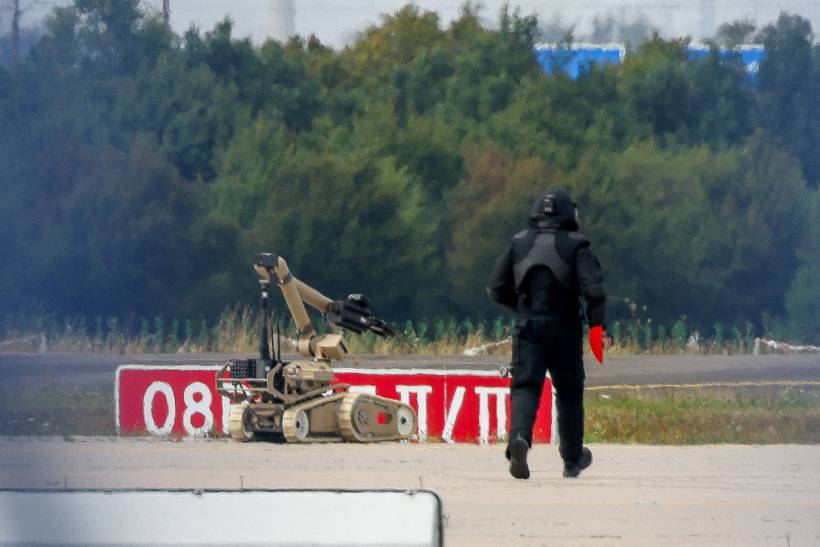
The European Union is facing growing concerns over alleged Russian hybrid operations on European territory after Germany concluded that Russia was responsible for an attempted drone attack at Leipzig/Halle Airport last month. German authorities said their assessment was based on intelligence and police investigations pointing to Russian state involvement. Moscow has rejected the accusation.
EU foreign policy chief Kaja Kallas said the Leipzig incident had the hallmarks of state sponsored terrorism, placing the attack within a wider European debate over Russia’s use of sabotage, cyber operations, airspace violations and other forms of hybrid pressure. European officials argue that such activities are designed to test Europe’s vulnerabilities while avoiding the threshold of conventional military confrontation.
The issue dominated discussions as EU foreign ministers gathered informally in Ireland. Kallas said work was continuing on sanctions targeting Russia’s military complex, while several ministers called for additional measures to increase pressure on Moscow. Germany has also indicated that the EU will pursue further sanctions against Russian individuals in the coming weeks.
The Leipzig incident comes amid a broader pattern of security concerns across Europe. Romania has repeatedly reported Russian drone incursions into its airspace, while European governments have increasingly warned about threats to critical infrastructure. Germany itself has also been dealing with a recent sabotage incident targeting its power grid.
Stay ahead of the geopolitical week.
MD Briefing delivers expert analysis across five global fronts — the Indo-Pacific, energy, geoeconomics, European security, and the Middle East — every Monday morning. Free.
Why It Matters
The Leipzig incident matters because it reflects a shift in how European governments perceive Russia’s activities. What might previously have been treated as isolated acts of sabotage or espionage are increasingly being viewed as part of a broader campaign designed to undermine European security and political cohesion.
The accusation of state sponsored terrorism also carries political significance. If EU governments increasingly establish direct links between Russian state actors and attacks inside Europe, the distinction between Russia’s war against Ukraine and its confrontation with European states becomes increasingly blurred.
The episode also exposes a difficult dilemma for Europe. The EU wants to raise the costs for Moscow without triggering a direct military confrontation with Russia. Stronger sanctions, diplomatic expulsions, tighter counterintelligence measures and improved protection of critical infrastructure therefore become increasingly important tools.
At the same time, Ukraine is using the incident to reinforce its demand for stronger European air defence assistance. Ukrainian Foreign Minister Andrii Sybiha called for additional European interceptors to help protect Ukrainian airspace, linking European security directly to Ukraine’s ability to defend itself against Russian attacks.
The dispute over Russia’s frozen assets adds another layer. EU countries have immobilised around €210 billion in Russian central bank assets, with roughly €185 billion held through Euroclear in Brussels. Some European governments are again pressing for these resources to be used to support Ukraine, although concerns over legal and financial risks remain.
Key Stakeholders
European Union: The EU must determine whether the Leipzig incident warrants a stronger collective response and how far it is prepared to escalate sanctions and counter hybrid threats.
Germany: Berlin is at the centre of the episode after formally attributing the attempted attack to Russia and announcing diplomatic and other countermeasures. Germany is also pushing for further EU sanctions.
Russia: Moscow has denied responsibility and accused Germany and other European governments of making unfounded allegations. Any additional EU measures could prompt further Russian diplomatic retaliation.
Ukraine: Kyiv has a direct interest in the European response because stronger European air defence and continued sanctions could strengthen Ukraine’s ability to withstand Russian attacks.
EU member states: Countries such as Poland, Romania, Lithuania and the Baltic states are particularly concerned about Russian hybrid activities because of their geographic proximity and previous experiences with airspace violations and suspected sabotage.
European financial institutions: Euroclear and European governments remain central to the dispute over whether frozen Russian assets can be mobilised to support Ukraine without exposing European states to significant legal and financial liabilities.
What’s Next
The immediate next step is likely to be additional EU sanctions against Russian individuals and entities, with European governments already indicating that new measures are being prepared. The bloc will also face pressure to strengthen cooperation against Russian hybrid operations, particularly around airports, energy networks, transport infrastructure and other strategic facilities.
Europe is also likely to intensify diplomatic pressure on Moscow. Several EU states have already summoned Russian diplomats over the Leipzig incident, while Germany has taken additional measures against Russian diplomatic and cultural institutions.
The more difficult question will be whether EU governments can reach consensus on using frozen Russian sovereign assets to support Ukraine. While several states are reviving the proposal, concerns over legal exposure and financial liability have previously prevented agreement.
Ultimately, the Leipzig case could become a test of whether Europe can move from reacting individually to Russian hybrid operations toward a coordinated security strategy that treats attacks on European infrastructure as part of the wider Russia Europe confrontation.
With information from Reuters.
