


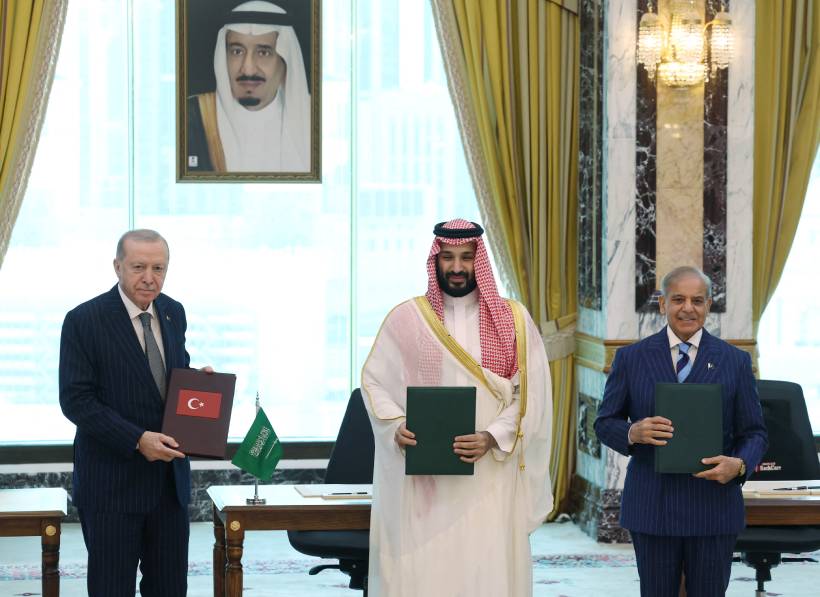
When Saudi Crown Prince Mohammed bin Salman, Turkish President Recep Tayyip Erdoğan and Pakistani Prime Minister Shehbaz Sharif signed the Mecca Joint Defence Agreement at Al-Safa Palace on 7 August 2026, the joint statement was studiously silent about who the pact was meant to deter. It committed the three states to treat an armed attack on any one of them as an attack on all, and to deepen defence cooperation across the board. It named no adversary. Within a fortnight, that silence had become the most consequential thing about the agreement, because it left the door open to a fourth member whose accession would carry implications none of the founding three appear to have designed for: Bangladesh.
Dhaka has not been invited formally, and it has not applied. What it has done is decline to rule anything out. Prime Minister Tarique Rahman’s foreign affairs adviser, Humayun Kabir, said in August that Bangladesh takes a positive view of joining an economic or defence framework involving Riyadh, Ankara and Islamabad, framing the question in terms of a “Bangladesh First” calculation of national interest. Foreign Minister Khalilur Rahman went further in tone if not in substance, saying Dhaka would consider an offer positively if one arrived. A Bangladeshi foreign ministry source has told Reuters that Saudi Arabia extended an informal invitation. India’s Ministry of External Affairs responded to all of this with the diplomatic equivalent of a raised eyebrow, saying only that it was closely following developments in West Asia.
The debate that followed in Dhaka has been unusually revealing, less about the pact than about how a new government understands the country’s place in a region that has stopped being predictable.
An agreement without an architecture
The first thing to establish is what the MJDA currently is, as opposed to what it is described as by its supporters and its critics.
Stay ahead of the geopolitical week.
MD Briefing delivers expert analysis across five global fronts — the Indo-Pacific, energy, geoeconomics, European security, and the Middle East — every Monday morning. Free.
It is, textually, a mutual defence commitment of the NATO Article 5 family, and Turkish officials have said as much. It builds directly on the Strategic Mutual Defence Agreement that Pakistan and Saudi Arabia concluded in September 2025, extending a bilateral arrangement into a trilateral one. On paper the combination is formidable: the world’s largest oil exporter, NATO’s second-largest army, and the only nuclear-armed Muslim state, together fielding roughly 1.4 million active personnel by the 2026 Global Firepower tally.
What it lacks is everything that turns a commitment into a capability. There is no joint command, no integrated planning staff, no standing secretariat, no published accession protocol, no agreed definition of the geographic area within which the guarantee applies, and no visible mechanism for deciding when it has been triggered. Former Turkish diplomat Mustafa Enes Esen has argued the agreement is largely symbolic until such structures exist, and that Ankara is unlikely to be pulled into a war with Iran or India in their absence. Analysts at the Belfer Center have similarly cautioned against reading the pact as an extension of Pakistan’s nuclear umbrella to its partners, a commitment no signatory has announced.
This matters for Bangladesh in a specific way. A country considering membership of a mature alliance can read the planning documents, examine the force-generation obligations and calculate its exposure. A country considering membership of an alliance that has not yet built any of that is being asked to accept an obligation whose content will be defined later, largely by others. Pakistan’s own framing acknowledges as much: officials describe operationalisation as being at an early stage and say any formal request from Dhaka would be considered in consultation with Riyadh and Ankara. That is candid, and it is also the crux of the problem. The terms are not yet written.
Why the offer is attractive in Dhaka
The pull factors are real and they are not primarily military.
Saudi Arabia is central to Bangladesh’s labour export economy and to the remittance flows that stabilise its balance of payments. Türkiye has become an important defence-industrial partner and a political model of sorts for parts of the Bangladeshi establishment. Relations with Pakistan have undergone a security reset since the fall of the Awami League government, with direct flights, resumed military contacts and trade normalisation moving faster than most observers expected. Membership of a pact that includes all three would place Bangladesh inside a circle of states whose investment, energy and labour decisions materially affect it.
There is a domestic dimension too. The Tarique Rahman government, in office since late February, is building a foreign-policy identity distinct from its predecessor’s, and distance from New Delhi is part of that identity’s political appeal. A Riyadh visit is being prepared at the Crown Prince’s invitation. Association with an Islamic security architecture centred on Mecca carries symbolic weight in a country where more than nine in ten citizens are Sunni Muslim, and Bangladeshi officials have not hesitated to say so publicly.
Finally, there is status. Erdoğan has explicitly said the framework is not meant to remain a trio and that he would like it eventually to encompass the region. For a state that has historically been treated as a demographic and economic actor rather than a strategic one, an invitation to a security architecture is a form of recognition.
Why the arithmetic is harder than it looks
The case against is not that Bangladesh would be dragged into someone else’s war tomorrow. It is that the country would be assuming a contingent liability priced against benefits that are largely available without it.
The three founding members joined because each faces a threat the others can help with. Saudi Arabia has absorbed Iranian drone strikes and lives with Houthi pressure on its southern flank and its shipping lanes. Türkiye has active security interests from Syria and Iraq to Libya and the Caucasus. Pakistan faces militancy on its western border and a standing confrontation on its eastern one. Bangladesh’s principal security challenges are of a different order: the Rohingya caseload and instability across the Myanmar border, maritime security in the Bay of Bengal, and the management of a long land frontier with India. None of these is solved by an Article 5 clause centred on the Gulf.
The economic exposure runs the other way. Bangladesh’s growth model depends on undisturbed access to Western garment markets, Gulf labour markets and Indian land routes simultaneously. Dhaka University’s Asif Shahan has warned that the perception of alignment alone carries risk for an export-driven economy dependent on breadth of partnership. Saudi Arabia matters enormously, but so do the UAE, Qatar, Kuwait and Oman, none of which has joined, and some of which have their own reasons for wariness about a Riyadh-led bloc. Egypt’s hesitation is instructive here: Cairo reportedly balked in part because unconditional support obligations sit awkwardly with its existing commitments. If the second-largest Sunni military power in the Arab world found the terms difficult, a state with Bangladesh’s constraints should at minimum ask why.
Then there is India. Bangladesh’s border with India runs more than 4,000 kilometres, and virtually all of its overland connectivity to the rest of Asia passes through Indian territory. Indian commentary has already begun to game out scenarios in which membership gives Pakistan standing on India’s eastern flank, though the pact grants no publicly specified right of access to any member’s territory and the logistics of 1971 remain what they were. The military scenarios are the least plausible part of the Indian anxiety. The political consequences are the plausible part, and they would be borne by Dhaka in the form of border friction, trade measures and the slow attrition of a relationship that is already strained.
The ambiguity is the point, and the risk
The most likely outcome, on present evidence, is neither accession nor refusal but prolonged suspension between them. That is not a failure of Bangladeshi diplomacy. Ambiguity is precisely what the MJDA was designed to produce: an agreement with binding language and no apparatus, deterrent value derived from uncertainty, and an open door that costs nothing to leave open.
The difficulty is that ambiguity distributes unevenly. For Riyadh, Ankara and Islamabad, an undefined pact is leverage. For Dhaka, hovering at the threshold may deliver the reputational costs of alignment without the substantive benefits of membership. India will price in the intention regardless of whether it is consummated. Gulf partners outside the pact will note the tilt. Western trade partners will ask questions. Meanwhile the guarantee itself, being unbuilt, guarantees nothing.
There is a coherent path between the horns. Bangladesh could pursue what it actually wants from these relationships through instruments that carry no collective-defence obligation: defence-industrial cooperation with Türkiye, labour and investment agreements with Saudi Arabia, normalised military-to-military contact with Pakistan, and observer or consultative status in any structure the MJDA eventually builds. That is a less dramatic answer than membership, and a more accurate reflection of where Bangladesh’s interests lie.
What should be watched over the coming months is not rhetoric but architecture. If the MJDA develops an accession protocol, a joint staff and a defined area of application, the question facing Dhaka will become a concrete one that can be answered on its merits. Until then, Bangladesh is being asked to sign a cheque before the amount has been written. The prudent response to that request is neither yes nor no. It is a question about the terms.
