


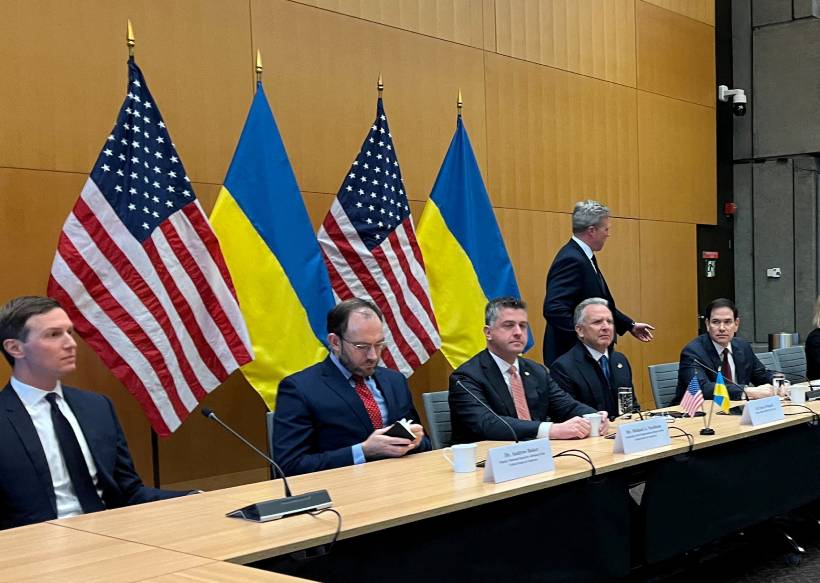
Ukraine and the United States have discussed postponing the next round of peace negotiations with Russia as the escalating war involving Iran begins to reshape diplomatic priorities, President Volodymyr Zelenskiy said on Thursday.
The talks intended to bring together Ukrainian, Russian and American representatives had been expected to take place in Abu Dhabi between March 5 and March 9. However, the location has come under scrutiny after Iranian strikes hit targets in the Gulf region, prompting Kyiv and Washington to consider alternative venues or a temporary delay.
Speaking in an interview with Italy’s Rai Italia, Zelenskiy said Ukraine had raised the possibility of moving the talks to other neutral locations, including Turkey or Switzerland, both of which have previously hosted diplomatic negotiations related to the war.
The negotiations are part of ongoing efforts to end the conflict that began with Russia’s full-scale invasion of Ukraine in 2022. Despite intermittent diplomatic contacts, major disagreements over territory and security arrangements have repeatedly stalled progress.
Stay ahead of the geopolitical week.
MD Briefing delivers expert analysis across five global fronts — the Indo-Pacific, energy, geoeconomics, European security, and the Middle East — every Monday morning. Free.
Donetsk Dispute Remains Central Obstacle
One of the most significant barriers to a settlement remains the future of the eastern Ukrainian region of Donetsk. Moscow has demanded that Kyiv withdraw from the remaining portions of the region that remain under Ukrainian control, a condition Zelenskiy has firmly rejected.
Russia claims the industrialised territory as part of its annexed regions, although its forces have not fully captured it. Ukraine, for its part, argues that abandoning fortified positions would amount to surrendering sovereign territory without any military justification.
Zelenskiy said Moscow’s demand reflected the limits of Russia’s battlefield progress rather than a realistic negotiating position. Ukrainian forces, he added, have recently stabilised parts of the front line and regained some territory.
Recent battlefield assessments by analysts at the Finland-based Black Bird Group suggest Ukrainian forces made modest gains in February — the first time since 2023 that Kyiv’s military recovered more territory than it lost.
War in the Middle East Complicates Diplomacy
The widening conflict involving Iran has introduced new uncertainty into the diplomatic calendar. The Middle East war has disrupted air travel, raised security concerns in Gulf states and diverted international political attention away from the Ukraine conflict.
The situation illustrates how global crises increasingly overlap. While the war in Ukraine remains one of Europe’s largest military confrontations in decades, the rapidly expanding confrontation involving Iran and Israel and the involvement of the United States has begun to reshape strategic priorities for Washington and its allies.
Despite the potential delay in negotiations, Zelenskiy said Kyiv still hopes that a previously agreed exchange of prisoners of war between Ukraine and Russia will move forward.
Allegations Over Drone Components
Zelenskiy also raised concerns about possible military links between Moscow and Tehran, suggesting Russia might be supplying electronic components used in Iranian-made Shahed attack drones.
These drones have been widely used by both Russia and Iran in their respective conflicts, making them a symbol of growing technological cooperation between the two countries.
The Kremlin denied that Iran had asked Russia for military assistance related to the Middle East conflict, though Western officials have long alleged close defence cooperation between the two governments.
Analysis
The potential postponement of Russia–Ukraine peace talks highlights how interconnected global conflicts are becoming. Diplomatic initiatives that once revolved around a single war are now increasingly shaped by events in entirely different theatres.
For the United States, managing simultaneous crises in Eastern Europe and the Middle East presents a strategic dilemma. Washington must balance military commitments, diplomatic engagement and alliance management across multiple regions at once.
For Ukraine, the emergence of another major international conflict carries both risks and opportunities. On one hand, global attention may shift away from Kyiv’s war effort, potentially weakening political momentum behind Western military aid. On the other hand, Russia’s growing ties with Iran could deepen Western perceptions of a broader strategic alignment among U.S. rivals, potentially strengthening support for Ukraine.
Ultimately, the postponement of the talks would underscore a broader reality of contemporary geopolitics: major conflicts rarely occur in isolation. Instead, they increasingly intersect, influencing diplomatic timelines, military calculations and the global balance of power simultaneously.
With information from Reuters.
