


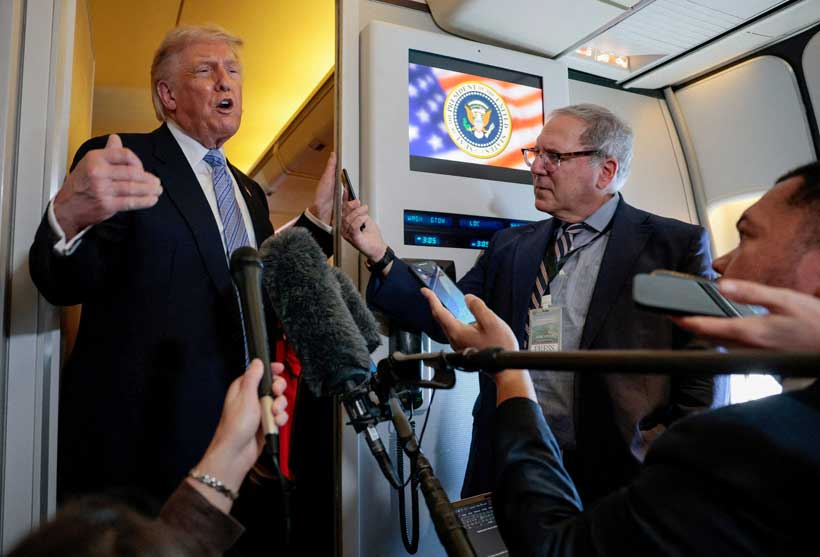
The US delegation’s disposal of Chinese gifts by throwing them in the trash represents a strict security and protocol measure reflecting the deep distrust between Washington and Beijing. This behavior is not merely a (deliberate political snub), but also carries clear strategic implications within the context of the escalating conflict between the two superpowers. The US security measures included strict instructions to members of the presidential delegation – including senior officials and businesspeople accompanying Trump – to prohibit any items of Chinese origin from being brought onto Air Force One, such as (gifts, badges, pins, and souvenirs). These items were to be disposed of in containers at the bottom of the aircraft stairs, given numerous US security concerns. The security measures also included the disposal of the temporary phones used throughout the flight to prevent any potential Chinese cyber espionage. The US presidential delegation relied on devices that left no digital footprint.
The most significant implication of this American security scene at the Chinese airport is the continued obsession with cyber infiltration and espionage. American security agencies, particularly the American Intelligence Agency CIA, are deeply concerned about the possibility of Chinese electronic chips or sophisticated listening devices being planted within the gifts, electronic devices, and temporary phones that China distributed to Trump and his delegation. The prevailing security motto for the American delegation was, Nothing from China gets on the plane. This American security measure also reflects a decline in soft diplomacy. In political norms, Chinese gifts are considered a means of rapprochement and building trust. However, the American delegation’s immediate disposal of these gifts demonstrates their failure to soften the stances between the two sides and indicates that relations have reached a point where customary diplomatic courtesies are no longer effective.
The American move to remove the Chinese gifts before Trump and his delegation boarded Air Force One reflects the depth of the technological competition between Washington and Beijing. This action reveals ongoing American concerns about intellectual property theft and China’s rapid technological advancements, making any Chinese technological product – no matter how simple – a potential Trojan horse for gathering sensitive information about the American presidential delegation. It also reflects a policy of tit-for-tat and escalating tensions, as the scene at the airport, orchestrated by Washington, is seen as a tit-for-tat response amidst intensifying global competition between the two countries. This American action underscores the highly pragmatic nature of the visit, characterized by strict security measures and a preoccupation with digital protection during the delegation’s departure. This behavior embodies the American view of China as Washington’s greatest strategic and technological challenge. The level of strategic caution and deep-seated fears regarding Chinese infiltration of US databases underscore how the intense rivalry between the two superpowers casts a shadow even on the most basic rules of diplomatic protocol and interaction.
In general, this American behavior embodies and summarizes the essence of the technological cold war between Washington and Beijing. The competition is no longer limited to economic or military influence, but has extended to cybersecurity and data protection, leading to a heightened security obsession and a decline in strategic trust between the two countries. The most prominent dimension of this strategic competition is the escalating security concern and the threat of data breaches. Cybersecurity reports and geopolitical analyses indicate that US intelligence agencies consider China to be Washington’s greatest technological challenge. Washington fears that even the simplest Chinese devices and advanced technologies could be used for data collection or espionage. As for the impact of this American security measure on diplomatic relations – disposing of Chinese gifts in trash bins before boarding the presidential plane – this deep American concern has been reflected in diplomatic protocols and dealings with China in particular. Official meetings and encounters between Washington and Beijing are now subject to strict screening procedures, transforming into something resembling an undeclared intelligence battleground. This caution has pushed both countries toward technological decoupling, with the United States seeking to protect its technological dominance and prevent China’s access to advanced chips, while Beijing is working to achieve strategic independence and build a domestic technological infrastructure.
Stay ahead of the geopolitical week.
MD Briefing delivers expert analysis across five global fronts — the Indo-Pacific, energy, geoeconomics, European security, and the Middle East — every Monday morning. Free.
The most prominent features of this technological conflict and polarization between Washington and Beijing are evident in several strategic areas, most notably the semiconductor and chip race. The US continues its policy of restricting the supply of advanced technology to China, tightening its grip on the supply of advanced chips, such as by (revoking licenses for major Chinese companies to acquire advanced computing equipments). This is an attempt to prevent China from developing leading artificial intelligence models. However, China continues its efforts to counter these US technological restrictions. Beijing is leading massive projects to develop its domestic chip infrastructure and is working to completely exclude Western and American technology from its supply chains. This comes amidst ongoing intelligence-based protection measures and diplomatic restrictions between China and the United States. Security concerns related to intellectual property theft have led to strict screening protocols for official meetings, transforming interactions into arenas for intelligence operations and cyber counter-espionage between the two sides. The US continues to accuse China of intellectual property violations, particularly as Washington officials deliberately monitor and counter attempts by Chinese entities to acquire American artificial intelligence technologies. Consequently, Washington has pursued a policy of technological decoupling, striving to maintain its technological dominance and reduce its reliance on China for future technologies. Meanwhile, China is developing domestic investment policies and programs to bolster its national capabilities in highly advanced fields, positioning itself against Washington and the West.
Based on the preceding understanding and analysis, we can see that the technological and diplomatic competition between Washington and Beijing represents a comprehensive geopolitical struggle. The United States is attempting, through various means, to curb China’s rise in sensitive technologies, such as (artificial intelligence and microchips), by imposing strict export and investment restrictions. In response, China is investing billions of dollars to achieve self-sufficiency and strategic independence by building completely independent supply chains.
