


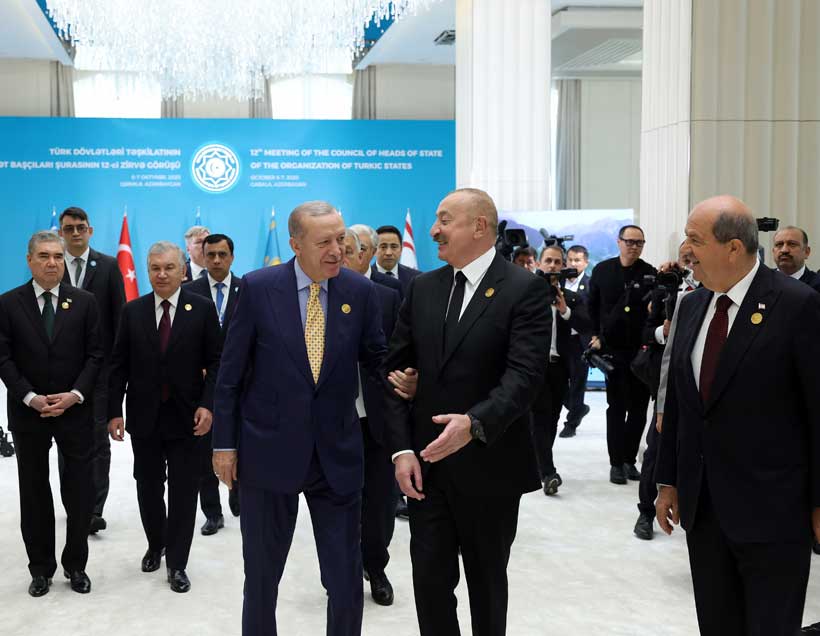
The 12th summit of the Organization of Turkic States (OTS) was held in Gebele, Azerbaijan, on October 6-7, under the theme of “Regional Peace and Security.” At this year’s OTS heads of state summit, regional peace and security issues such as Gaza, Azerbaijan-Armenia peace, Syria, and Afghanistan came to the fore, while the question of whether the organization is entering a new phase was opened for discussion. This is because the “OTS Plus (or OTS+)” debate was on the organization’s agenda for the first time. Responding to journalists’ questions upon his return from the Azerbaijan summit, Turkish President Recep Tayyip Erdoğan also emphasized the issue of the Turkish Republic of Northern Cyprus (TRNC) developing relations with member states of the organization. Because member states Kazakhstan and Uzbekistan, along with observer member Turkmenistan, had appointed ambassadors to the Greek Cypriot administration in April, putting themselves in a position that undermined Türkiye’s two-state solution on the island. In fact, on May 21, 2025, the organization’s leaders gathered for an informal summit in Budapest, Hungary. One of the important topics of the summit was the emphasis that the TRNC should be an integral part of the Turkic World under the umbrella of the organization. In addition, regional issues such as Syria, Gaza, and Afghanistan were among the prominent topics at the Budapest summit.
On the other hand, on September 18, President Erdoğan’s supporter, Nationalist Movement Party (MHP) leader Devlet Bahçeli, caused confusion with his announcement of a Türkiye-China-Russia Alliance. Bahçeli expanded on his statements and outlined a broader vision. Following Bahçeli’s statements, the OTS+ initiative at the OTS summit raised the possibility of Türkiye attempting to establish an alliance between the SCO and BRICS through the OTS. Clearly, several points in Bahçeli’s statement need to be examined. Firstly, Bahçeli underlined that developments were happening in the region where Israel and the US-centered aggression were targeting neighboring countries (Palestine, Lebanon, Yemen, Iran, Syria, and Qatar), and that Türkiye is at risk of conflict. Bahçeli attributes the basis of the Türkiye-Russia-China Alliance to the greatly increased risk of Türkiye facing off against Israel and the US. Secondly, he emphasized the geopolitical importance of the Eurasian geography. For instance, Bahçeli stated, “It is essential that the Organization of Turkic States, by developing cooperation with Russia and China, brings together the three powers of the Eurasian geography on an equal footing. The SCO and OTS can bring the world back into order with an understanding that respects each other’s laws and existence and the principles of sovereign equality and the rule of law.” Bahçeli also emphasized that Türkiye’s relations with Russia and China should be a multi-layered partnership extending beyond the military dimension to energy, trade, transportation, and finance. Several predictions can be made for OTS+ based on Bahçeli’s message. For instance, he emphasized that Türkiye’s cooperation with Russia and China will be multi-layered, covering economic and financial aspects like the OTS, rather than military. However, if Türkiye faces a high risk of conflict with the US and Israel, shouldn’t it also develop military cooperation with Russia and China? I think this could be an important question for discussion.
Finally, it is important to mention a significant development in the history of the Turks. A shared history and linguistic and cultural roots unite the OTS like a family. In September 2024, the Turkic World Common Alphabet Commission, which met in Baku, announced the Common Turkic Alphabet, consisting of 34 Latin-based letters. The first step toward a common alphabet was taken at the Gebele summit. At the summit, the first book printed in the common Turkic alphabet, a work about Cengiz Aytmatov, was presented to the leaders. This development is quite significant in terms of the Turks’ efforts to create a common language.
Conclusion
Stay ahead of the geopolitical week.
MD Briefing delivers expert analysis across five global fronts — the Indo-Pacific, energy, geoeconomics, European security, and the Middle East — every Monday morning. Free.
Since the organization changed its name to the “Organization of Turkic States (OTS)” at its 2021 Istanbul summit, its importance has been growing steadily. The OTS+ initiative, first introduced at the Gebele summit, is highly significant in terms of the organization’s evolution into a new phase. On the other hand, it is quite difficult to predict exactly how OTS+ will develop. However, it is debatable how realistic the organization can be on an issue such as OTS+, given that it has not been able to take a fully decisive stance on the TRNC. However, Erdoğan’s ally Bahçeli gave some preliminary signals before the organization’s summit about how OTS+ could be structured. This indicates that, contrary to those who claim that the OTS was established against Russia and China, it will cooperate with Russia and China through the SCO and BRICS. Finally, the organization’s transformation into OTS+ will not only increase its influence but also, by developing alongside the SCO and BRICS, which support a multipolar world, will be a very important development in terms of Eurasia becoming a single entity.
The views contained in this article are the author’s alone and do not represent the views of Shanghai University.
