


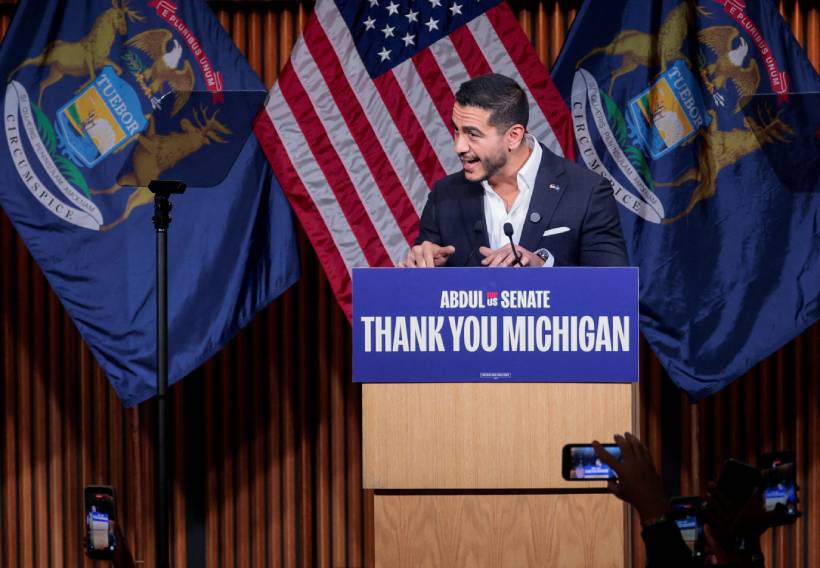
Democrat Abdul El-Sayed has won Michigan’s open US Senate seat, according to media projections, becoming the first Muslim elected to the US Senate. His victory preserves a key Democratic seat and delivers a significant breakthrough for the party’s progressive wing as it seeks to regain control of the chamber.
The 42-year-old former public health official defeated Republican Mike Rogers in a closely contested race to succeed retiring Democratic Senator Gary Peters. The result also denied Republicans an opportunity to gain ground in Michigan, a state that has become increasingly important to the national political battle.
El-Sayed campaigned on reducing living costs, expanding access to healthcare and limiting corporate influence in politics. His election carries both symbolic and political significance, reflecting the growing visibility of Muslim Americans in national politics and the influence of progressive candidates within the Democratic Party.
A Historic Breakthrough for Muslim Representation
El-Sayed’s election marks a historic moment for Muslim representation in American political institutions. Although Muslim Americans have previously served in the US House of Representatives and other elected offices, he is the first Muslim to win election to the Senate.
Stay ahead of the geopolitical week.
MD Briefing delivers expert analysis across five global fronts — the Indo-Pacific, energy, geoeconomics, European security, and the Middle East — every Monday morning. Free.
His victory could also encourage greater political participation among Muslim and other minority communities, particularly at a time when questions of religious identity, immigration and foreign policy remain prominent in American political debate.
However, the result is not simply symbolic. El-Sayed secured a seat that Democrats needed to defend as they pursued a path towards Senate control. His campaign demonstrated that a progressive platform focused on economic concerns could compete in a closely contested state.
Healthcare and Living Costs Define His Campaign
A central feature of El-Sayed’s campaign was his focus on the economic pressures facing working families. He advocated Medicare for All, a government-funded universal healthcare programme that has become a defining policy proposal for the Democratic Party’s progressive wing.
His broader agenda included reducing healthcare costs, challenging corporate influence and addressing the financial pressures affecting ordinary Americans.
These issues proved particularly important in an election shaped by dissatisfaction with the economy and concerns about the cost of living. While national political debates often centre on foreign policy and ideological divisions, El-Sayed’s campaign sought to connect those concerns with everyday economic pressures.
His victory strengthens the position of progressives who argue that Democrats can regain electoral support by placing affordability and economic inequality at the centre of their political agenda.
Republican Attacks on El-Sayed Become a Campaign Issue
Republican candidate Mike Rogers, a former congressman and FBI agent, entered the race with strong backing from President Donald Trump and national Republican figures.
His campaign attempted to portray El-Sayed as a radical candidate, raising allegations of sympathy for Islamic extremism through supposed connections to the Muslim Brotherhood. El-Sayed rejected the accusations, which were not supported by evidence. Democrats described the attacks as relying on Islamophobic stereotypes.
The campaign also exposed divisions over US policy towards Israel and the war in Gaza. Rogers sought to appeal to Jewish voters who might have been uncomfortable with El-Sayed’s opposition to American military aid for Israel and his description of Israel’s actions in Gaza as genocide.
These arguments placed El-Sayed’s foreign policy positions under intense scrutiny. Nevertheless, they did not prevent him from winning a race in which economic concerns remained central to voters.
Trump’s Influence Faces Another Electoral Test
Rogers’ defeat represents another setback for Republicans seeking to expand their Senate majority under Trump’s leadership.
Republicans entered the midterm elections with a 53–47 advantage, meaning Democrats needed a net gain of four seats to take control of the chamber. Holding Michigan was therefore essential to preventing Republicans from widening their advantage.
Rogers also faced difficulties separating his campaign from broader dissatisfaction with the Trump administration. Concerns about the economy and the president’s low approval ratings weakened the Republican candidate’s position.
In the final weeks of the campaign, Rogers broke with Trump over the war in Iran and the US trade dispute with Canada, arguing that ending both was necessary to reduce costs for businesses and consumers. His criticism suggested an effort to distance himself from policies that had become politically difficult for Republicans.
The result reinforces the challenge facing Republicans in competitive states: candidates closely associated with the president may struggle when voters are dissatisfied with the administration’s economic and foreign policy decisions.
What Happens Next for the Senate?
El-Sayed’s victory ensures that Democrats retain Michigan’s Senate seat and gives the party a significant political boost. However, the broader fight for Senate control depends on the results of other closely contested races.
For the Democratic Party, his election presents an opportunity to strengthen its progressive influence while demonstrating the electoral appeal of a campaign centred on healthcare, affordability and corporate accountability.
For Muslim Americans, the result represents a historic advance in representation at the highest level of the US legislature. Yet El-Sayed will also face the challenge of translating his campaign promises into legislative influence in a deeply divided Senate.
His election is therefore significant on two fronts: it breaks a longstanding barrier in American political representation and reinforces the role of economic populism in the Democratic Party’s effort to challenge Republican control.
With information from Reuters.
