Two Answers in Two Days
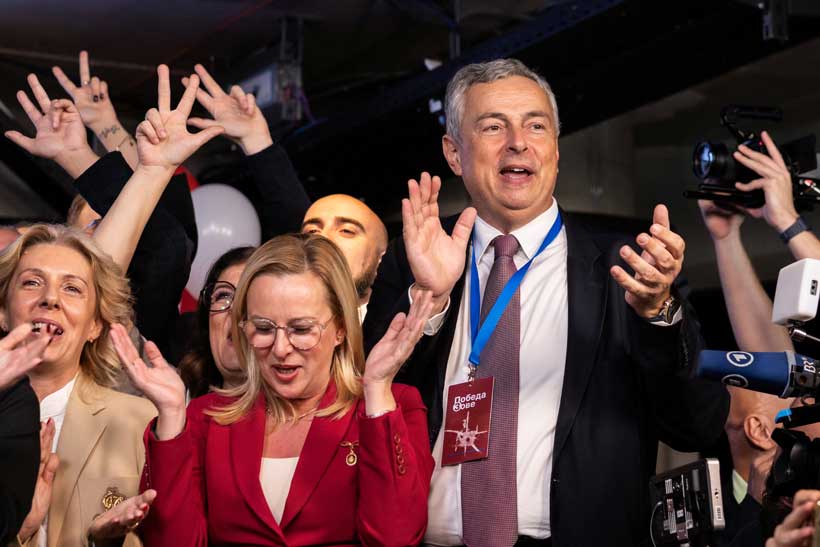
Forty-eight hours after the Student List won about 140 of the National Assembly’s 250 seats, two of its own accounts of how Serbia’s next government will be chosen already differed. The weekly Vreme, describing the movement’s plans, said the cabinet will be decided “jointly” by the students and the MPs they selected. Ilija Srdanović, the Novi Sad cardiologist who heads the list but insists he is not its leader, told Radio Free Europe that government posts will be filled by “a majority group” of the list’s MPs.
The gap sounds technical, but it is the most important unanswered question in Serbian politics. A movement that beat Aleksandar Vučić precisely by refusing to have a leader must now nominate a prime minister, and very probably a presidential candidate within weeks. The history of horizontal movements suggests the danger is not the choice of a face. It is the unresolved question of who owns the power that face will hold.
A Movement Built to Be Hard to Target
Stay ahead of the geopolitical week.
MD Briefing delivers expert analysis across five global fronts — the Indo-Pacific, energy, geoeconomics, European security, and the Middle East — every Monday morning. Free.
The student movement began after the Novi Sad railway-station canopy collapsed in November 2024, killing 16 people. It organised through faculty plenums, open assemblies that take decisions collectively, and deliberately avoided figureheads so that the government had no individual to smear or arrest. When Vučić called snap elections, the plenums vetted a 250-name list of doctors, professors, economists and farmers. No students stood on it. Several opposition parties stepped aside to back it.
That design won the election. It also left the list without a published candidate for prime minister, without a programme much beyond anti-corruption, lustration (barring officials of the old regime from public posts) and institutional independence, and with members who, by its own account, span both sides of the political spectrum. Under the constitution, the new parliament must form a government within 90 days of convening. Meanwhile Vučić resigned the presidency on 27 September, so a presidential election must take place within three months of his departure.
Where Horizontal Movements Actually Break
Most commentary frames the challenge as finding a leader. The record says that part is easy. In Bangladesh, two days after Sheikh Hasina fled in August 2024, student coordinators named the Nobel laureate Muhammad Yunus to head an interim government, and Nahid Islam declared that “no government other than the one proposed by the students will be accepted”. In Serbia in 2000, the opposition coalition that Otpor (the youth resistance that had decided it “would have no leaders”) had pushed into unity rallied behind Vojislav Koštunica, who beat Slobodan Milošević. Neither movement fractured over the figurehead.
They fractured over the second decision: how to turn moral authority into an organisation that could compete for power. Otpor became a party only in November 2003. It ran a 250-candidate list with no official leader and won 1.66% and no seats. Within a year, amid embezzlement accusations from former members, it merged into the Democratic Party. Bangladesh’s students founded the National Citizen Party in 2025, then allied with the Islamist Jamaat-e-Islami. Thirteen central leaders resigned over a decision they called non-transparent, and the party won six seats in February.
The second pattern followed from the first. While the movements argued about their vehicles, established parties filled the space. Serbia’s reformist coalition split three ways before the 2003 election, three years after the revolution, and could not form a majority on its own. In Bangladesh, the Bangladesh Nationalist Party took a two-thirds majority. Modern Diplomacy’s reporting found young voters drifting back to the old parties well before polling day. Some reforms outlived the movements: Bangladeshis approved Yunus’s “July Charter” of reforms with 60% of the vote. The movements themselves did not survive.
Serbia’s students have done something neither precedent managed. They won power directly, with a majority, on their own list. So the question of which vehicle to build has already been answered: the list is the vehicle. That does not remove the fracture point, though. It moves it from the vehicle to the chain of accountability: do 140 MPs answer to the plenums that chose them, or to the voters who elected them? The two accounts of the past 48 hours point to two different governments. One is a caucus run by a parliamentary majority. The other is a delegation answerable to assemblies of students who hold no seat and no electoral mandate.
Three fault lines run through that question. The first is ideological breadth. The list holds conservatives and liberals and is divided over Moscow. It has already pledged to stay out of sanctions on Russia, while Srdanović promises to keep the EU path and the Kosovo dialogue. Any real cabinet decision will force a choice between them. The second fault line runs through the parties that stood aside to back the list. They will expect influence they cannot get through a caucus with no party whips. The third is the presidential election. A parliamentary list can be collective; a presidential candidate cannot. It will be the first decision made in public, under time pressure, in a contest the outgoing ruling party (the SNS) can win.
The strongest objection is that this is overthinking. Parliamentary systems routinely produce prime ministers from caucuses, and 140 seats is a comfortable majority. But the margin over the 126 needed is 14 seats. In a list with no whip, no party discipline and no shared ideology, 14 MPs is not a large faction. Otpor’s lesson is that the moral authority of a movement does not transfer automatically to its representatives. Bangladesh’s lesson is that one opaque decision is enough to break it.
Three Ways the Majority Holds — or Doesn’t
Base case: a caucus government with plenum consultation (roughly 50%). The parliamentary group nominates a technocratic prime minister, Srdanović or an economist, after consulting the plenums rather than seeking their formal approval. A cabinet is formed inside the 90-day window. The list backs an independent figure for president rather than one of its MPs. A handful of defections follow the first hard votes, but the majority survives. The key assumption is that students accept a consultative role after winning a decisive one.
Downside case: fracture through the presidency (roughly 30%). The plenums and the caucus favour different presidential candidates, or the list fails to unite behind one. The SNS candidate exploits the division and wins in December, giving the old regime a president with a veto in the form of the power to return laws to parliament, and a platform. Defections then approach the 14 seats that matter, and the new government spends its first year surviving instead of reforming. Investors and EU negotiators would face an unstable cohabitation rather than a clean transition.
Upside case: collective leadership written into rules (roughly 20%). The list publishes a written code. Plenums ratify the prime minister and a short list of core laws, MPs commit to resign if they break it, and the list delivers early, visible wins on procurement transparency and lustration. That would be a genuinely new model: a horizontal movement that institutionalises itself instead of becoming a party. It is the outcome neither Otpor nor Bangladesh’s students reached.
Probabilities reflect the author’s analytical judgment based on currently available information and are not statistical forecasts.
The Question Behind the Name
Serbia’s students have already avoided the trap that sank their predecessors: they did not hand their victory to someone else’s party. The trap ahead is subtler. A movement that refused leaders must now decide who leads it, and the answer is not a name. It is a rule for who can overrule whom. Without that rule, the coalition that won on Sunday can lose its majority in the same way Otpor and the NCP lost their movements: one opaque decision at a time.
Watch for: how the prime minister-designate is announced. If the name comes from the parliamentary group alone, the list has chosen to be a caucus. If the faculty plenums ratify it first, the list has chosen to be a movement in office, and Serbia is running an experiment no country has finished. Either way, the decision will tell Serbians who now holds the power that Vučić lost.