


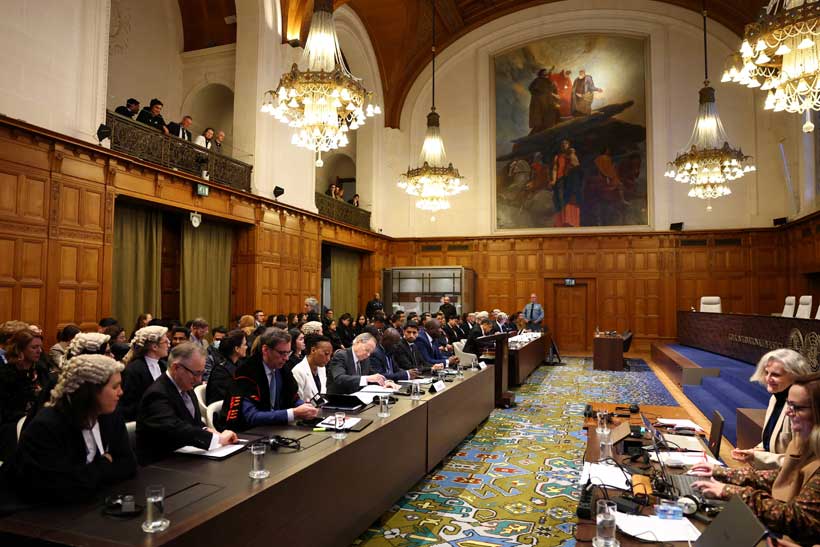
The International Court of Justice (ICJ) is set to deliver a long-awaited judgment on allegations that Myanmar committed genocide against its Rohingya Muslim minority, bringing renewed international attention to one of the world’s most protracted displacement crises.
The ruling comes nearly a decade after Myanmar’s 2017 military crackdown forced more than 730,000 Rohingya to flee across the border into Bangladesh. Despite years of international pressure, the community continues to face displacement, insecurity, declining humanitarian assistance and limited prospects of returning home.
More than 1.3 million Rohingya remain displaced across South and Southeast Asia, including approximately 1.2 million living in refugee camps in Bangladesh’s Cox’s Bazar, according to the United Nations.
How the Rohingya Were Forced to Flee Myanmar
The mass displacement began in August 2017, when Myanmar’s military launched an offensive in Rakhine State following attacks by the Arakan Rohingya Salvation Army (ARSA) on approximately 30 police posts and an army base.
Stay ahead of the geopolitical week.
MD Briefing delivers expert analysis across five global fronts — the Indo-Pacific, energy, geoeconomics, European security, and the Middle East — every Monday morning. Free.
The subsequent military operation triggered widespread allegations of atrocities against Rohingya civilians. Refugees reported mass killings, sexual violence, torture and the destruction of hundreds of villages, according to Human Rights Watch.
Myanmar’s authorities denied the allegations, maintaining that the military operation was directed against insurgent groups.
The crackdown forced hundreds of thousands of Rohingya into neighbouring Bangladesh, creating one of the world’s largest refugee populations. Nearly a decade later, the majority remain unable to return to their homes.
Why Is Myanmar Facing a Genocide Case at the ICJ?
In 2019, The Gambia filed a case against Myanmar at the International Court of Justice, alleging violations of the Genocide Convention during the military operations against the Rohingya. The case received backing from the 57-member Organisation of Islamic Cooperation.
During preliminary hearings, Myanmar’s then-leader Aung San Suu Kyi rejected the genocide allegations, describing them as incomplete and misleading.
However, in January 2020, the ICJ ordered Myanmar to implement urgent provisional measures to protect the Rohingya population remaining in the country. These included preventing acts that could constitute genocide and preserving evidence related to the allegations.
The forthcoming judgment represents a significant stage in the international legal proceedings.
ICJ judgments are final and legally binding on the parties to a case. However, the court has no direct enforcement mechanism, cannot prosecute individuals and cannot issue arrest warrants. Its ruling therefore carries considerable legal and diplomatic weight, but implementing its decisions remains a separate challenge.
Myanmar’s Civil War Has Deepened the Rohingya Crisis
The Rohingya crisis has become increasingly complicated since Myanmar’s military seized power in February 2021, overthrowing Aung San Suu Kyi’s elected government.
The coup triggered a nationwide civil war that has killed an estimated 100,000 people and displaced more than 3.5 million.
Fighting between the military and the Arakan Army, an ethnic armed organisation operating in Rakhine State, intensified in November 2023, creating additional insecurity for Rohingya communities.
The Rohingya have also faced attacks attributed to the Arakan Army. In May 2024, the group was accused of setting fire to large parts of the Rohingya settlement of Buthidaung, further aggravating civilian displacement.
Consequently, the community faces insecurity not only from Myanmar’s military authorities but also from the wider conflict involving armed groups competing for control of Rakhine State.
Why Rohingya Refugees Cannot Return Home
Despite repeated discussions about repatriation, conditions for the safe and voluntary return of Rohingya refugees remain absent.
Myanmar announced in August that it had verified 308,797 people living in displacement camps in Bangladesh as former residents of Rakhine State. However, authorities maintained that repatriation could begin only after security conditions improved.
For many Rohingya refugees, security alone is not sufficient. They have demanded full citizenship, legal recognition, basic rights and guarantees of dignity before considering a return.
Myanmar has historically denied the Rohingya citizenship, frequently describing them as illegal migrants from neighbouring Bangladesh despite generations of Rohingya families having lived in the country.
Previous repatriation initiatives in 2018 and 2019 failed to produce any returns, reflecting the deep mistrust between refugees and Myanmar’s authorities.
Meanwhile, declining humanitarian assistance has placed additional pressure on refugee communities in Bangladesh, where overcrowded camps, limited resources and prolonged uncertainty have become persistent challenges.
What the ICJ Judgment Means for the Rohingya
The ICJ’s decision could represent an important moment for international accountability and the legal recognition of alleged atrocities against the Rohingya.
However, a judicial ruling alone cannot resolve the political and security conditions preventing their return. Myanmar’s ongoing civil war, competing armed groups and longstanding restrictions on Rohingya citizenship remain major obstacles.
The case also tests the effectiveness of international legal institutions in addressing mass atrocities when the state concerned remains unwilling or unable to implement international obligations.
For Bangladesh, which continues to host the overwhelming majority of displaced Rohingya, the outcome carries significant implications for its diplomatic engagement with Myanmar and the international community.
Ultimately, the judgment may strengthen the legal framework for accountability, but justice for the Rohingya will require more than a court decision. Without security guarantees, citizenship rights and meaningful political recognition, the prospect of a safe and dignified return to Myanmar will remain distant.
With information from Reuters.
