


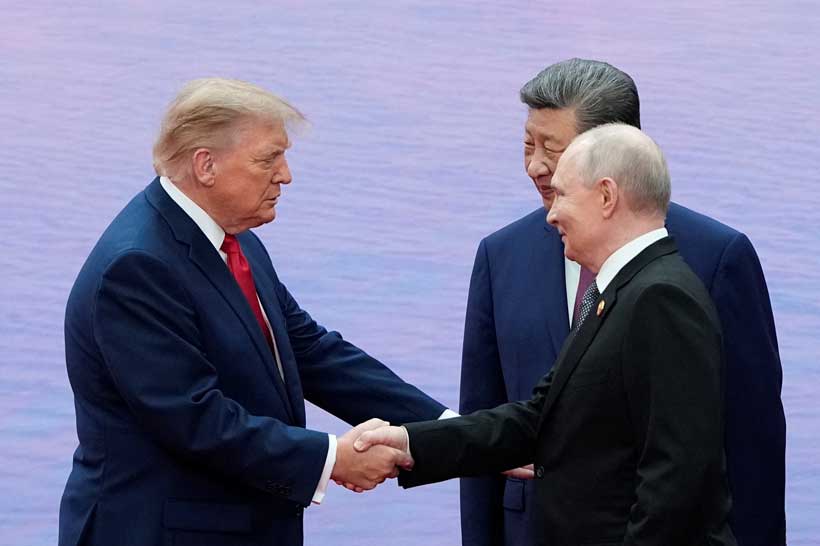
US President Donald Trump has described his high-profile visit to China as a diplomatic victory, praising the reception hosted by Chinese President Xi Jinping ahead of an unprecedented trilateral meeting with Xi and Russian President Vladimir Putin.
The gathering brings together the leaders of the world’s three largest nuclear powers, creating a significant diplomatic moment amid growing geopolitical tensions. However, expectations of concrete agreements remain limited, with disagreements over the war in Ukraine, Iran, nuclear weapons and international trade likely to complicate negotiations.
The meeting has also raised concerns among smaller countries that their interests could be sidelined as Washington, Beijing and Moscow pursue their own strategic priorities.
Trump Highlights Diplomatic Gains From Beijing Visit
Speaking ahead of the trilateral talks, Trump described Xi’s personal reception at the airport as a major diplomatic achievement. Xi’s decision to welcome Trump personally marked the first time he had greeted a visiting leader at the airport since becoming China’s president.
Stay ahead of the geopolitical week.
MD Briefing delivers expert analysis across five global fronts — the Indo-Pacific, energy, geoeconomics, European security, and the Middle East — every Monday morning. Free.
The reception included military honours, large crowds, children and an elaborate display of pageantry. Trump contrasted the welcome with the more subdued arrivals of other visiting leaders, including Putin and Japanese Prime Minister Sanae Takaichi.
Calling the reception a “big win”, Trump said the gesture demonstrated mutual respect between Washington and Beijing. He also described the two countries’ trade relationship as having reached a fairer balance.
During a separate meeting with Xi, Trump emphasised their shared interest in maintaining the flow of oil through the Strait of Hormuz, which has been disrupted by the Iran conflict.
Meanwhile, Trump held separate talks with Putin, whom he described as a friend. The Kremlin confirmed that the discussions included the war in Ukraine, adding that the Russian president left the meeting in an excellent mood.
Ukraine and Iran Complicate Trilateral Diplomacy
Despite the symbolic importance of bringing the three leaders together, their competing geopolitical interests present significant obstacles to substantive agreements.
Ukraine remains a major point of disagreement, particularly given China’s close relationship with Moscow and Washington’s continuing involvement in efforts to address the conflict.
Patricia Kim, a foreign policy fellow at the Brookings Institution, argued that Beijing would be reluctant to assume responsibility for negotiating an end to the war.
China has consistently characterised the Russia-Ukraine conflict as primarily a European issue. The absence of Ukrainian and European leaders from the trilateral gathering further complicates any attempt to present Beijing as a mediator.
Iran is another sensitive issue. Although Trump has highlighted the importance of securing energy shipments through the Strait of Hormuz, he indicated that he would not seek Russian or Chinese assistance to resolve the conflict.
This suggests that cooperation on specific economic and security concerns may remain possible without translating into a broader alignment on regional conflicts.
Nuclear Arms Control Emerges as a Major Challenge
Trump has also sought to make nuclear arms control a central component of the discussions, despite China’s reluctance to participate in negotiations alongside Washington and Moscow.
China possesses a substantially smaller nuclear arsenal than either the United States or Russia and has repeatedly resisted calls to join trilateral arms control negotiations.
Trump expressed concern over China’s expanding nuclear capabilities, while acknowledging the difficulty of securing meaningful reductions from all three countries.
He suggested that Beijing could condition its participation on Washington agreeing to substantial reductions in its own nuclear stockpile, presenting a challenge for any potential agreement.
The issue reflects a broader difficulty in international arms control: existing arrangements between the traditional nuclear powers do not necessarily accommodate China’s expanding strategic capabilities.
Trump has also expressed interest in meeting North Korean leader Kim Jong Un during his Asian visit, although no imminent meeting has been confirmed.
Trade and Technology Tensions Threaten US-China Relations
The summit comes against the backdrop of renewed economic competition between Washington and Beijing.
Although both countries have extended their trade truce, tensions persist over China’s industrial policies, technology access and the effectiveness of American export restrictions.
At the Asia-Pacific Economic Cooperation summit in Shenzhen, Xi defended what he described as free and open trade, while criticising Western protectionism. Putin also condemned Western sanctions and emphasised Russia’s role in regional food and energy security.
Western governments, meanwhile, have raised concerns that China’s economic model prioritises industrial production and exports over domestic consumption, contributing to global trade imbalances.
Technology competition represents another potential flashpoint. Reports that Nvidia chips were being diverted to China through Southeast Asian countries have raised questions about the enforcement of US export controls.
Craig Singleton of the Foundation for Defense of Democracies warned that the issue could have consequences beyond the immediate commercial relationship.
He argued that China risks facing stricter restrictions if bipartisan support for tougher technology controls grows in Washington, potentially limiting Beijing’s ability to negotiate access directly with the US president.
What the Summit Means for the International Order
The trilateral gathering reflects the growing importance of direct diplomacy among the world’s major powers, particularly as traditional international mechanisms struggle to manage competing security and economic interests.
For Trump, the summit offers an opportunity to demonstrate American influence while pursuing a more favourable trade relationship with China and maintaining communication with Moscow.
For Xi, hosting both leaders reinforces China’s diplomatic standing and its ambition to shape the regional and international economic order. Putin, meanwhile, gains an opportunity to demonstrate that Western sanctions and diplomatic isolation have not prevented Russia from maintaining high-level international engagement.
However, the meeting also exposes the limitations of great-power diplomacy. A joint appearance may offer political advantages to all three leaders, but their conflicting priorities make substantive compromises considerably more difficult.
As Craig Singleton observed, the three leaders have strong reasons to appear together, but far fewer reasons to agree on the substance of their competing agendas.
The broader question is whether this diplomatic engagement can produce mechanisms for managing geopolitical competition or will remain primarily a demonstration of political influence among the world’s most powerful states.
With information from Reuters.
