


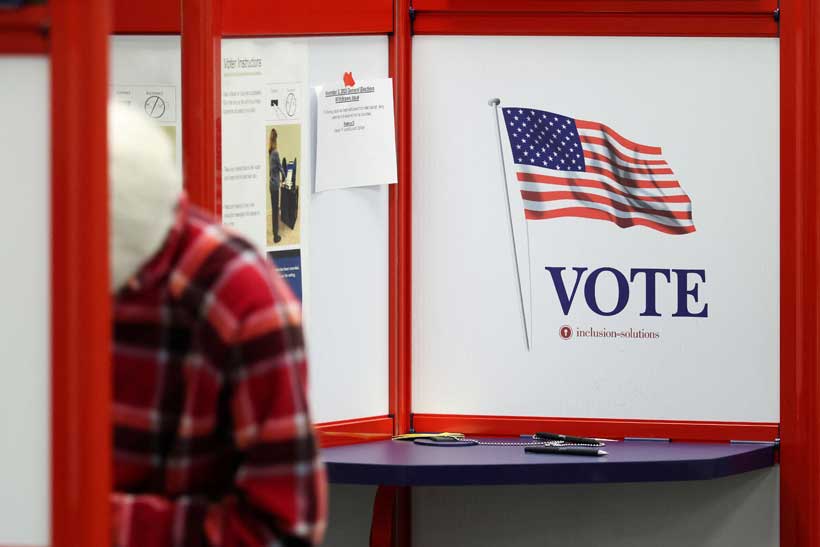
The November 2026 midterm elections could reshape the balance of power in the US Senate, with Democrats targeting Republican-held seats in traditionally conservative states while Republicans seek to flip several Democratic-held seats. With Republicans holding a 53–47 majority, Democrats need a net gain of at least four seats to take control, according to the election analysis.
Voter dissatisfaction over rising prices, President Donald Trump’s policies and the war involving Iran has brought several Republican-held seats into contention. Campaign fundraising, outside spending and candidate controversies are also shaping races across the country.
Alaska: A Competitive Race Under Ranked-Choice Voting
Republican Senator Dan Sullivan is seeking re-election against Democrat Mary Peltola, a former US representative, and another candidate named Dan Sullivan.
Alaska’s ranked-choice voting system allows voters to rank candidates in order of preference. Republicans have described the second Sullivan’s candidacy as an attempt to confuse voters, an allegation linked to concerns about the potential impact on the incumbent’s campaign.
Stay ahead of the geopolitical week.
MD Briefing delivers expert analysis across five global fronts — the Indo-Pacific, energy, geoeconomics, European security, and the Middle East — every Monday morning. Free.
Peltola has raised more money than Sullivan, but the Republican entered the latest reporting period with more cash available. Trump won Alaska by 13 percentage points in 2024, while recent polls cited in the report showed Peltola narrowly ahead.
Iowa: Economic Concerns Shape an Open-Seat Contest
Iowa is an open-seat race following Republican Senator Joni Ernst’s decision not to seek re-election. Republican Representative Ashley Hinson faces Democratic state Representative Josh Turek, a two-time Paralympic gold medallist.
Trump won Iowa by 13 points in 2024, but dissatisfaction over tariffs, fuel costs and the Iran war has complicated the Republican campaign.
Hinson has called for an immediate end to the war, arguing that Iowans should not face higher fuel and grocery prices because of the conflict. However, she has repeatedly voted against congressional resolutions calling for an end to the war.
Turek has raised more money, while Hinson has maintained a cash advantage and Republicans have spent more overall. Recent polls cited in the report showed Hinson with a narrow lead.
Kansas: Democrats Challenge a Long Republican Stronghold
Kansas has emerged as a competitive contest despite Trump winning the state by 16 percentage points in 2024.
Republican Senator Roger Marshall faces Adam Hamilton, the founding pastor of a Methodist megachurch. Republican leaders have redirected resources to defend Marshall, whose campaign has also faced scrutiny over Immigration and Customs Enforcement activity in the state.
Hamilton has raised substantially more money than Marshall, and Democratic groups have outspent Republican organisations in the race. Recent polls cited in the report showed Hamilton narrowly ahead.
Kansas last elected a Democrat to the US Senate in 1932, making the contest notable for its potential to challenge the state’s longstanding Republican voting pattern.
Maine: Susan Collins Faces a Democratic Challenge
Republican Senator Susan Collins is defending a seat in Maine, which Trump lost in 2024. Democrat Troy Jackson, a former president of the Maine Senate, is challenging her.
Collins has sought support from former Senator Joe Manchin, while Jackson has campaigned with progressive Representative Alexandria Ocasio-Cortez.
The race has been complicated by controversy surrounding the Democratic nomination process. Original nominee Graham Platner withdrew following sexual assault allegations, which he denied, and Jackson subsequently emerged as the party’s replacement candidate. Jackson has also faced criticism over his treatment of women and his confrontational exchanges with Collins.
Jackson has raised more money than Collins, but the Republican maintains a cash advantage, and Republican outside groups have spent considerably more than their Democratic counterparts. Recent polls showed Jackson narrowly ahead or the candidates tied.
North Carolina: An Open Seat With Major Financial Differences
North Carolina is another open contest after Republican Senator Thom Tillis decided not to seek re-election. Former Democratic Governor Roy Cooper is running against Michael Whatley, the former chairman of the Republican National Committee.
Trump won North Carolina by three percentage points in 2024, but Cooper has established a substantial fundraising advantage. He has raised $50 million and reported $9 million in cash, compared with Whatley’s $14 million raised and approximately $900,000 available.
Recent polls cited in the report showed Cooper leading by double digits. Republican allies have begun shifting resources towards other states as the party reassesses its position in North Carolina.
Ohio: Sherrod Brown Seeks a Return to the Senate
Democrat Sherrod Brown is attempting to regain the Senate seat he lost in 2024. He faces Republican Senator Jon Husted, who was appointed to replace JD Vance after Vance left the Senate to become vice president.
The contest has become one of the country’s most expensive Senate races. Republican outside groups have spent approximately $232 million, while Democratic groups have invested $118 million.
Brown has raised more than three times as much as Husted, although both campaigns reported similar amounts of cash available in mid-October. Recent polls cited in the report showed Brown leading by three to five percentage points.
The winner will serve the remainder of the current term and face voters again in 2028 for a full six-year term.
Texas: Democrats Target a Longstanding Republican Stronghold
Texas has not elected a Democrat to statewide office since 1994. Democratic state Representative James Talarico is seeking to challenge that pattern against Republican Attorney General Ken Paxton.
Trump won Texas by nearly 14 percentage points in 2024. Nevertheless, the Republican campaign has attracted substantial spending as the party works to retain the seat.
The Republican nomination of Paxton over incumbent Senator John Cornyn has introduced additional complications. Leaked audio has revealed tensions between Paxton and Trump, while billionaire Elon Musk has contributed $158 million to a Republican super PAC investing in the race.
Talarico has raised substantially more money than Paxton, and recent polls cited in the report showed him narrowly ahead or the candidates tied.
Georgia: Republicans Try to Challenge Jon Ossoff
Republicans are also seeking to gain ground in Georgia, where Trump won by two percentage points in 2024.
Democratic Senator Jon Ossoff faces Republican Representative Mike Collins. Ossoff has built a considerable fundraising advantage, raising nearly $126 million more than Collins through October 14.
He also reported $15.1 million in campaign funds at the start of the second half of October, compared with Collins’ $1.1 million. Recent polls have consistently shown Ossoff ahead, while outside spending has been relatively close.
The contest will test whether Republicans can translate Trump’s statewide victory into a Senate gain.
Michigan: A Closely Contested Open Seat
Michigan is among the central Republican targets for a potential Senate pickup. Democrat Abdul El-Sayed, a progressive political outsider, defeated moderate Representative Haley Stevens in the Democratic primary. He now faces Republican former Representative Mike Rogers.
Both Trump and former President Barack Obama campaigned in Michigan over the weekend, highlighting the race’s national significance.
El-Sayed has raised more than twice as much as Rogers, but Rogers entered October with more cash available. Republican outside groups have invested approximately $136 million in the contest, compared with more than $70 million from Democratic groups.
A pro-Israel super PAC has also spent money opposing El-Sayed after previously investing heavily in efforts to prevent his nomination. Recent polls cited in the report showed El-Sayed narrowly ahead.
New Hampshire: Democrats Defend Another Open Seat
Democrats are defending an open seat in New Hampshire following Senator Jeanne Shaheen’s decision to retire.
Democratic Representative Chris Pappas is running against former Senator John Sununu, whose family has a long political history in the state.
Pappas has raised approximately four times as much as Sununu and maintains a modest cash advantage. However, Republican outside groups have spent more than Democratic groups on the contest.
Recent polls cited in the report showed Pappas leading by five to eight percentage points.
What the Senate Races Mean for US Politics
The contests illustrate the competing pressures shaping the 2026 midterms. Democrats are seeking to capitalise on voter concerns about the economy, fuel prices and the Iran war, while Republicans are attempting to defend seats in states where Trump’s 2024 victories may not guarantee similar results in Senate contests.
Fundraising and outside spending are significant across several races, but financial advantages do not automatically translate into electoral victories. Candidate controversies, local political conditions and voter turnout will also influence the results.
The balance of power will depend on how these contests develop across both parties’ targets. For Democrats, winning control requires a net gain of at least four seats under the current Senate division. For Republicans, retaining their majority means defending vulnerable incumbents while limiting Democratic gains.
The election will therefore serve not only as a test of the parties’ Senate campaigns but also as an indicator of how voters are responding to the Trump administration’s policies ahead of the next presidential election.
With information from Reuters.
