


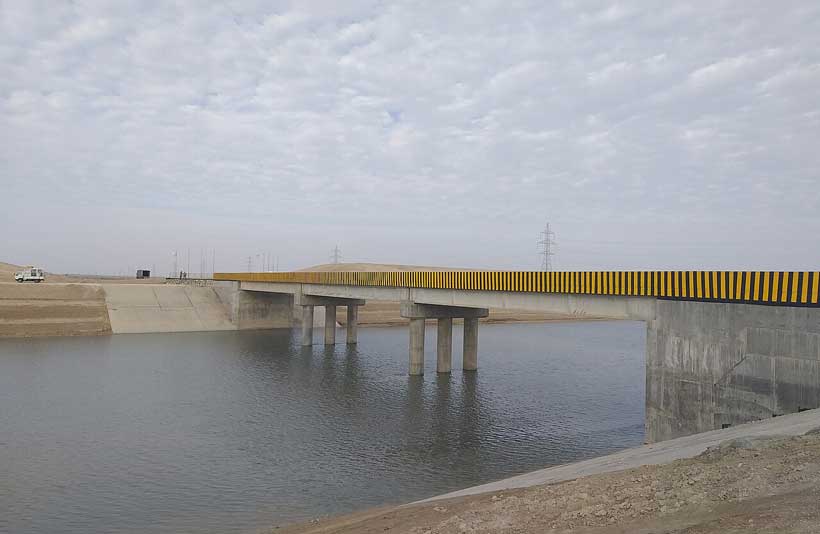
Afghanistan’s Qosh Tepa Canal is forcing Central Asia to confront a dangerous question: when a river crosses borders, who gets to decide who drinks first?
Firing a missile is not a prerequisite for disturbing a country’s neighbors. Sometimes, just a canal is what’s needed. The Qosh Tepa Canal is quietly reshaping geopolitical dynamics in northern Afghanistan. The scheme is intended to transport water from the Amu Darya to the dry northern plains of Afghanistan, facilitating agricultural growth and ensuring food security and economic opportunities. However, the river doesn’t end at Afghanistan’s borders. It has a downstream impact on the lives and livelihoods of millions of people, especially in Uzbekistan and Turkmenistan.
For Afghanistan, the canal represents development long denied. Its neighbors have an unsettling prospect: they will face a future with less predictable water. It’s not just that river levels may be lower, but a shared resource might be a cause for regional rivalry.
But the controversy about Qosh Tepa is posing the wrong question. Much of the focus is on the amount of water that Afghanistan may divert. The more significant question is why it is that a project that has implications for the whole region has revealed such a glaring weakness in regional cooperation.
Stay ahead of the geopolitical week.
MD Briefing delivers expert analysis across five global fronts — the Indo-Pacific, energy, geoeconomics, European security, and the Middle East — every Monday morning. Free.
After decades of war, poverty, and dependence on food imports, Afghanistan has all the reasons to build up its agriculture capacity. To ask that it stop developing for the “convenience” of downstream countries would be neither fair nor realistic. Nor can Uzbekistan and Turkmenistan be expected to accept water supplies on the other hand that are uncertain without consultation, reliable data, and safeguards.
There are valid rights on both sides. What they don’t have is a sufficiently inclusive management system for them.
Much of the water agreements in Central Asia were formed in the Soviet period when the republics in the region were under one political system. Administrative boundaries became international borders, and Afghanistan was not a part of the main regional water sharing framework. The outcome is a basic mismatch: shared resources and the lack of inclusion of all who rely on the river.
Afghanistan is not only threatening the water regime of Central Asia. It is revealing the failure of a system that does not have the capacity for the ambitions of a big stakeholder for development. That distinction matters. Downstream governments that see the canal just as a threat could aggravate a legitimate development issue into a geopolitical confrontation. Afghanistan must demonstrate some measure of transparency and engage in dialogue; otherwise, it risks further deepening distrust among its neighbors, who will have to cooperate with Afghanistan for the coming decades.
Water resources are already under pressure in the region due to climate change, suboptimal irrigation, and increasing water demand. The canal is an additional factor of uncertainty. The impact may extend beyond crop yields, as it could impact rural livelihoods, food prices, and state-to-state relationships. The actual impacts will depend on the amount of water diverted, the timing and efficiency of use, and how the region manages water supplies.
Abandoning the canal is not the answer. It is to give up the notion that national projects with shared rivers can be done unilaterally.
Governments of the Central Asian region should create a comprehensive Amu Darya water framework, where Afghanistan is involved in concrete negotiations. It should be based on joint monitoring of river flows, water-use projections by river regulators that are independently assessed, transparent data-sharing, and seasonal allocation. Improved irrigation technologies may also be able to contribute to the possibility of more production per drop of water.
Such cooperation need not wait for political disagreements over Afghanistan’s government to disappear. Governments can disagree on recognition and negotiate over a river that feeds their people.
In the long run, Qosh Tepa offers Central Asia a choice: whether or not to let diverging national interests turn water into another geopolitical fault line or to create institutions to manage those diverging interests before it becomes a bone of contention.
The world often measures power in barrels of oil, military bases, and trade routes. But for a region where agriculture sustains millions, water may prove just as consequential.
The next Great Game in Central Asia might not be one for control of the region. It could be a matter of control of the river, and perhaps the neighbors accept that survival cannot be guaranteed by leaving others thirsty.
