


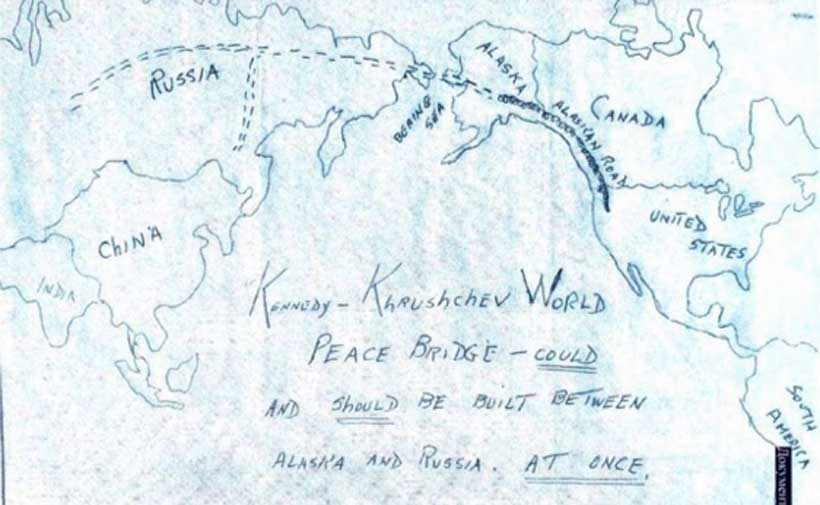
The proposal to construct a railway and cargo tunnel beneath the Bering Strait, connecting Russia’s Chukotka region with Alaska, recovers an old ambition to physically unite Eurasia and North America. In October 2025, Kirill Dmitriev, an advisor to Russian President Vladimir Putin and CEO of the Russian Direct Investment Fund (RDIF), extended a public invitation to Elon Musk’s ‘The Boring Company’ to participate in the subject matter’s project. Within this period, Dmitriev suggested such innovative construction methods could reduce the cost from more than USD 65 billion to below USD 8 billion, with completion possible ‘within 8 years’. In June 2026, Dmitriev reiterated and publicised these figures of the named ‘Putin-Trump Tunnel’ proposal at the St. Petersburg International Economic Forum, with most recent renewals of the claim on X this month, October 2026.
Nevertheless, these figures remain preliminary estimates, and not an independently established project budget or construction schedule.
It must be heightened that the significance of this intercontinental strategy extends well beyond its engineering challenges. From the perspective of the Global Academy for Future Governance’s (henceforth referred to as GAFG) Connectivity Doctrine, the Bering Strait is not simply a geographical obstacle in need of a technological solution. Instead, it is a potential entry point to a wider system of transport, energy, trade and institutional cooperation. One of which needs to be considered as such, especially as the project provides a possible new node within a global network of networks.
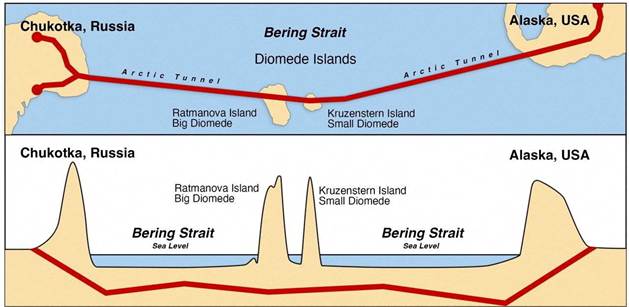
Figure 2: Visualised proposal of the aforementioned Bering Strait connection, (https://www.reuters.com/world/kremlin-envoy-proposes-putin-trump-tunnel-link-russia-us-2025-10-17/)
Stay ahead of the geopolitical week.
MD Briefing delivers expert analysis across five global fronts — the Indo-Pacific, energy, geoeconomics, European security, and the Middle East — every Monday morning. Free.
Beyond the tunnel: Connecting systems
The Bering Strait is approximately 82 kilometres wide at its narrowest point, and the idea of connecting its shores has circulated for more than a century, surviving changing political circumstances and successive generational engineering ambition. The reasons to which the project has been preventive is not solely due to the difficulty in crossing the strait, but also the absence of the wider infrastructure and cooperation required to make such a crossing executable.
The concept of connecting both Eurasia and North America through the Bering Strait is older than the available technology that could attempt it. As highlighted in Figure 3, such connectivity has explored different avenues, each deeming the Bering Strait as a political and economic advantage. At this present juncture, the Bering Strait shows its credibility, however with necessitated further investigation of its use, and its external environmental consequences.
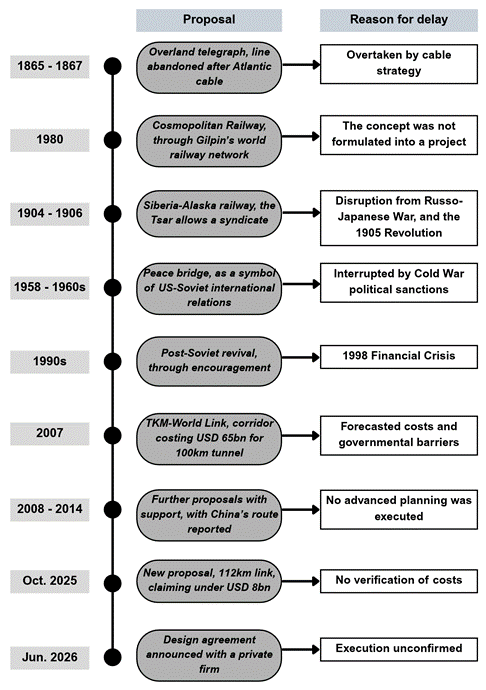
Figure 3: Visualisation of connectivity strategies over time concerning the Bering Strait (Joe Harvey Field, GAFG)
For example, extensive bilateral transport connections would be necessary. This includes railway access, freight terminals, energy supply, telecommunications, customs facilities, and upgraded logistics infrastructure. The sparse transport of networks within northeastern Russia and Alaska present a challenge in their own right, heightening that the tunnel would only be one component of a much larger undertaking.
This exact distinction lies at the very heart of the GAFG Connectivity Doctrine, whereby infrastructure is governance made physical. A tunnel can connect two territories, however only an integrated and thought-through system can connect and withstand their economies. The physical proximity between the two states does not automatically produce such economic integration, just as a transport corridor does not by itself guarantee prosperity.
The fundamental question is consequently not whether the Bering Strait can be crossed, but whether the crossing itself can be embedded into an interoperable, resilient and economically viable transcontinental corridor.
The GAFG Connectivity Doctrine
Through its Global Maritime Governance Forum (GMGF), GAFG has developed its own Connectivity Doctrine to ensure all is follows the institutional coherence, rules and standards. Consequently, corridors are treated as networked governance environments, as opposed to projects concerning infrastructure alone.
The five key dimensions from the GAFG Connectivity Doctrine recur in this exploration:
- Systems over projects – a corridor should be judged by how it interacts with the networks around it, as opposed to an isolated event;
- Governance as the multiplier: infrastructure creates potential, however connec-tivity also depends on the engagement of coherence and institutional capacity;
- Complementarity over competition – corridor systems are optimised as portfolios, not rival routes;
- Interoperability as the core constant: The main bottleneck usually concerns mis-alignment of rules, standards and institutions (as opposed to physical capacity);
- Connectivity as an ecosystem property – economic value emerges from system-wide integration, not as individual corridor efficiency.
GAFG continuously argues that current approaches to such projects each miss these key dimensions. Corridor planning presumes that institutions will follow the infrastructure, however this is sometimes not explicitly the case. The doctrine treats these dimensions coherently, and considers how to make such approaches work between systems that were not originally designed to align. The example of the Bering Strait is a test of the GAFG Connectivity Doctrine’s argument. A corridor between Russia and the United States would connect two governance systems within an environment that could complicate sanctions, security measures, and the states’ international relations.
The geopolitics of connectivity
The aforementioned proposal illustrates how infrastructure can become geopolitically significant. The project itself as a symbol of ‘unity’ between Russia and the US, and more comprehensively, between Eurasia and the Americas. Such symbolism is understandable, especially as the last century has shown the crossing’s reflection of easing diplomatic dialogue and intl relations, as opposed to it solely being a construction plan.
Nevertheless, a political announcement and a durable framework for cooperation are two disparate entities. The project, which intends to transcend geopolitical divisions, cannot exclusively depend on the goodwill of individual leaders, temporary diplomatic openings, nor the commercial interests of a single company. The proposal would also have to be reconciled with the existing sanction mechanisms and the wider political context. This includes current Eastern European geopolitical conflict, which could influence who would finance, insure, and operate such connections.
The proposition is also contingent upon agreements that are capable of surviving political change, whether organic or mandated. Financial arrangements, ownership, operational responsibilities, security provisions, environmental standards and dispute-settlement mechanisms should be established before construction could become a credible prospect. Ultimately, institutional continuity must mirror the engineering capacity.
In this specific context, the tunnel exemplifies a broader question – could strategic infrastructure become a platform for rebuilding practical cooperation, even when political relations remain difficult?
The answer would depend less on the symbolism attached to the project, than on the institutions created to govern it.
From a bilateral project to a governance ecosystem
A fixed physical connection between Russia and the United States would be bilateral geographically, and multilaterally in its economic consequences. The value of such a project would also depend on its opportunity to extend its connections to Canada, the wider North American railway network, Siberia, and the Eurasian transport system. Additional links to Asian and European markets could generate a longer-term vision, subject to demand and the engagement to continue connecting infrastructure.
Holistically, this opportunity changes the planning question. As opposed to treating the tunnel as an isolated construction project, policymakers would need to consider a coordinated and subjective governance ecosystem that encompasses transport standards, customs procedures, investment rules, data-sharing, energy infrastructure, environmental protection and cross-border energy management. With this perspective, the GAFG Connectivity Doctrine’s logic of governance as the multiplier applies, whereby infrastructure creates potential, but institutional quality determines its productivity.
Furthermore, the Arctic dimension must also be noted. Infrastructure within this region must take accountability for severe climatic conditions, fragile ecosystems, permafrost, and the interests of local and Indigenous communities. Long-term viability would also require environmental assessment, meaningful consultation, and clear mechanisms for monitoring impacts through the project’s life cycle.
This heightens the cruciality in examining how connectivity can cause resilience, the economic opportunities it distributes, and the risks it introduces. A technologically monumental link that lacks sufficient traffic, effective connecting networks or an effective governance framework could become an expensive liability, or perhaps a multilateral cautionary tale.
This perfectly instantiates the core tenets of the GAFG Connectivity Doctrine and its ecosystem logic: economic value emerges from a variety of different streams, not from the efficiency of any single link.
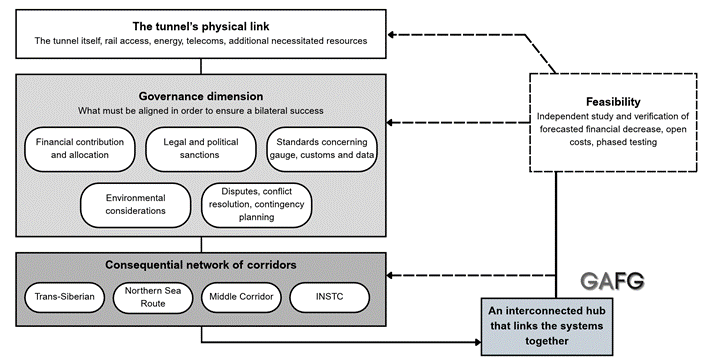
Figure 4: Visualisation of governance considerations for a Bering Strait link within the framework of the GAFG Connectivity Doctrine (Joe Harvey Field, GAFG)
Economic opportunities
From a specific economic perspective, advocates for the project suggest several possible advantages. For example, the current proposition would invite shorter land connections between Asian and North American markets, access to mineral and energy resources of the Far North, collective energy and data lines alongside the tunnel, as well as a land alternative to sea routes. Nevertheless, such advantages depend on the conditions that the tunnel cannot currently offer. Likeminded critics heighten that US-Russia trade is small, subject to sanctions, and that neither Siberia nor Alaska currently consist of the infrastructure that the tunnel would require. The economic case for this project, therefore, relies less on the cross of freight volumes, but instead ensuring markets and insurers would accept the connected infrastructure and financing.
Complementarity, not rivalry
The project would not exist in isolation, as the tunnel would enter a crowded field that already includes the Trans-Siberian Railway, the Northern Sea Route, the Middle Corridor, and the International North-South Transport Corridor. The GAFG Connectivity Doctrine’s answer to such complexity is to assess corridors as a portfolio of complementary routes rather than as competing projects. The relevant question is therefore not simply whether the tunnel could offer another connection, but whether it would add genuine resilience, optionality and value to the wider network. Where could traffic be redirected if one route were disrupted, and under what institutional and economic conditions would alternative routes remain viable?
This analysis builds on GAFG’s previous work on Arctic connectivity, Alice Ferrari’s examination of the Eurasian Gateway Network, and GAFG’s recent discussion of the America–Panama corridor. Together, these contributions reinforce the Connectivity Doctrine’s central argument: infrastructure must be understood not as an isolated project, but as part of a wider network of complementary routes, interoperable systems and coherent governance. The Bering Strait Tunnel should therefore be assessed within this broader connectivity ecosystem, particularly given the tendency for ambitious infrastructure proposals to become entangled in political rhetoric before their practical requirements have been established.
Feasibility before symbolism
The argued cost reduction forecast to ‘below USD 8 billion’ is an attractive proposition, however it should be deemed as a claim that requires further independent verification. The operating costs of just boring the tunnel cannot be equated with the cost of delivering a transcontinental corridor. Therefore, a comprehensive feasibility study is suggested, in order to assess geological conditions, safety, construction methods, access infrastructure, freight demand and financing. Notwithstanding, the project’s feasibility analysis should also consider the lifecycle of continuous operations, maintenance, and potential expansion strategies.
A suggested phased approach would allow governments, investors, and additional stakeholders to test the project’s economic assumptions, before committing to its full development. Essential assignments should consider independent technical assessments, transparent cost estimates, a credible allocation of financial and operational risks, and their subsequent contingencies. Through this preparation phase, one must not consider this as a diminishment of the project’s ambition, but instead ensure the project has a gravitational strategic vision.
The missing link is governance
The proposal provides the opportunity to reconsider how major infrastructures should be conceived in an increasingly interconnected world. Corridors are not simply lines on a map; they organise economic relationships, shape regional development, and redistribute strategic opportunities. The durability of such an impressive project depends on the coherence of the systems that are built around it.
The tunnel may or may not prove technically or economically feasible under the proposed conditions. Nevertheless, the deeper significance provokes another question – can connectivity become a practical instrument of cooperation, as opposed to a mere expression of political aspiration?
As referenced, the strategic objective should prioritise the project’s viability, resilience, and mutual benefit within the governance ecosystem that is concerned with the tunnel. Only then can a physical link between Eurasia and North America become an outstanding instrument to intercontinental activity, and more than just an engineering achievement.
The Bering Strait could eventually become such a gateway, but the tunnel itself would not deliver that outcome on its own. Therefore, the main denominator within this project, as well as previous projects that GAFG Connectivity Doctrine analyses, is the significance of governance. Considering the GAFG Connectivity Doctrine, the answer begins with the policy recommendation’s core principle. As repeatedly noted by GAFG’s Forum researchers: ‘gateways link places; network hubs link systems’.
