An Adjourned Session in Cairo
On Sunday, Egypt’s parliament met in emergency session to authorise military support for Saudi Arabia, and then adjourned without a vote, promising to reconvene on Monday. The session existed because President Abdel Fattah el-Sisi had told a military graduation the day before that it was “inconceivable” Egypt would let Saudi security be harmed. In the same breath he added two qualifiers: Egypt would act only “if requested,” and “we are speaking only about defense.”
Those qualifiers are the story. Two weeks earlier, Pakistan said its forces under the new Mecca defence pact were “already there” in the kingdom, as they have been for decades. Every partner rushing to Riyadh’s side is careful to arrive without a weapon pointed at Iran.
Eight Weeks From Signature to Invocation
Stay ahead of the geopolitical week.
MD Briefing delivers expert analysis across five global fronts — the Indo-Pacific, energy, geoeconomics, European security, and the Middle East — every Monday morning. Free.
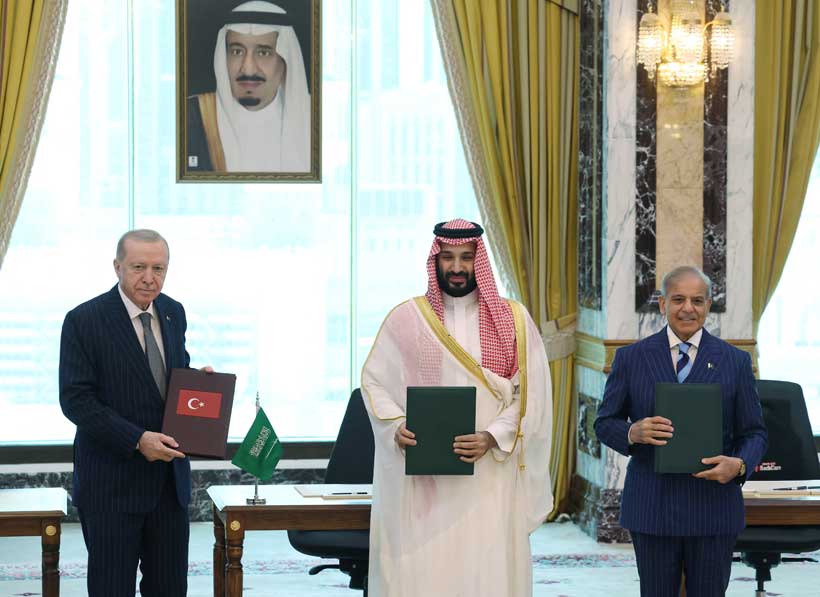
Saudi Arabia, Turkey and Pakistan signed the Mecca Joint Defence Agreement on 7 August. It borrows NATO’s language: an attack on one is an attack on all. Two months later it was tested. Yemen’s 2022 truce had unravelled, the Houthis seized the country’s Red Sea coast in September, and missiles began reaching Riyadh’s airport and Aramco’s headquarters. On 5 October the three governments’ defence and foreign ministers met in Riyadh and invoked the pact for the first time, agreeing to “activate collective deterrence measures”. Modern Diplomacy argued at signing that the pact was a confession, not a deterrent, a hedge against doubts about American guarantees. The invocation is the first test of that judgement.
Washington, Riyadh’s traditional guarantor, has largely watched. President Trump has said the Houthis are “behaving very badly” but promised to “be there after the Elections”, meaning after the US midterms on 3 November. Into that gap stepped Iran. On 11 October Foreign Minister Abbas Araghchi phoned his Saudi counterpart and offered to “help initiate a dialogue” between Riyadh and the Houthis. The Saudi readout of the call did not mention the offer.
Four Members, Four Invoices
The tempting reading, and the one most coverage has adopted, is that a “Sunni NATO” is forming because America has proved unreliable. That gets the motive right and the mechanism wrong. Look at what each partner is actually offering, and what each wants back.
Pakistan brings the most troops and the most need. Its army has long kept trainers and advisers in the kingdom, and Reuters reported in May that Islamabad sent 8,000 troops, a fighter squadron and an air-defence system under an earlier bilateral pact. Invoking the Mecca agreement largely relabelled forces that were already deployed. Meanwhile Pakistan’s finance minister is asking Riyadh for a 15-year, $6.7bn oil financing facility to ease pressure on its reserves. Pakistan also shares a long border with Iran. It will defend Saudi airfields. It will not march on Sanaa, and it will not fight Tehran.
Turkey brings industry. Ankara’s defence firms have struggled to win Saudi contracts beyond Baykar’s 2023 Akinci drone deal, and the pact opens doors for air-defence systems and the KAAN fighter. Turkey’s offer after the invocation was, in Hakan Fidan’s words, mainly air defence, and its parliament has still not ratified the treaty. On Saturday Fidan was in Baghdad for an Islamic foreign ministers’ meeting, where he sat down with Araghchi. Turkey is not the pact’s sword against Iran. It is the member that keeps a line open to Tehran.
Egypt brings the most urgent self-interest and stays furthest outside. The Houthi attacks on shipping have cost the Suez Canal about $11bn in revenue, so reopening the Bab el-Mandeb, the strait at the Red Sea’s southern mouth, is a Treasury matter for Cairo as much as a gesture of solidarity. Riyadh has the same priority: with Hormuz contested, the Red Sea now decides Saudi foreign policy, because its crude exports run through Yanbu. Egypt has not joined the Mecca pact, and Gulf money has underwritten Egypt since 2013. The “if requested” clause shifts a political cost onto Riyadh: to get Egyptian forces, the kingdom must publicly ask for them.
Put the four invoices together and the shape is clear. Riyadh is paying, in financing, contracts and political cover, for partners who strengthen its air defences and its image. None of them is prepared to change Iran’s calculus by force, and Tehran knows it. When the pact was signed, an Iranian lawmaker dismissed it as a paper agreement that would not bring Saudi Arabia security. This is not a bloc built to deter Iran. It is a coalition of witnesses.
Why Riyadh Won’t Take Tehran’s Call
That explains Riyadh’s silence on the mediation offer. Saudi Arabia is not ignoring Iran: Foreign Minister Faisal bin Farhan took Araghchi’s call, and the Saudi ambassador attended a funeral for Araghchi’s sister this month. What Riyadh refuses is the role Tehran is claiming.
A mediator is a neutral party. On 16 October the Saudi foreign ministry’s Rayed Krimly said the Houthi escalation is “encouraged by Iran,” and Riyadh treats it as a breach of the 2023 Beijing deal that restored relations. That deal was widely understood to include Iran restraining the Houthis. Accepting Iranian mediation would let Tehran turn a broken promise into a favour, collecting credit for turning off a tap Riyadh believes it controls. Riyadh wants Iran at the table as a party to be held to account.
That is where the coalition earns its fee. Riyadh is not using the pact to fight; it is using it to negotiate from a position where it can show it has friends. The strongest objection is that the deployments are real. Pakistani air defence and Turkish radars genuinely help against drones, and Turkey has agreed to join a Saudi-led Red Sea navigation coalition. All true, and all defensive. Better air defence protects Saudi skies, but it does nothing to change what the Houthis or Iran want. Nor has the United States gone anywhere: analysts say it is still helping the kingdom behind the scenes. The pact is not a security order built without Washington. It is insurance for the months Washington is distracted.
Three Ways the Coalition Gets Tested
Base case (55%): a defensive shield and quiet talks. The pact stays defensive. Pakistani and Turkish air defences are folded into Saudi networks, Egypt’s parliament passes a conditional authorisation, and Riyadh never makes the formal request. After 3 November, Washington steps up strikes or pressure, and Riyadh reopens direct talks with Tehran on its own terms. The key assumption is that the Houthis keep hitting infrastructure without causing a mass-casualty event on a holy site.
Downside case (25%): the pact is called on to fight. A Houthi strike kills large numbers at Mecca or Medina, or puts Yanbu’s export terminal out of action. Riyadh formally asks Egypt for forces and presses partners to join offensive operations in Yemen. Pakistan, with Iran on its border and a large Shia minority at home, declines anything beyond defence, exposing the gap between the pact’s wording and its willingness. If US strikes on Iran after the midterms use Saudi facilities, Tehran may treat pact members as co-belligerents. That would put Turkish and Pakistani air-defence crews in the line of fire their governments never voted for.
Alternative case (20%): Turkey becomes the mediator. Riyadh refuses Iran as mediator but accepts a member of its own pact, most plausibly Turkey, as the channel to Tehran and the Houthis. A de-escalation brokered by Ankara would turn the pact from a military arrangement into a diplomatic instrument. That would be the genuinely post-American moment: Gulf security managed by regional powers talking to each other, with Washington informed rather than in charge.
Probabilities reflect the author’s analytical judgment based on currently available information and are not statistical forecasts.
Watch Cairo, Not Islamabad
The Mecca pact is real, but it is not what its admirers or its critics describe. It is Saudi Arabia buying defensive capacity and visible company, priced in oil financing and arms contracts, so that it can face Iran as an aggrieved party with friends rather than a client waiting for Washington. That is also why Riyadh will not let Tehran play broker.
The signal to watch is Egypt’s parliament on Monday, and above all whether Riyadh then files a formal request. Authorisation costs Cairo nothing. A request would mean Riyadh has decided it needs more than witnesses. Until then, the kingdom has not found new protectors. It has found an audience, and in the Gulf, being seen to have friends is half of deterrence.