


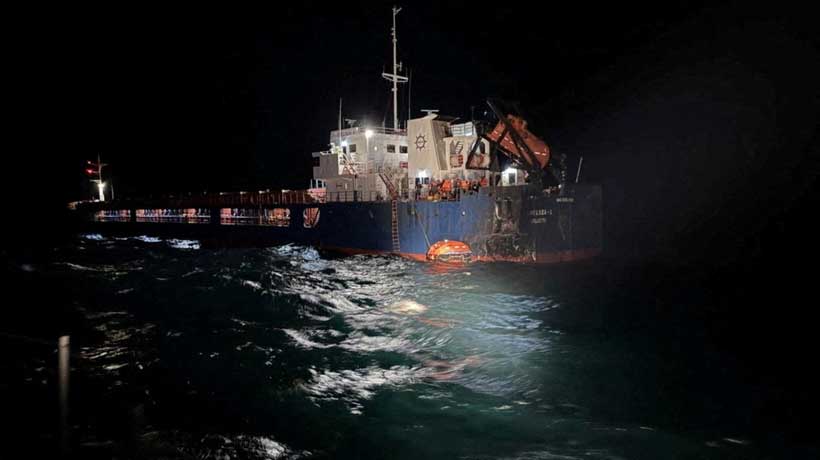
In little more than a week, three merchant ships have gone to the bottom of the Black Sea inside the exclusive economic zones of two NATO members. On 5 October, the Royad Mammadov, a Turkish-operated grain carrier sailing from the Danube port of Izmail to Ravenna, caught fire and sank in Romania’s economic zone, killing two crew; Kyiv blamed a Russian drone, though Romanian authorities have not officially confirmed the cause. On 6 October, the Togolese-flagged Alfa Watan was struck by aerial and naval drones in Bulgaria’s EEZ and sank, with its ten crew missing. Then, on the night of 12 to 13 October, drones struck two more cargo ships roughly 20 miles off the Bulgarian coast, sinking the HS Dignity near Krapets and leaving eleven sailors missing.
These incidents have been reported largely as tragedies at sea, which they are. But they also expose something more structural. The Black Sea is the one part of NATO’s eastern flank where the alliance’s usual tools of deterrence are constrained by law, geography and treaty at the same time, and the attacks are taking place in precisely the space those constraints leave open.
Why the ships are there
The geography of the attacks follows the geography of Ukraine’s trade. Russian strikes on Ukraine’s Black Sea ports have pushed Ukraine to lean more heavily on Danube river ports and on routes hugging the coasts of Bulgaria and Romania. That corridor was built in 2023 on an implicit wager. Ukrainian officials argued at the time that Russia would hardly dare to strike shipping in the waters of three NATO states, and for a long period the wager largely held. It is now being tested in the most direct way possible.
Bulgaria has avoided formal attribution. Prime Minister Rumen Radev said authorities lacked clear evidence, but told Russia’s ambassador that it made no sense for Ukraine to destroy its own ships and that the results favoured Russian interests. Moscow has denied responsibility. The ambiguity should not be dismissed, but nor should it be overread, because the sea war is two-sided. Since July, Ukraine has run a sustained drone campaign against Russian commercial shipping, and its drone forces commander claims to have disabled around 300 vessels in the Sea of Azov and the Black Sea, targeting ships supplying Crimea and carrying Russian exports. The Sea of Azov alone handles about a quarter of Russia’s grain exports. Both belligerents now treat the other’s export flows as legitimate targets. What has changed is that this contest has moved into waters under the economic jurisdiction of alliance members.
Stay ahead of the geopolitical week.
MD Briefing delivers expert analysis across five global fronts — the Indo-Pacific, energy, geoeconomics, European security, and the Middle East — every Monday morning. Free.
The EEZ gap
The location of the strikes matters as much as their frequency. The vessels hit off Bulgaria this week were struck about 20 miles from shore, in what Radev called the immediate vicinity of Bulgarian territorial waters, and the Royad Mammadov went down outside Romania’s territorial waters. Under the law of the sea, territorial waters extend twelve nautical miles from the coast and carry sovereignty. The exclusive economic zone, which extends further, grants a coastal state rights over resources, not sovereignty over the water. An attack on a foreign-flagged merchant vessel twenty miles offshore is therefore not, in legal terms, an attack on Bulgaria or Romania.
That distinction is central to how the alliance can respond. Article 5 is built around armed attacks on the territory, forces or vessels of members. Drone strikes on third-country ships in a member’s EEZ sit below that line. Radev’s own phrasing captures the problem exactly: the strikes are close enough to impose real economic and political costs on a NATO state, yet far enough offshore to deny any clear trigger for collective action.
The flags and crews reinforce the gap. The ships sunk off Bulgaria were registered in Togo and Guinea-Bissau and crewed largely by Syrian and Egyptian sailors, according to the Syrian Sailors’ Union and Syrian authorities; the Royad Mammadov flew the flag of Saint Kitts and Nevis. These are states with little capacity to demand redress or protection. Whoever is conducting the strikes has found a category of target that imposes damage on NATO coastal states and on Ukraine’s trade, while involving no flag state able to escalate on its own behalf.
The Montreux ceiling
In the Baltic, NATO’s answer to grey-zone pressure has been to surge allied presence: more patrols, more ships and more surveillance aircraft, drawn from across the alliance. That model does not transfer to the Black Sea. Passage through the Turkish Straits is governed by the 1936 Montreux Convention, and since early 2022 Turkey has used Article 19 to bar the warships of the belligerents from transiting. The convention also caps the aggregate tonnage of non-littoral navies in the Black Sea and limits how long their warships may stay. Allied navies from outside the region cannot simply sail in to establish a standing escort presence off Bulgaria and Romania.
Montreux is not an obstacle to be wished away. It has kept Russian naval reinforcements out of the Black Sea for most of the war, and Ankara regards it as a vital strategic interest rather than a mere technical treaty. But it means that maritime security in the western Black Sea depends overwhelmingly on the littoral NATO members themselves: Romania, Bulgaria and Turkey. Of the three, Bulgaria has the most limited naval and surveillance capacity, which is why Radev’s first request to Ursula von der Leyen and Mark Rutte was for help strengthening Bulgaria’s maritime and airspace surveillance.
The responses he received were supportive but general. Rutte said the alliance would continue monitoring the region and adjust deterrence and defence measures as needed, while von der Leyen described the Black Sea as another front of escalation in Russia’s war. Neither statement amounts to a change in posture.
A littoral solution, and its limits
The more promising signal came from Sofia itself. Radev said Bulgaria would open talks with Romania and Turkey on joint proposals to secure Black Sea shipping. There is a precedent. In early 2024, the three states agreed to form a task group to deal with mines drifting into their waters from the war. That arrangement was designed for a passive hazard. Drones launched deliberately against shipping are a different and harder problem, requiring persistent maritime surveillance, rapid information sharing and some capacity to intercept, not just to clear.
Turkey is the pivot. It has the largest navy among the three littoral allies and controls access to the sea, but it has also invested heavily in its position as an interlocutor with both Moscow and Kyiv. A trilateral mechanism that looks like a NATO escort operation by another name may be harder for Ankara to embrace than one framed around navigational safety and the protection of civilian crews. How that framing is negotiated will determine whether the initiative becomes operational or remains a diplomatic gesture.
There is also a gap the European Union can fill more readily than NATO. Coastal radars, maritime drones, sensor networks and the financing to acquire them do not require warships to pass through the Turkish Straits. Bulgaria’s request is, in large part, a request for capability that can be bought, built or leased within the region. Treating it as such would be faster than waiting for an alliance-level consensus on what the attacks legally constitute.
The flank that law left open
The Black Sea’s security architecture, shaped by Montreux, by the law of the sea and by the alliance’s own threshold for collective defence, was designed to manage great-power naval competition. It was not designed for cheap drones striking flag-of-convenience freighters a few miles beyond territorial waters. Each of those legal lines has a sound rationale. Together, they create a zone where sustained attacks on commercial shipping can continue without crossing any line the alliance is structured to respond to.
Whether Russia is responsible, as Bulgaria’s prime minister has all but said, or whether the picture proves more complicated, the effect is the same: the western Black Sea is becoming contested water on NATO’s doorstep. For Sofia, Bucharest and Ankara, the task is to build a regional mechanism quickly enough to close that zone themselves. For the rest of the alliance, the measure of solidarity will be whether it supplies the sensors, funding and political cover to make that mechanism work, rather than another round of statements.
