


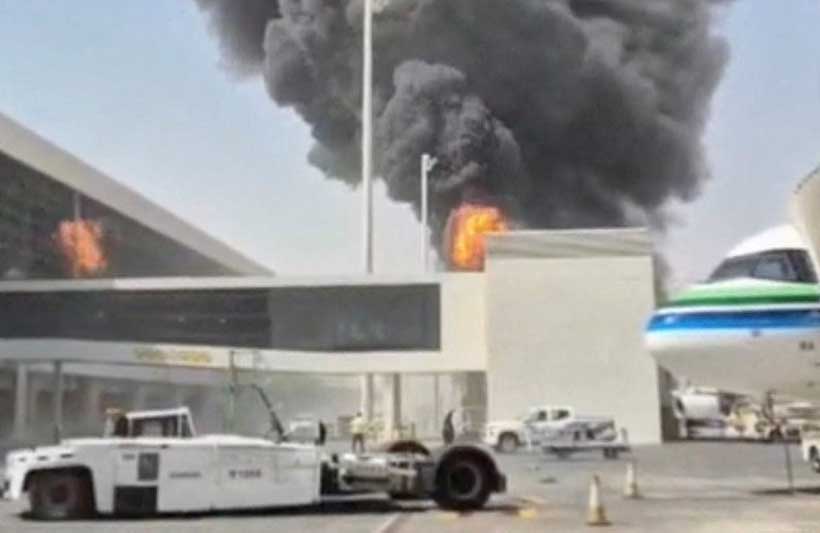
Yemen’s Houthi movement has exposed vulnerabilities in Saudi Arabia’s air defences after attacks on Riyadh’s international airport and the headquarters of Saudi Aramco, raising concerns about the kingdom’s security and its ambitions to become a global investment hub.
The attacks highlight how the Iran-backed group has developed increasingly sophisticated military capabilities despite years of conflict, weapons seizures and international efforts to restrict its access to advanced technology.
Security experts point to several factors behind Saudi Arabia’s difficulties, including Iranian assistance in developing local weapons production, access to components from international commercial supply chains, battlefield experience and pressure on regional air defence systems following the US-Israeli war against Iran.
Together, these developments have made the Houthis a more capable adversary, complicating Saudi Arabia’s efforts to protect critical infrastructure and maintain investor confidence.
Stay ahead of the geopolitical week.
MD Briefing delivers expert analysis across five global fronts — the Indo-Pacific, energy, geoeconomics, European security, and the Middle East — every Monday morning. Free.
How Has Iran Helped the Houthis Build Their Own Weapons?
Iran has provided weapons, funding and training to Yemen’s Houthis, formally known as Ansar Allah, for more than a decade. Tehran denies supplying weapons in violation of the UN arms embargo.
However, military and regional experts say the relationship has evolved beyond the direct transfer of equipment. Iranian Revolutionary Guards personnel and members of Lebanon’s Hezbollah initially helped the Houthis develop knowledge of missile systems and their operation.
According to Andreas Krieg, a senior security studies lecturer at King’s College London, former Yemeni military engineers and locally trained specialists have since helped establish a more durable domestic weapons-production capability.
This development has reduced the group’s dependence on complete weapons systems arriving from Iran. Instead, the Houthis have increasingly learned to assemble drones and missiles using components obtained through different channels.
Hamid Nikou, a former political adviser to Iran’s Islamic Revolutionary Guard Corps, said Tehran had anticipated the possibility that direct weapons shipments could be intercepted or disrupted. Training the Houthis to assemble weapons from dual-use components was therefore an important part of the strategy.
The result is a more resilient military capability that could survive disruptions to Iranian supply routes.
For Saudi Arabia, this presents a difficult problem. Intercepting weapons shipments or targeting storage facilities may limit the Houthis’ capabilities, but it becomes harder to dismantle a network that can assemble and maintain weapons locally.
Why Are Commercial Supply Chains Important?
The Houthis’ growing capabilities are not dependent entirely on equipment manufactured in Iran. Access to components from international commercial supply chains has also become an important factor.
Conflict Armament Research reported that the group was seeking to manufacture advanced medium-range ballistic missiles using components shipped from China. The report followed the seizure of a shipment by Yemen’s internationally recognised government.
Krieg said China had become an important commercial source of components, while Iran continued to provide specialised military technology, technical expertise and parts that were difficult to obtain through ordinary commercial channels.
The distinction matters because restricting a single supply route may not prevent the acquisition of components that have legitimate civilian uses but can also be incorporated into weapons.
The Houthis’ ability to combine externally sourced parts with locally developed expertise makes their weapons programme more difficult to disrupt.
Artificial intelligence may add another layer to this challenge. Anthropic said in September that a group of threat actors based in northern Yemen had used its Claude AI assistant to help develop software associated with a guided rocket and planned missile systems.
Such reports illustrate the potential for commercially available technologies to support military development, although they do not establish that AI alone has transformed the Houthis’ battlefield effectiveness.
Why Are Saudi Arabia’s Air Defences Under Pressure?
The Houthis’ improving capabilities coincide with mounting pressure on US and regional air defence systems following the war involving the United States, Israel and Iran.
The United States has used substantial quantities of missile interceptors to protect its regional bases and allies. The resulting strain on available stocks has raised concerns about the ability of Gulf states to sustain prolonged defensive operations.
Saudi Arabia also faces geographical challenges. Its large territory and widely distributed energy infrastructure make it difficult to provide comprehensive protection against attacks from multiple directions.
Farzan Sabet, a Middle East expert at the Geneva Graduate Institute, argued that Saudi Arabia’s integrated air defence capabilities were not yet comparable to those of Israel or Ukraine.
The challenge is not simply whether Saudi forces can intercept individual missiles or drones. It is whether they can maintain sufficient surveillance, coordination and interceptor supplies to defend numerous critical sites against repeated attacks.
Saudi Arabia’s oil facilities, airports and other strategic infrastructure are particularly important because successful strikes could have consequences beyond immediate physical damage.
The Saudi-led military coalition fighting the Houthis has previously reported intercepting missiles aimed at Saudi cities and destroying 127 Houthi weapons storage facilities and launch platforms. Coalition spokesperson Turki al-Maliki has also accused regional actors of helping the group acquire advanced military technology.
These measures demonstrate the scale of efforts to contain the threat, but they have not eliminated the underlying challenge.
How Has Years of War Strengthened the Houthis?
The Houthis have accumulated operational experience through years of fighting in Yemen and their subsequent involvement in wider regional confrontations.
The Yemeni civil war intensified in 2014, when the Houthis expanded their control and fought forces backed by Saudi Arabia and other regional actors. A fragile ceasefire took hold in 2022, although the conflict remained unresolved.
Following the outbreak of the Gaza war in 2023, the Houthis began launching attacks towards Israel and targeting commercial shipping in the Red Sea, expanding their military activity beyond Yemen.
These operations exposed the group to new operational challenges and created opportunities to adapt its tactics, weapons and supply networks.
The escalation surrounding the US-Iran war in 2026 subsequently increased the risk of renewed fighting in Yemen, with the Houthis entering this phase of regional confrontation after years of weapons development and battlefield experience.
Sabet said the group had continued diversifying its supply chains and improving its capabilities through operational experience.
This evolution helps explain why the Houthis should not be viewed simply as a militia dependent on external weapons deliveries. They have developed into a more experienced armed movement with an expanding capacity to produce, adapt and deploy weapons.
What Does This Mean for Saudi Arabia’s Economic Ambitions?
The attacks carry implications beyond military security. Saudi Arabia is investing heavily in economic diversification, tourism, logistics and international business as part of its effort to reduce dependence on oil revenues.
Repeated attacks on Riyadh and major energy infrastructure could undermine perceptions of the kingdom as a secure destination for foreign investment.
Even when air defences intercept incoming weapons, the cost of maintaining protection can be substantial. Persistent threats may also increase insurance costs, disrupt business operations and complicate long-term investment decisions.
The risks are especially significant for energy infrastructure. Saudi Aramco occupies a central position in the kingdom’s economy and global oil markets, making its facilities strategically important.
The prospect of sustained attacks could therefore create a wider economic vulnerability, particularly if regional conflict keeps energy markets volatile and diverts resources towards defence.
Can Saudi Arabia Contain the Houthi Threat?
Saudi Arabia faces an adversary whose capabilities have developed through a combination of external assistance, local technical expertise, diversified supply chains and years of combat experience.
This combination makes the threat harder to address through air strikes or weapons interceptions alone. Even successful attacks against launch sites and storage facilities may not permanently eliminate a production network capable of adapting to changing circumstances.
The pressure on regional interceptor stocks adds another complication, forcing Saudi Arabia and its partners to balance immediate defensive requirements against the possibility of a prolonged confrontation.
Ultimately, the challenge is not only to strengthen air defences but also to prevent the conflict from expanding further and to address the conditions that allow the Houthis to sustain their military operations.
The recent attacks underscore a broader regional reality: advanced air defence systems can be strained when confronting a persistent adversary that combines relatively inexpensive weapons with increasingly sophisticated production capabilities. For Saudi Arabia, protecting critical infrastructure will remain essential not only to national security but also to the credibility of its economic transformation strategy.
With information from Reuters.
