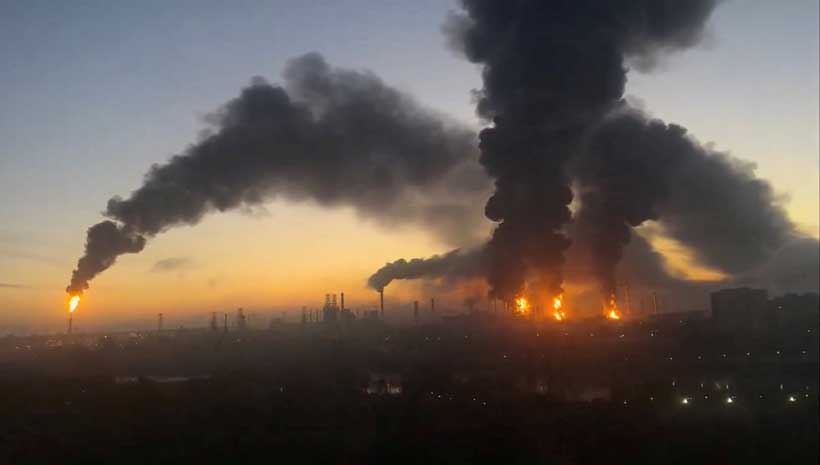
“Don’t Hit Refineries”
On 10 October, standing outside the White House, Donald Trump gave Ukraine a targeting instruction. “Don’t hit refineries. There’s plenty of targets,” he said of Volodymyr Zelensky, adding that he “better damn well stop” and that Ukraine needed a new president. The day before, according to the Financial Times as reported by Townhall, US envoys in Miami had raised the possibility of cutting off intelligence sharing if the strikes continued. Hours after that meeting, Russian authorities reported a Ukrainian strike on an oil terminal in Rostov-on-Don.
This is no longer a disagreement about tactics. Washington has just licensed Russian diesel for import and is relying on Russian refineries to bring down fuel prices before the 3 November midterms. That makes the United States a stakeholder in the uptime of the plants Ukraine is trying to destroy. Whatever Kyiv does next will show whether Ukraine is America’s partner or its client.
Ukraine’s Most Successful Campaign
Stay ahead of the geopolitical week.
MD Briefing delivers expert analysis across five global fronts — the Indo-Pacific, energy, geoeconomics, European security, and the Middle East — every Monday morning. Free.
Ukraine’s long-range drone campaign is the most successful thing it has done since 2022. Bloomberg counts at least 70 strikes on Russian refineries this year, pushing output to a two-decade low. In September, three of Russia’s six largest diesel refineries cut or halted production, and Kirishi shut down entirely. Kyiv’s Defence Ministry claims 51% of Russian refining capacity has been disabled. Independent analysts put the figure nearer 30%, which is still extraordinary.
The effects are visible. Russian diesel exports fell below 1 million tonnes in June, against about 2.5 million a year earlier. Moscow has banned gasoline exports through January and extended its diesel export ban for producers to 31 October, while regions ration fuel. At the Valdai Forum on 1 October, Vladimir Putin conceded that Ukraine had “partially achieved its objectives” and put the cost at 1% of Russian GDP.
America Now Wants Russian Refineries Running
Most commentary frames Trump’s demand as impatience with Zelensky, or as one more sign of Trump’s sympathy for Moscow. Both readings miss the mechanism. On 9 October Treasury issued a general licence (a blanket sanctions exemption) allowing Russian diesel to be sold and imported until April 2027. Trump has promised voters Russian diesel rising to a million tonnes in December. Every tonne has to come out of a refinery that Ukraine is trying to set on fire. The licence and the “don’t hit refineries” instruction are the same policy. For the first time in this war, Washington’s domestic interest depends on Russian industrial capacity staying intact.
The stakes for Washington are clear. US diesel averaged $6.51 a gallon last week, nearly double a year ago, in an election where farm-state Senate seats in Iowa and Kansas are in play. A Ukrainian drone hitting a refinery in Kirishi now shows up, through a chain of prices, in a campaign ad in Des Moines.
The strongest objection is that Trump has a point. The strikes have taken Russian diesel off a market already short of supply because of the Iran war, and someone has to pay that cost. But the numbers don’t support the scale of the demand. The IEA estimates that lost Gulf exports are about three times the Russian reduction, and Hormuz, not Kirishi, is what sets the diesel price. Analysts put the first Russian releases at 72,000–124,000 barrels a day against global consumption of about 30 million, a “Band-Aid over a bullet hole”. Washington is asking Kyiv to give up its most effective lever against Moscow for a price effect American drivers will barely notice.
That imbalance is why Kyiv is unlikely to comply. According to the FT’s account, a senior Ukrainian official’s reply was blunt: “We will burn refineries.” Ukraine has a structural reason to keep going, not just an emotional one. The refinery campaign is the only Ukrainian pressure on Russia that does not depend on Western approval. Kyiv builds the drones itself and has tripled production this year. Sanctions can be waived, as the diesel licence shows, but a burned-out crude distillation unit cannot. Giving up the strikes would leave Kyiv with only the levers Washington controls, at the moment Washington has shown it will trade them for fuel.
Washington’s leverage is real but limited. US intelligence has helped Ukrainian drones plan routes and evade air defences, and the eight-day intelligence pause in March 2025 measurably weakened Ukraine’s long-range strikes. Cutting it off again would cost Ukraine accuracy, not the ability to strike: the targets are fixed, mapped and enormous. It would also hand the Kremlin an American-made ceasefire on Russia’s most vulnerable infrastructure, while Russian glide bombs keep falling on Ukrainian cities. Trump’s call to replace Zelensky shows the White House knows its practical leverage is thin and is reaching for political leverage instead.
Europe sits uncomfortably in between. The EU bans Russian petroleum products and has been tightening its own sanctions as Washington loosens. Europeans also pay for the diesel shortage at the pump. European governments cannot replace US satellite intelligence quickly, but they can supply drones, financing and political cover. Whether they choose to will show whether “European strategic autonomy” means anything when the US and Ukraine disagree.
Three Paths From Miami
Base case: Kyiv keeps striking, but shifts its targets (about 55%). Ukraine stays away from the diesel-heavy refineries that Washington now counts on and redirects its strikes to export terminals, crude pumping stations, military fuel depots and gasoline production. Moscow is hurt almost as much, Washington’s specific complaint is defused, and Kyiv keeps the campaign alive. The White House grumbles but does not cut intelligence before the midterms, because doing so would look like taking Moscow’s side in the middle of a campaign. The key assumption is that Kyiv judges a partial adjustment cheaper than open defiance. For energy traders, this means Russian crude export disruptions increase while product flows stabilise slightly.
Downside case: Washington switches off the satellites (about 30%). If strikes continue on major refineries such as Kirishi or NORSI, the US repeats March 2025 and suspends intelligence support for energy targets. Ukraine’s strike accuracy falls, Russian refinery output recovers by December, and the diesel licence starts delivering real volumes. Europe is asked to fill the gap and largely cannot. Few readers are pricing this in: it would be the first time the US has actively degraded a Ukrainian capability to protect its own fuel prices. That precedent would outlast this administration.
Alternative case: an energy truce (about 15%). Kyiv has already proposed a mutual halt on strikes against energy infrastructure. The proposal went nowhere in Miami. With winter approaching and Russian strikes hitting Ukraine’s grid, a US-brokered energy truce becomes the face-saving deal for everyone. Kyiv protects its power plants, Moscow protects its refineries, and Trump claims lower diesel prices. The obstacle is the Kremlin, which says it does not want a “fragmented solution”.
Probabilities reflect the author’s analytical judgment based on currently available information and are not statistical forecasts.
Watch the 31 October Ban
The refinery campaign has become the purest test of the US–Ukraine relationship. It is the one weapon Kyiv owns outright, aimed at a target Washington now needs intact. If Ukraine keeps striking, the alliance becomes a partnership of unequals who sometimes say no to each other. If it stops, Kyiv has accepted that its war strategy is set by American petrol prices.
The cleanest signal is in Moscow, not Miami. Russia’s diesel export ban for producers expires on 31 October. If the Kremlin lets it lapse, Russian refineries are recovering and Kyiv has eased off. If it extends the ban again, Ukraine is still burning refineries, whatever Washington asked.
Trump asked Kyiv to choose between his goodwill and its best weapon. The answer will come from the smoke over Russia’s refineries, not from any summit communiqué.