


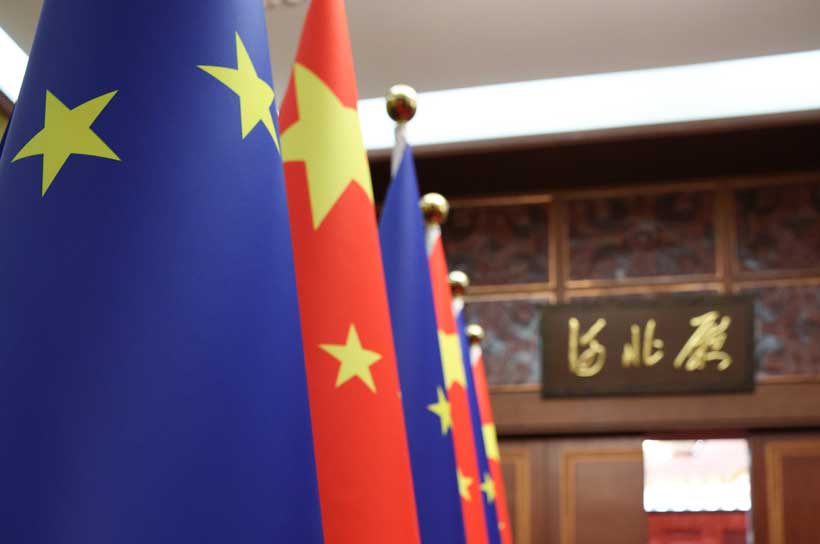
China’s fast-growing hybrid vehicle exports to Europe face fresh uncertainty after Beijing agreed to curb shipments to the European Union, threatening a key growth channel for Chinese automakers as domestic demand slows and competition intensifies.
Chinese exports of hybrid vehicles to the EU’s 27 member states tripled to $7.5 billion in the first half of 2026 from $2.5 billion a year earlier, according to Chinese customs data. The figure was nearly nine times the $845 million recorded for the whole of 2021.
The surge followed the EU’s introduction of additional tariffs on Chinese-made electric vehicles in 2024. Plug-in hybrids were exempt from the extra duties, prompting manufacturers to expand shipments of models that combine electric driving with conventional engines.
Demand has also benefited from limited charging infrastructure in parts of Europe, where consumers value the longer driving range and fuel efficiency offered by plug-in hybrids.
Stay ahead of the geopolitical week.
MD Briefing delivers expert analysis across five global fronts — the Indo-Pacific, energy, geoeconomics, European security, and the Middle East — every Monday morning. Free.
Chinese manufacturers SAIC, BYD and Chery accounted for more than 90% of Chinese hybrid sales volume in the EU, while hybrids represented more than half of their European sales, according to Jefferies.
The emerging agreement could restrict this expansion, although its practical impact will depend on how Beijing and Brussels implement the arrangements.
China’s Automakers Face a New Trade Barrier
The EU agreement marks a potential shift in the trade dispute over Chinese electric vehicles, with restrictions on hybrid exports now threatening another important route into the European market.
Chinese brands captured a record 15% share of Europe’s electric vehicle market in the second quarter, up from 9.5% in the first quarter of 2024. Chinese plug-in hybrids have expanded even more rapidly, accounting for more than a quarter of the segment after holding just 1.7% at the beginning of 2024, according to Schmidt Automotive Research.
The growth has intensified competition for European manufacturers, including Volkswagen, which has traditionally held a strong position in the plug-in hybrid market.
Felipe Munoz of Car Industry Analysis said the agreement would make conditions more difficult for Chinese manufacturers but was unlikely to stop their expansion into Europe entirely.
He argued that European policymakers would eventually have to decide how far they wanted to protect domestic manufacturers against growing Chinese competition.
Quotas Could Replace Tariffs as the Main Risk
The agreement’s implementation remains uncertain. European Trade Commissioner Maros Sefcovic said on Friday that it would reduce imports by several million cars over four years, but Brussels and Beijing have yet to disclose the detailed arrangements.
China’s Commerce Ministry said on Monday that the agreement would allow exports to continue growing and guarantee China a quota no smaller than that granted to any other source of imports.
The arrangement has been viewed by some investors as a step towards easing trade tensions, potentially reducing the immediate risk of additional tariffs on Chinese hybrids. However, questions remain over possible import quotas, minimum prices and exemptions.
Shares in BYD fell 1.8%, while Chery and SAIC gained 1.4% and 0.5%, respectively. Citi analysts said the agreement offered relief from trade risks, although its ultimate effects would depend on technical negotiations over implementation.
Renault Chief Executive Francois Provost described the surge in Chinese hybrid imports as unsustainable for Europe but said the agreement was preferable to a trade war. He called for a more measured approach to managing trade relations.
The uncertainty means Chinese automakers could face restrictions on the number of vehicles they export even if additional tariffs are avoided.
Volkswagen Faces Intensifying Competition
The rapid expansion of Chinese hybrids has increased pressure on European manufacturers competing for market share in one of the region’s most important automotive segments.
Li Yanwei, an analyst at the China Automobile Dealers Association, said the growth of Chinese brands had increasingly challenged European producers, including Volkswagen, which has long been a leading seller of plug-in hybrids.
BYD, China’s largest hybrid vehicle exporter to Europe, sold more plug-in hybrids than fully electric vehicles during the first eight months of the year, according to data compiled by Li. Its Seal U sport utility vehicle was its best-selling model.
Together with Chery, SAIC and Geely, BYD has narrowed the competitive gap with Volkswagen, which still held a 31.8% share of the EU plug-in hybrid market.
The outcome of the agreement could therefore influence not only Chinese export volumes but also pricing, product strategies and competition across Europe’s automotive industry.
Michael Dunne, a consultant who follows China’s automotive sector, said it remained to be seen whether Beijing would comply with the agreement or seek alternative arrangements, including temporary tariff exemptions.
Could Chinese Automakers Move Production to Europe?
The prospect of tighter restrictions on imports could encourage Chinese manufacturers to accelerate plans to produce vehicles within Europe rather than rely on exports from China.
Building factories closer to European customers could provide a way to maintain market access if quotas constrain imported vehicles. However, establishing local production requires substantial investment and may be more difficult for smaller manufacturers.
Bill Russo, founder of Shanghai-based consultancy Automobility, said restrictions on imports would strengthen the incentive for Chinese automakers to manufacture in Europe. He cautioned that the capital requirements could force smaller players to reconsider their expansion plans.
Jefferies analysts said the agreement could shift the main concern from tariffs to quotas, potentially encouraging Chinese manufacturers to focus on higher-priced vehicles while increasing pressure on German premium brands.
The deal could also accelerate investment in European production facilities, reshaping how Chinese automakers serve the region’s market.
Europe’s Automotive Trade Dispute Enters a New Phase
The agreement highlights the EU’s challenge in balancing access to competitively priced vehicles with concerns about the competitiveness of its domestic automotive industry.
For Chinese manufacturers, Europe remains a major growth market as they expand internationally and face pressure to find new sources of demand. For European producers, the rapid rise of Chinese brands has increased the urgency of improving competitiveness while navigating changing trade rules.
Much will depend on the agreement’s final implementation, particularly the size of any quotas, pricing requirements and exemptions. Until those details are settled, automakers and investors will face uncertainty over the future of Chinese hybrid imports.
If restrictions become binding, the next phase of competition may be fought less through exports and more through local manufacturing, investment and control over access to the European market.
With information from Reuters.
