


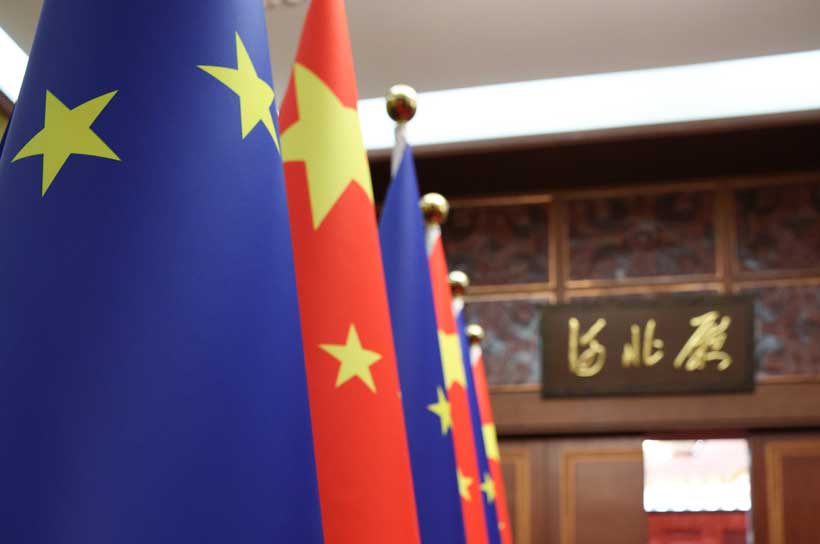
China is calling for equal dialogue and greater cooperation with the European Union as Brussels and Beijing try to manage growing tensions over trade, critical minerals and the widening imbalance in their economic relationship.
The latest discussions come as European Trade Commissioner Maros Sefcovic visits Beijing for talks with Chinese Commerce Minister Wang Wentao. His visit follows three months of negotiations over the EU’s growing trade deficit with China, which has reached more than €1 billion a day.
The talks also come amid Chinese restrictions on exports of rare earths and other critical minerals, adding a strategic dimension to what has traditionally been a major commercial relationship.
China’s Foreign Ministry said on Thursday that open cooperation and equal dialogue were necessary to resolve the differences.
Stay ahead of the geopolitical week.
MD Briefing delivers expert analysis across five global fronts — the Indo-Pacific, energy, geoeconomics, European security, and the Middle East — every Monday morning. Free.
“We hope that the European side can work towards solutions together with China,” ministry spokesperson Mao Ning said, arguing that stable economic and trade relations serve the common interests of both sides.
Trade Imbalance at the Centre
The EU’s trade deficit with China has become one of the most persistent sources of tension between Beijing and Brussels.
European governments and businesses have increasingly raised concerns about the scale of Chinese exports into the European market, while European companies face difficulties expanding their access to China.
For Beijing, maintaining trade and investment ties with Europe remains important at a time when economic relations with the United States have become increasingly uncertain.
For the EU, however, the challenge is how to reduce economic vulnerabilities without damaging one of its most important trading relationships.
That tension has become more complicated as European policymakers increasingly use the language of economic security and strategic dependence in their approach to China.
Critical Minerals Add a Strategic Dimension
The dispute is no longer limited to conventional goods.
China’s restrictions on exports of rare earths and other critical minerals have heightened European concerns over supply-chain dependence. These materials are essential to industries ranging from electric vehicles and renewable energy to advanced manufacturing and defence technologies.
European governments have been seeking to diversify their sources of critical raw materials, but reducing dependence on China cannot happen quickly.
This gives Beijing considerable leverage in negotiations. At the same time, using trade and mineral exports as sources of pressure could encourage European governments to accelerate efforts to build alternative supply chains.
The issue therefore creates a difficult balance for both sides: Europe wants greater resilience, while China wants continued access to the European market and a stable economic relationship.
France Seeks a Broader Strategic Conversation
The trade discussions are taking place alongside a separate diplomatic engagement between China and France.
Emmanuel Bonne, diplomatic adviser to French President Emmanuel Macron, is scheduled to visit China from October 9 to 13 and meet Chinese Foreign Minister Wang Yi.
According to Beijing, the talks will focus on strategic communication and international issues.
The timing is significant because China-EU economic relations are increasingly linked to broader geopolitical questions, including the global economy, supply chains and relations with the United States.
France has also sought to maintain an independent European approach toward Beijing while supporting greater European strategic autonomy.
Bonne’s discussions with Wang could therefore provide a wider diplomatic channel alongside the more technical trade negotiations between Sefcovic and Wang Wentao.
Can Dialogue Close the Gap?
The immediate challenge for Beijing and Brussels is finding a compromise that addresses Europe’s concerns without turning economic differences into a broader confrontation.
China’s emphasis on “equal dialogue” suggests that Beijing does not want negotiations framed as unilateral European demands. The EU, meanwhile, is under growing political pressure to address the trade imbalance and reduce strategic dependence on Chinese supply chains.
That makes the current talks more important than a dispute over individual products or trade figures.
The relationship is increasingly about how two major economic powers manage dependence in an era of geopolitical competition.
If Beijing and Brussels can reach practical agreements on market access, trade imbalances and critical-mineral supplies, the talks could help stabilize one of the world’s most important economic relationships.
If negotiations stall, however, Europe may accelerate efforts to diversify away from China, while Beijing could face a more fragmented and restrictive European market.
The coming discussions will therefore test whether economic interdependence can still provide a foundation for cooperation between China and the EU, or whether strategic competition is beginning to reshape the relationship.
With information from Reuters.
