


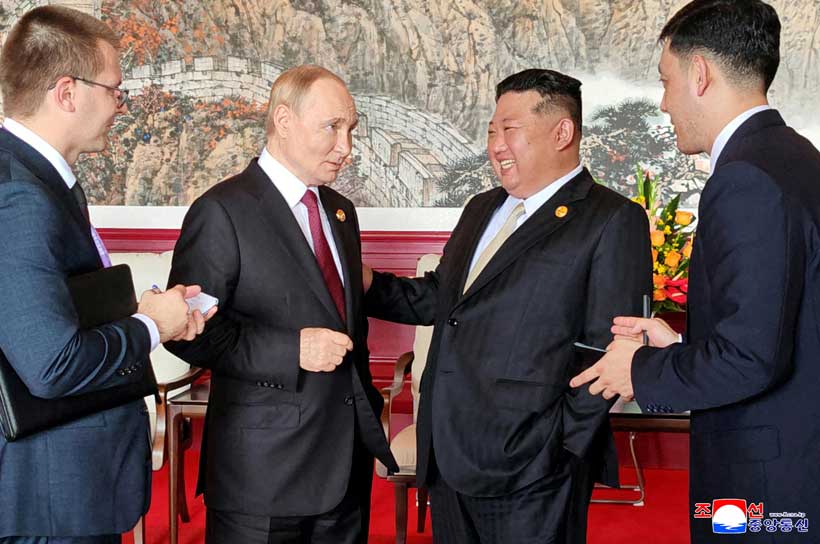
North Korea is increasingly positioning itself alongside China and Russia on some of the most contentious security issues confronting the United States, highlighting the emergence of a more closely aligned bloc of US rivals across Asia and beyond.
Pyongyang on Wednesday criticised Washington’s military support for Taiwan, accusing the United States of increasing tensions in the Taiwan Strait and warning that it could face serious consequences if it confronts China over the island.
The comments came through North Korea’s state news agency KCNA, which cited international affairs analyst Kim Myong Chol. He criticised US arms sales to Taiwan and the appearance of American-supplied fighter aircraft on the island.
The statement warned Washington to consider whether it was prepared for a direct confrontation with China over Taiwan and whether it could deal with the consequences.
Stay ahead of the geopolitical week.
MD Briefing delivers expert analysis across five global fronts — the Indo-Pacific, energy, geoeconomics, European security, and the Middle East — every Monday morning. Free.
The remarks followed Taiwan’s receipt last week of the first two of 66 F-16V Block 70 fighter jets ordered from the United States in 2019. The delivery comes as Taiwan faces growing military pressure from Beijing.
North Korea’s criticism is significant because it reinforces Pyongyang’s increasingly explicit support for Beijing’s position on Taiwan while also highlighting its parallel strategic relationship with Moscow.
Why Does North Korea’s Taiwan Position Matter?
North Korea has traditionally been closely aligned with China, but its security relationship with Russia has expanded dramatically in recent years.
Its stronger support for Beijing on Taiwan suggests that Pyongyang is becoming more willing to publicly align itself with China’s core foreign policy interests, rather than treating the Taiwan issue primarily as a matter between Beijing, Taipei and Washington.
China claims Taiwan as part of its territory and has repeatedly warned against foreign military and political support for the island. Taiwan, which has its own democratically elected government, rejects Beijing’s sovereignty claims.
Washington does not have formal diplomatic relations with Taipei but is legally required to provide Taiwan with the means to defend itself.
This creates a fundamental strategic contradiction between the United States and China. Washington sees arms sales as part of maintaining Taiwan’s ability to deter a potential attack, while Beijing views them as interference in what it considers an internal Chinese matter.
North Korea’s latest statement places Pyongyang firmly on Beijing’s side of that dispute.
Kim Jong Un Has Already Backed Beijing’s Position
North Korean leader Kim Jong Un gave Xi Jinping a strong political signal earlier this year when the two leaders met in Pyongyang.
During their June summit, Kim pledged full support for China’s “One China” principle. Beijing regards Taiwan as part of China and has consistently demanded that other governments avoid official engagement with Taipei.
The summit also pointed to closer cooperation between Beijing and Pyongyang in areas including diplomacy, law enforcement and military affairs.
North Korea’s latest criticism of US support for Taiwan therefore appears consistent with a broader effort to strengthen its strategic relationship with China.
At the same time, however, Pyongyang’s relationship with Russia has developed along an even more concrete military trajectory.
Russia Has Become a Major Security Partner
North Korea has provided substantial support to Russia since Moscow’s full-scale invasion of Ukraine.
Ukrainian and South Korean estimates indicate that Pyongyang has sent between 14,000 and 15,000 troops to support Russian forces since 2024. North Korea has also deepened its military relationship with Moscow following the signing of a mutual defence pact in June 2024.
Kim reiterated that support in a separate birthday message to Russian President Vladimir Putin, according to KCNA.
He said North Korea would continue joint work with Russia under their comprehensive strategic partnership and expressed confidence that Russia’s “sacred war of justice” to defend its sovereignty and security interests would end in victory.
Although the message did not explicitly mention Ukraine, its political meaning was clear: Pyongyang continues to portray Russia’s war effort in favourable terms and has no apparent intention of distancing itself from Moscow.
Is a China-North Korea-Russia Bloc Emerging?
The developments do not necessarily indicate the creation of a formal military alliance between China, North Korea and Russia.
Their relationships with one another remain different, and Beijing has generally been more cautious than Pyongyang in its direct military involvement in Russia’s war against Ukraine.
North Korea’s decision to deploy troops to Russia demonstrates a willingness to provide direct wartime assistance that China has not matched.
But their interests increasingly overlap in opposing US influence and challenging aspects of the US-led security order.
For North Korea, closer ties with Russia provide economic, military and diplomatic benefits. Its relationship with China remains essential for trade and political support. For Moscow, North Korean military assistance provides additional manpower and potentially other forms of support for the war in Ukraine.
For Beijing, meanwhile, North Korea remains an important strategic buffer on China’s northeastern border, while Pyongyang’s increasingly supportive position on Taiwan reinforces China’s diplomatic messaging against Washington.
What Does This Mean for the United States?
For Washington, the growing coordination among its major rivals creates a more complicated security environment.
The United States already faces simultaneous strategic challenges involving China in the Indo-Pacific and Russia in Europe. North Korea adds another layer through its nuclear weapons programme, growing military cooperation with Moscow and increasingly explicit alignment with Beijing.
Taiwan is particularly sensitive because any crisis in the Taiwan Strait could quickly involve the United States and create wider regional consequences.
North Korea’s warning does not mean Pyongyang would necessarily intervene in a Taiwan conflict. But it demonstrates that Beijing can increasingly expect political support from Pyongyang on an issue that China considers central to its national security.
The broader trend is therefore more important than the individual statement.
North Korea is strengthening its links with both China and Russia while presenting US military alliances and partnerships as threats to regional stability. As Washington attempts to deter China in the Indo-Pacific and contain Russian power in Europe, Pyongyang’s expanding strategic relationships could make the geopolitical landscape even more difficult to manage.
With information from Reuters.
