Stalling Clubs, Growing Caucus
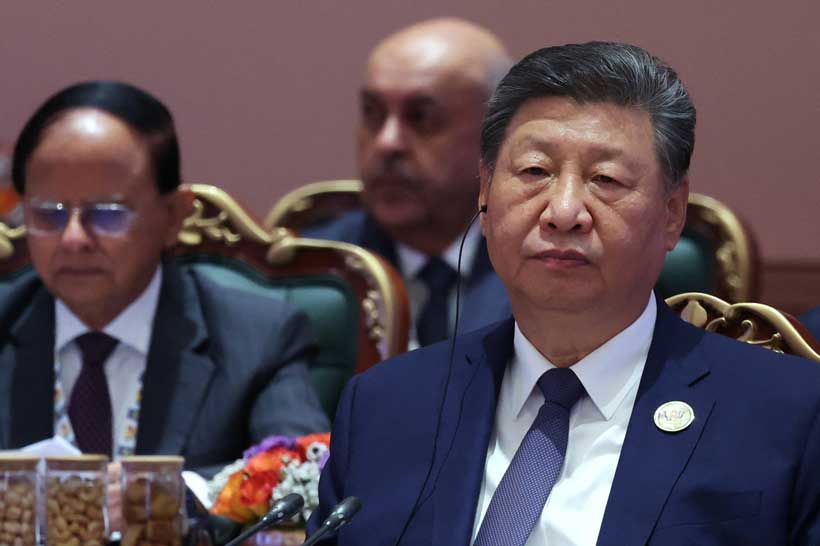
In mid-September Xi Jinping made his first visit to India in seven years for the BRICS summit in New Delhi. The bloc’s declaration opposed “unilateral tariff and non-tariff measures” without naming the United States. It softened last year’s language on the Middle East and once again stopped short of a common currency. Two weeks earlier in Bishkek, the Shanghai Cooperation Organisation amended its charter but left its long-promised development bank stuck in a quarrel between Kyrgyzstan and Kazakhstan over which of them would host it. In the same weeks, Beijing said that about 160 countries and organisations now back its Global Governance Initiative, and that more than 60 have joined a “Group of Friends” meeting in New York, Geneva and Vienna, the UN’s three main seats. The clubs China helped build are stalling, while the caucus it is building inside the UN keeps growing. That contrast is the clearest answer yet to what Beijing wants.
Four Initiatives and a Retreating America
Xi launched the Global Governance Initiative on 1 September 2025 at the SCO summit in Tianjin, timed to the UN’s 80th anniversary. Its five principles — sovereign equality, international rule of law, “true” multilateralism, a people-centred approach and a focus on results — complete a set with Beijing’s earlier development, security and civilisation initiatives. Steve Tsang of SOAS calls this the Global South half of Xi’s “double pivot”. BRICS, meanwhile, has grown to 11 members and ten partner countries.
Stay ahead of the geopolitical week.
MD Briefing delivers expert analysis across five global fronts — the Indo-Pacific, energy, geoeconomics, European security, and the Middle East — every Monday morning. Free.
Two shifts changed the backdrop. The first is American retreat: in January Washington announced it would leave 66 international organisations. The second is China repositioning itself inside existing bodies. In September 2025 Premier Li Qiang said China would no longer seek special and differential treatment, the softer WTO rules reserved for developing countries, in future agreements, while keeping its developing-country status. And since 1 May 2026, goods from 53 African countries have entered China tariff-free.
Recruit Outside, Win Inside
The debate is usually framed as a choice: is China building a rival order, or reforming the existing one from within? The evidence of the past year points clearly to the second. Beijing is not trying to replace the UN, the IMF or the WTO. It is trying to win a durable majority inside them, and it uses BRICS and the SCO to recruit that majority, not to house it.
Look at where the effort goes. The Group of Friends meets in UN cities, not in Shanghai. China’s nine stated reform priorities lead with strengthening the UN and the authority of the Security Council, and Beijing has made more African representation on the Council an explicit goal. The one new international body it has created, the International Organization for Mediation in Hong Kong, is a mediation service that sits alongside existing courts and tribunals rather than competing with them. At this year’s WTO ministerial in Yaoundé, which collapsed over the rules for developing countries, it was Washington that attacked the system’s foundations and Beijing that defended “true multilateralism”.
The reason is simple: the existing institutions hold the prize. At the IMF, China’s actual quota share is 6.39%, less than half the 13.7% that the Fund’s own formula says its economy justifies. The US share of 17.4% preserves Washington’s veto over decisions that need 85% support. A parallel fund cannot break that veto or confer that legitimacy. Only votes inside the IMF can. Trade tells the same story. China ran a record $1.2 trillion trade surplus in 2025 on exports of $3.77 trillion. A country that sells that much abroad needs open markets under predictable rules, not a world broken into rival blocs.
The weakness of BRICS and the SCO is therefore not a failure of Chinese strategy. It is evidence of what the strategy is. If Beijing wanted an alternative order, a bloc that cannot agree on a currency and a security organisation that cannot site a bank would be the flimsiest possible foundations, especially with India inside both, ready to slow anything that looks like a Chinese project. As recruiting grounds and test beds — for local-currency lending through the New Development Bank, or for links between national payment systems — they work well enough.
So what does Beijing want from the Global South? Votes, markets and a story. It wants votes to reweight the IMF, to defend developing-country rules at the WTO and to win Security Council seats for African states that would rarely vote against China. It wants markets to absorb the exports America no longer takes. And it wants a story in which China, not the US, is the defender of the UN Charter. The Africa zero-tariff scheme shows how cheaply some of this can be bought: the continent already runs a large trade deficit with China, so the gesture costs Beijing little and earns it a great deal. Giving up new WTO concessions while keeping developing-country status is the mirror image. It removes an American talking point without leaving the Global South club.
The strongest objection is that “reform from within” is cover. China has also built its own cross-border payments network, a digital currency, lenders such as the Asian Infrastructure Investment Bank, and now a mediation body it hosts. On this view, these are the skeleton of an exit. Part of that is right: Beijing is building plumbing that would survive Western sanctions. But plumbing built to survive sanctions is insurance, not a destination. The bigger threat to China’s strategy is its own export machine. In January Mexico imposed tariffs of up to 50% on 1,463 product lines from countries without a trade deal with it, China first among them. The surplus that pays for the courtship is also what is alienating the countries being courted.
Three Paths for Beijing’s Majority
Base case: incremental capture (about 55%). The Group of Friends keeps growing, Chinese candidates win more posts in UN agencies, and Beijing leads the push to rewrite the IMF quota formula. BRICS and the SCO stay modest. The key assumption is that the US stays disengaged and that Global South trade friction with China remains limited to sectors such as steel and cars. For Western governments and companies, Chinese influence will show up first in standard-setting fights inside UN technical agencies on AI, data and telecoms, long before it shows up in any new bloc.
Downside for Beijing: a Global South trade backlash (about 25%). Chinese goods diverted from the US flood a second wave of markets, and Brazil, Indonesia, South Africa or India follow Mexico with broad tariff increases rather than case-by-case anti-dumping duties. Votes become transactional, and BRICS splits along trade lines, with India leading a camp that treats China as a competitor first. The clearest early signal would be a large developing economy filing a WTO case against Chinese industrial subsidies.
Alternative: reform by inheritance (about 20%). If Washington’s retreat deepens, through further cuts to the UN’s regular budget or a walk-away from what remains of WTO dispute settlement, China becomes the main sponsor of a weakened existing system rather than its reformer. That would hand Beijing the order without having to rebuild it, but also its bills: development finance, peacekeeping and crisis lending that China has so far preferred to provide on its own terms.
Watch Bangkok, Not Bishkek
China is not building a new world order. It is assembling a majority in the old one, and BRICS and the SCO are where it recruits, not where it rules. What it wants from the Global South is a constituency. Its weak point is that this constituency is also its export market of last resort.
The thing to watch is the IMF and World Bank Annual Meetings in Bangkok, which run from 12 to 18 October. If BRICS finance ministers hold a common line on IMF quota realignment there, with China leading it, the strategy is working. If India and Brazil hedge, the majority Beijing is counting on is thinner than its 160-country tally suggests. Beijing does not need a new world order. It needs a recount in the old one.