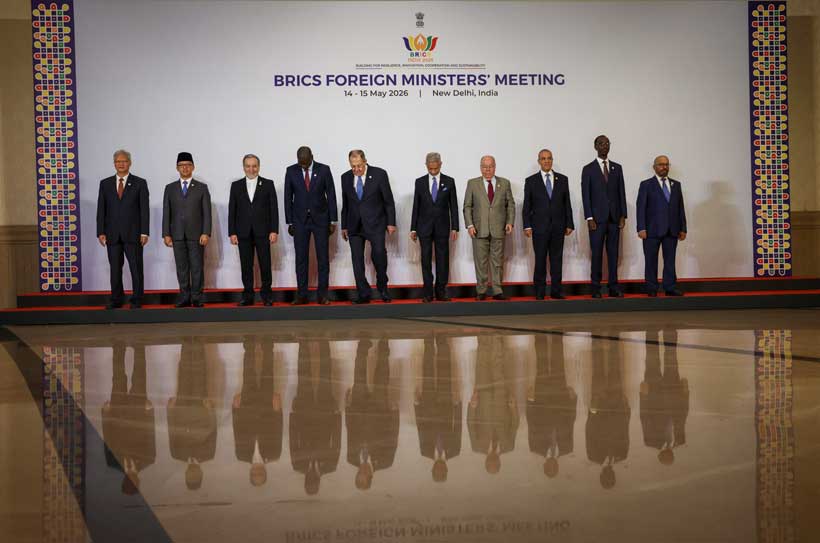
For much of the post-Cold War era, the global order revolved around Western-led institutions. The G7 shaped financial governance, the IMF and World Bank dictated economic prescriptions, and the U.S. dollar remained the unquestioned backbone of global trade. But in recent years, another grouping has steadily emerged from the margins of global politics into the center of geopolitical debate that is BRICS. What began in 2009 as a small coalition of Brazil, Russia, India, China, and later South Africa, is now increasingly being portrayed as the voice of the Global South and, by some critics, an emerging anti-Western bloc.
The debate intensified after the dramatic expansion of BRICS in 2024, when Egypt, Ethiopia, Iran, and the United Arab Emirates formally joined the organization. With the new members, BRICS now represents nearly half of the world’s population and roughly 40 percent of global GDP, in terms of purchasing power parity (PPP), surpassing the G7’s share which is around 30 percent. The symbolism alone is powerful: a grouping once dismissed as an economic acronym is now competing with the West’s most influential club in both scale and ambition.
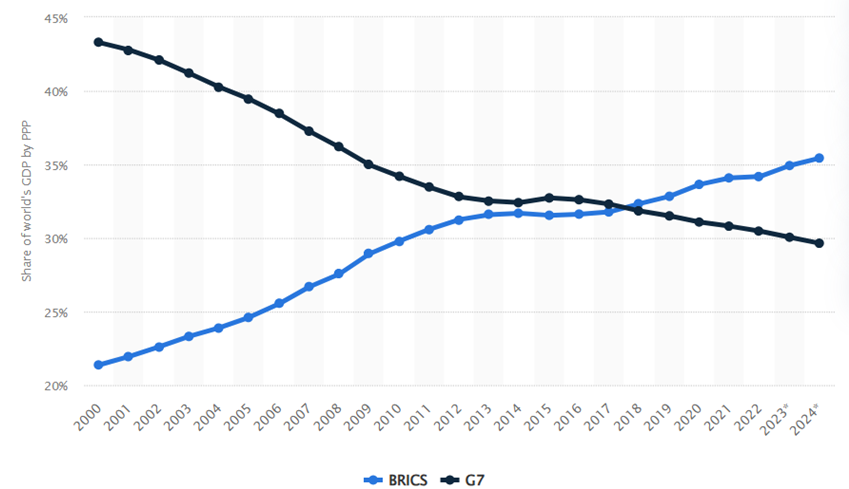
BRICS and G7 countries share of the world’s GDP in PPP
Source: Statista
Yet the core question remains unresolved. Is BRICS truly evolving into a coherent geopolitical alternative to the Western order, or is it simply a coalition of convenience held together by dissatisfaction rather than shared strategy?. The answer lies somewhere in between. There is little doubt that BRICS has become more politically assertive. This solution falls somewhere in between. It’s hard to dispute that there is an increasingly assertive political nature behind BRICS. Indeed, at the 2024 Summit of BRICS held in Kazan, Russia, leaders spoke about alternate financial institutions like trans-border payment systems and the use of non-US dollar currencies in trading and commodity exchanges. Russia, heavily sanctioned after the Ukraine war, has become particularly vocal in advocating “de-dollarization.” President Vladimir Putin argued that the dollar is being used as a “political weapon” and promoted BRICS as a counterweight to Western dominance.
Stay ahead of the geopolitical week.
MD Briefing delivers expert analysis across five global fronts — the Indo-Pacific, energy, geoeconomics, European security, and the Middle East — every Monday morning. Free.
China, meanwhile, sees BRICS as part of its broader strategy to reshape global governance. In addition, Beijing has been calling for the enlargement of the group, consolidation of entities such as the New Development Bank (NDB), and increased use of yuan for trade transactions. The economic power of China in the BRICS group is simply immense as it is responsible for nearly 60 percent of the total GDP of the group.
This reality fuels both the bloc’s rise and its internal tensions. For many countries in Africa, Latin America, and Asia, BRICS offers an attractive platform which promises economic advancement without any prerequisite conditions of forceful alignment. But for others, particularly India and Brazil, there is concern that BRICS could become excessively aligned with Chinese geopolitical interests.
This internal division is the biggest obstacle in the way of BRICS turning into a unified anti-Western alliance. The BRICS is not a club of common political values, collective security commitments or ideological cohesion like NATO or even the G7. Even though they are members of the same grouping, India and China are still embroiled in a bitter border rivalry. India is also deepening strategic relations with the United States through forums such as the Quad, a multilateral effort to counter China in the Indo-Pacific. Under President Luiz Inácio Lula da Silva, Brazil is calling for a more multipolar order, but it still depends economically on Western markets. Meanwhile, the UAE and Saudi Arabia have strong defense and financial ties with Washington, and are also engaging with BRICS.
This is why the idea of BRICS as a unified anti-Western bloc is often exaggerated. In practice, BRICS functions less as an alliance against the West and more as a platform against Western dominance. There is an important distinction between the two. Many BRICS members are not seeking to destroy the existing international order; they are demanding greater influence within it. Calls for IMF reform, greater representation for developing economies, and alternative payment systems stem from frustrations over unequal power distribution rather than outright hostility toward the West.
At the same time, however, Western policymakers would be mistaken to dismiss BRICS as merely symbolic. The economic momentum behind the grouping is real. BRICS economies are projected to grow by an average real GDP growth of 3.7 percent in 2026, driven largely by China and India, while the countries of G7 are expected to grow by an average rate of 1.2 percent. Trade within the Global South is expanding rapidly and trade among developing countries has grown by 4.6 times since 2000. Energy exporters like the UAE, Russia, and potentially Saudi Arabia give BRICS increasing influence over global commodity markets. The bloc is also becoming more attractive to countries frustrated with sanctions, debt conditionalities, or Western political pressure. More than 30 countries have reportedly expressed interest in joining or partnering with BRICS till now in some capacity.
The conflict in Ukraine hastened this process. Sanctions against Russia revealed flaws in the dollar-based financial system and spurred interest in other monetary options. China and Russia now conduct around 99 percent of their bilateral trade in local currencies such as Rubles and Yuan. While there may be some technical issues with discussions about creating a separate payment system among the BRICS nations, it demonstrates a clear intention to escape Western financial dominance.
Despite these efforts, many of the weaknesses inherent to BRICS persist. Despite its growing GDP share in PPP terms, BRICS does not yet rival the West in technological innovation, military integration, or financial influence. The U.S. dollar still accounts for nearly 60 percent of global foreign exchange reserves, while no BRICS currency comes close to replacing it. The G7 economies also continue to dominate advanced technologies, global banking systems, and high-end manufacturing. Even the most positive evaluations of BRICS admit that it lacks cohesion.
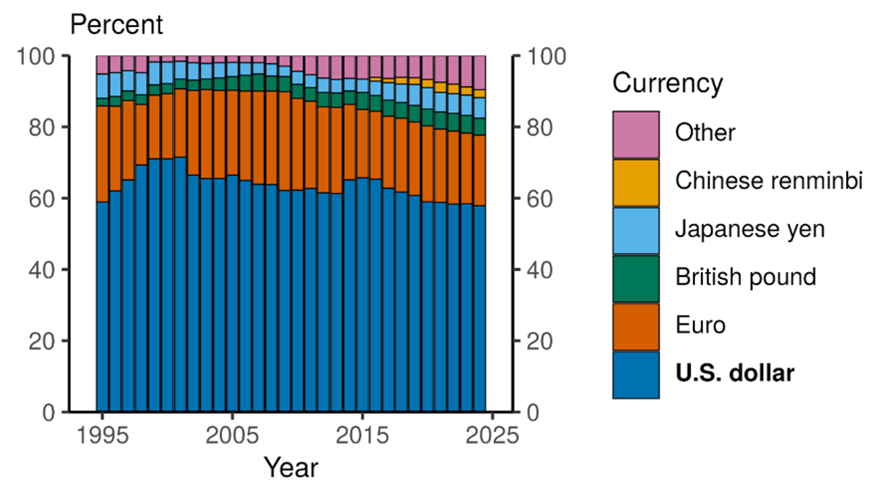
Share of globally disclosed foreign exchange reserves
Source: United States Government
The real significance of BRICS therefore lies not in whether it can defeat the West, but in how it is reshaping global politics itself. It is not replacing the West, but it is reducing the West’s monopoly over global governance. The rise of BRICS signals that the era when a handful of Western powers could unilaterally shape international institutions is gradually fading. Countries of the Global South increasingly want options, flexibility, and strategic autonomy rather than dependence on any single power center. Whether BRICS can become a force for change or a forum mired in internal divisions will depend on its ability to transcend rhetoric and develop lasting institutions.. For now, it is neither a united anti-Western alliance nor an empty talking shop. It is something more complicated: a coalition of rising powers trying to redefine the rules of a changing world order.