


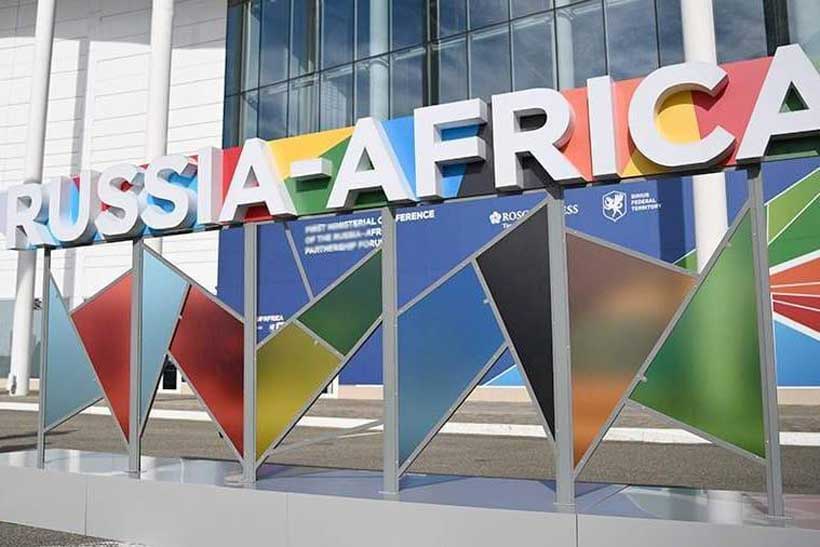
By declaring October 28-29, the dates for the third Russia-Africa Summit, which carries a strategic weight, Russia has demonstrated another practical approach towards raising multifaceted relations with Africa, reconvening African leaders, corporate executives, entrepreneurs, stakeholders, and academic researchers to highlight its noticeable achievements and bilateral agreements that have been implemented since 2019. Russia has already held two significant summits—the first one in its southern coastal city Sochi and the second in St. Petersburg, the second-largest city.
With an explicit purpose and sharpened position on its partnerships with Africa, the forthcoming October deliberations have to evolve into an in-depth analysis of its economic diplomacy and what has so far been delivered from the multitude of pledges and bilateral agreements signed during the previous summits.
Russia’s media gave tectonic coverage following concrete dates of the summit announcement, referencing Anatoly Bashkin, director of Sub-Saharan Africa at the Foreign Ministry, who noted that a number of African leaders have already confirmed their participation in the Kremlin-supported corporate event. In late March, President Vladimir Putin finally approved Moscow as the venue and ordered the creation of an organizing committee for the summit under the leadership of presidential aide Yury Ushakov.
Putin indicated to newly arrived African ambassadors, in the Kremlin, that Russia and Africa have “relations of true partnership, support, and mutual assistance” and added, “We remain committed to the expansion of mutual political, economic, and humanitarian contacts. We continue assisting the people of Africa in their ambition to develop, to actively participate in international affairs.”
Stay ahead of the geopolitical week.
MD Briefing delivers expert analysis across five global fronts — the Indo-Pacific, energy, geoeconomics, European security, and the Middle East — every Monday morning. Free.
Russia’s Economic Weaknesses
Research shows that Russia’s economic footprint in Africa remains comparatively weak, largely due to a lack of financing mechanisms and a reliance on short-term security-based diplomacy. While Russia boasts strong diplomatic and military ties, it seriously lacks the institutional funding and capital capabilities of competitors like China or the European Union.
Lack of Institutional Financing
Unlike China’s robust use of its policy bank, ExIm Bank, or Western development agencies like the U.S. DFC, Russia lacks the institutional mechanisms to provide African governments with major credit lines, concessionary loans, or capital guarantees for infrastructure. This frequently leaves bilateral memorandums, agreements, and investment deals stuck in the planning phases.
Western Sanctions
Since Russia’s invasion in Ukraine, Russia’s major banks have been severely impacted by global financial sanctions. This limits international credit and makes it remarkably difficult for Russian private firms to finance, sustain, and export large-scale industrial or development projects.
Asymmetrical Trade Dynamics
Outside of grain exports, nuclear energy technology, and some defense contracting, Russia and Africa share very little in complementary trade. Logistical hurdles, rising transport costs, and an over-reliance on a handful of commodities prevent Russia from competing effectively across broader commercial or consumer sectors.
Focus on Security over Economics.
Records show Russia barters military support, security training, and weapons in exchange for direct access to natural resources with African countries, particularly the Francophone, facing financial difficulties or instability, which they often blamed on France. It is no secret that Russia’s heavy reliance on exporting military equipment and weaponry to conflicting African regions is a problem. This has been very controversial, attracting arguments about whether Russia was concretely interested in development and providing infrastructure in the continent. Russia has never provided any development to African countries it has military agreements with. This leaves persistent gaps between its ambitions to siphon off resources in exchange (barter system) for military equipment supply and intention of keeping peace, mostly at the expense of on-the-ground economic development.
The South African Institute for International Affairs (SAIIA) said in its report that strengthening military-technical cooperation is part of the foreign policy to generate revenue. It has agreements with more than 20 African countries. In this report, SAIIA argues logically that few expect Russia’s security engagement to bring peace and development to countries with which it has security partnerships. The narratives pointed out clearly that Moscow’s strategic incapability, inconsistency, and dominating opaque relations are adversely affecting sustainable developments in those African countries. Peace-building and conflict resolution are so remote from providing infrastructure and spurring economic growth. In 2023, the Stockholm International Peace Research Institute also said Russia accounted for approximately $14 billion of arms supplied to Saharan Africa.
Rethinking Development Paradigms
With the third Russia-Africa Summit, African leaders have seriously thought along the following lines, determining how to finance projects instead of waiting over implementing agreements and to be re-signed in the future and finally keep postponing economic developments. In practical reality, African leaders have to choose between symbolism and concrete alternatives to attaining their development sovereignty.
From the previous summits, Russia has road-mapped priorities with Africa in the following spheres: energy and nuclear technologies, economic and trade, oil and gas exploration, transport and logistics, financial mechanisms, industry and manufacturing, agriculture and food security, military and maintaining security, healthcare systems, digital transformation, humanitarian, science and innovation, education and training,
For Africa, practical collaborations have to move beyond geopolitical symbolism and shift away from the stage of rhetoric to a different stage of interests in implementing agreements to measure results of partnerships and development growth. Collaboration has to move to a broader level of identifying economic opportunity and to be followed by an investment posture, a show of valuable engagement over mere rhetoric. It is practically time to act and show noticeable outcomes of declarations from the first and second summits. In a geopolitical context, Africa now has suitable external alternatives.
At the Institute for African Studies, researchers on Russian-African cooperation indicated that Russia has influenced Africa in multiple ways, but time has indeed changed. Across Africa, broader global dynamics are centered on the rivalry between the United States and China, including over-access to critical resources and technology chains. China’s global dominance in the extraction and processing of rare metals used by Beijing as a competitive advantage, including through control over African mining enterprises and logistics infrastructure. In turn, the United States is increasingly tying its position on the continent to countering China in critical raw materials supply chains, digital infrastructure, and technological standards. As a result Africa has become an important arena for their technological and economic clashes. In all these, Russia doesn’t have the same interest in African resources. Russia absolutely does not need Africa; it is resource-rich and wealthy itself. Africa has to ensure its own economic sovereignty. In this concluding context, Russia and Africa are poles apart. It is important to note that Russia’s interest is only to support Africa to gain economic power in the emerging multipolar world.
