


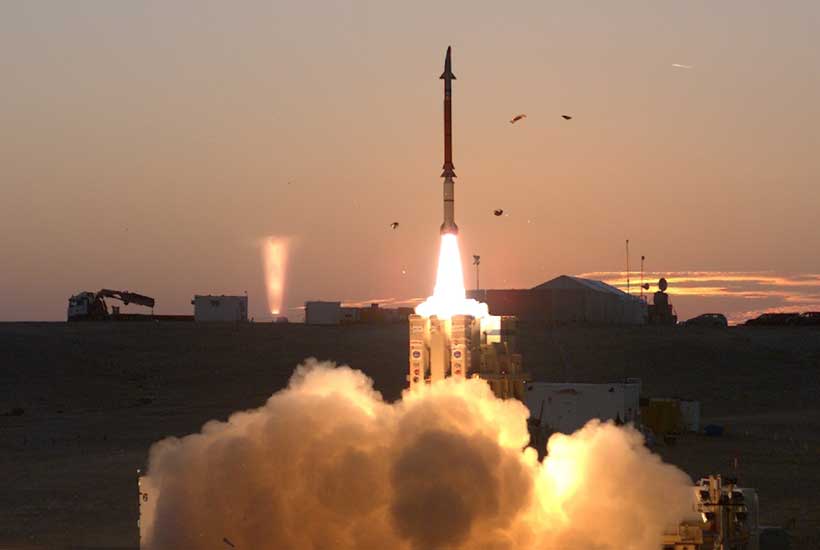
The global investment boom is no longer being driven by artificial intelligence alone. Governments are preparing to pour trillions of dollars into defence, creating a powerful new link between military spending, AI and technology while raising fresh concerns about inflation, public debt and government bond markets.
Former US Navy Admiral James Stavridis, now managing director and partner at The Carlyle Group, estimates that additional defence commitments by Group of Seven governments over the next decade could amount to around $8 trillion in new rearmament spending on top of existing trends.
With the combined annual gross domestic product of the United States, Japan, Germany, France, Britain, Italy and Canada now slightly above $55 trillion, that additional spending over a decade would be equivalent to almost 15% of the G7’s 2026 economic output.
Stay ahead of the geopolitical week.
MD Briefing delivers expert analysis across five global fronts — the Indo-Pacific, energy, geoeconomics, European security, and the Middle East — every Monday morning. Free.
Stavridis estimates that G7 defence spending has already risen to around 2% of GDP, its highest share in more than three decades, and could reach 3.8% by 2030.
Europe could account for a significant portion of the increase. Broader European defence targets could require roughly €4 trillion to €5 trillion in additional spending over the next decade, Stavridis estimates, rising toward €9 trillion when related infrastructure is included.
The scale of the US increase is similarly striking. Planned US defence spending for fiscal year 2027 is expected to reach a record $1.5 trillion, a level that would exceed the inflation-adjusted peak during World War Two.
According to estimates from the Center for Strategic and International Studies cited by Stavridis, that spending would amount to about 4.6% of US GDP, approaching levels seen during some of the most intense periods of the Cold War.
That could put US defence spending on a collision course with another major government expense: servicing the national debt. As borrowing costs rise, the competition between defence spending and interest payments could put additional pressure on government finances.
Why AI Is Becoming Part of the Defence Boom
The most significant change may not simply be how much governments are spending, but where the money is going.
Unlike previous rearmament cycles, a growing share of defence investment is expected to flow into technologies such as artificial intelligence, drones, cybersecurity, encryption, hypersonic weapons and other advanced systems.
Stavridis argues that the centre of gravity in defence procurement is shifting away from traditional weapons manufacturers and toward smaller technology companies developing cyber, encryption and hypersonic technologies.
That creates a significant overlap between the global AI investment boom and the new defence spending cycle.
Data centres are another point of convergence. The expansion of AI requires enormous computing capacity, while military and national security systems increasingly depend on secure data infrastructure and the protection of critical digital networks.
The result is a growing economic ecosystem in which civilian technology investment and military procurement increasingly reinforce each other.
Europe’s Defence Spending Could Reshape Its Tech Sector
The trend is particularly important for Europe.
The continent is facing increased security concerns along its eastern borders because of Russia’s war in Ukraine, while uncertainty over the future of US support for NATO under President Donald Trump has pushed European governments toward greater defence spending.
European policymakers and industry leaders hope that the spending surge could also help revive the continent’s technology sector.
Stavridis argues that decades of declining European defence investment coincided with declining European technological competitiveness, and that the current rearmament cycle could help reverse that trend.
The potential economic benefits, however, come with a major financial challenge.
Governments must finance much of the new defence spending while already facing high borrowing costs and rising debt-servicing bills.
Bond Markets Face Another Test
The scale of the spending increases is particularly significant for government bond markets, which must absorb additional borrowing at a time when interest costs are already elevated.
The Washington-based Institute of International Finance recently estimated that average government borrowing costs across the G7 are at their highest level since mid-2008, while annual interest expenses have risen by almost 85%.
Over the past year, advanced economies paid more than $3.3 trillion in interest on internationally traded government bonds alone.
That figure exceeds estimated global spending on AI of around $2.6 trillion, defence spending of roughly $3.1 trillion and clean energy investment of about $2.3 trillion.
The simultaneous expansion of defence and AI investment could provide a powerful stimulus to the global economy and potentially help contain debt-to-GDP ratios by increasing economic growth.
But the spending boom also creates a difficult balancing act.
Governments are trying to strengthen national security, compete in AI and other strategic technologies, maintain economic growth and manage rising debt costs at the same time.
The outcome will depend on whether the economic growth generated by these investments can keep pace with the enormous fiscal commitments they require. For now, the world’s major economies are entering a period in which defence, AI, public debt and bond markets are becoming increasingly interconnected, creating opportunities for technological growth while increasing the financial risks facing governments.
With information from Reuters.
