


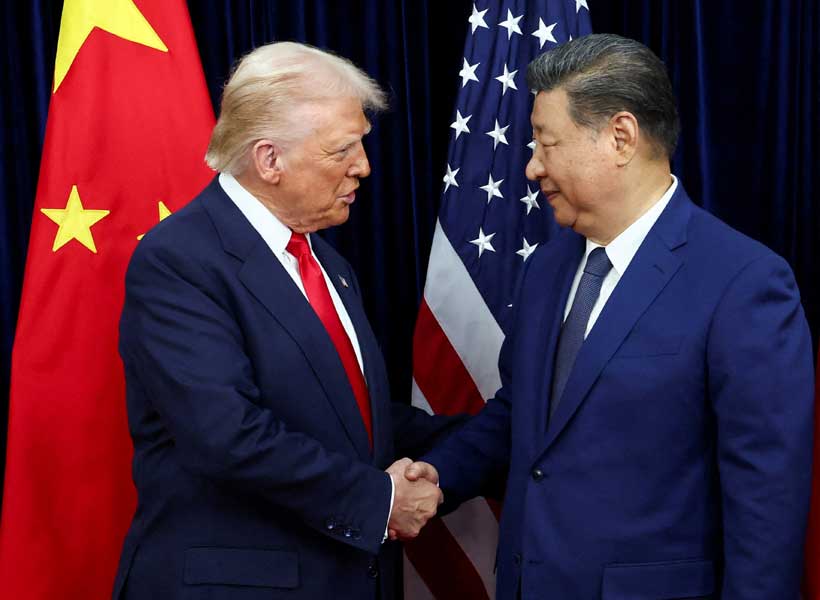
As Chinese President Xi Jinping and U.S. President Donald Trump prepare to meet next week, artificial intelligence governance will stand as one of the most urgent yet fraught items on their agenda. The rapid evolution of AI models and autonomous systems has brought technological risks that transcend borders. Yet in Washington and across much of the Western media, the conversation surrounding artificial intelligence has increasingly degraded into a simplistic, zero-sum struggle. Rather than framing AI safety as a shared human challenge, public discourse in the U.S. routinely depicts Chinese technological advancement through the lens of an existential threat.
If next week’s summit is to deliver meaningful progress on global stability, both leaders must recognize a fundamental reality: framing artificial intelligence as a geopolitical battleground hinders our ability to manage its real, objective risks. It is time to abandon the narrative of AI confrontation and pursue a framework grounded in dialogue, common standards, and shared responsibility.
The tendency to view AI exclusively through a competitive prism is not hard to find. Recently, prominent U.S. tech leaders, media commentators, and policymakers have regularly sounded alarm bells, warning that any advancement by China in frontier AI models poses a direct threat to Western dominance. Figures like Elon Musk and other Silicon Valley executives have frequently voiced concerns about AI’s existential risks while simultaneously framing the race as a military and economic contest that the West must “win” at all costs.
However, blending legitimate technical concerns with geopolitical alarmism distorts the issue. While some tech figures occasionally acknowledge the need for international safety guardrails, the overarching narrative pushed by Silicon Valley lobbyists and Washington hawks remains focused on containment, technology blockades, and economic decoupling.
Stay ahead of the geopolitical week.
MD Briefing delivers expert analysis across five global fronts — the Indo-Pacific, energy, geoeconomics, European security, and the Middle East — every Monday morning. Free.
This approach rests on a faulty premise. While AI applications reflect the values of their creators, the foundational mathematics of machine learning and its universal safety vulnerabilities carry no political ideology. Elevating every breakthrough in corporate innovation or open-source software into an episode of superpower rivalry obscures the true nature of AI risk and turns what should be a collaborative safety discussion into a rhetorical weapon.
To move forward, we must strictly separate two distinct issues: the objective, technical safety risks of AI on one hand, and the geopolitical confrontation narrative wrapped around it on the other.
No one denies that artificial intelligence presents serious risks. Issues such as algorithmic bias, data privacy, deepfake-driven misinformation, supply chain vulnerabilities, and the potential loss of human control over frontier models are real, pressing, and dangerous. These are inherent characteristics of advanced computing and autonomous decision-making systems. They do not respect national boundaries, nor do they discriminate between political systems. An unintended failure in a frontier AI system—whether in healthcare, critical infrastructure, or financial markets—poses a disaster for the global economy, regardless of where the code was written.
Recognizing these risks is a prerequisite for responsible governance. When “AI safety” is transformed into a pretext for tech blockades and ideological alignment, the result is not a safer world, but a fractured digital ecosystem. A divided world, operating on incompatible safety protocols and isolated research environments, is far less equipped to foresee or mitigate catastrophic AI failures than one bound by open lines of communication.
A zero-sum approach to AI governance actively undermines global security in three key ways.
It creates dangerous blind spots. If major powers treat AI research as a secretive arms race, they are less likely to share crucial safety benchmarks, alignment techniques, or threat intelligence regarding rogue actors and system vulnerabilities.
It also fragments global standards. AI systems operate on interconnected global networks. Divergent, conflicting regulatory regimes will inevitably create regulatory havens and weaken safety enforcement worldwide.
It stifles human-centric innovation too. When technological progress is measured solely by military or economic dominance, research into AI applications for climate change, medicine, and global poverty takes a back seat to defense capability.
The ultimate objective of artificial intelligence must be the enhancement of human well-being, not the escalation of strategic rivalry. As the U.S. and Chinese delegations prepare their negotiation points for next week’s summit, they should resist the impulse to treat AI as merely another front in a trade war. Instead, the summit offers an ideal opportunity to establish a durable framework for AI cooperation that prioritizes global stability.
First, both nations must agree to keep competition confined to healthy economic and scientific innovation, rather than letting it devolve into total technological conflict. Competition in commercial applications can drive progress, but foundational safety and ethical protocols must remain collaborative.
Second, Beijing and Washington should establish formal, continuous channels for AI safety dialogue. These mechanisms should focus on concrete, practical goals: developing shared terminology and risk assessment frameworks for frontier models; creating early-warning protocols for critical AI incidents and unexpected model behaviors; and establishing baseline ethics guidelines regarding human oversight in critical decision-making systems.
By focusing on shared technical challenges, such as model alignment, red-teaming methodologies, and watermarking synthetic media, the two nations can build mutual trust without sacrificing their respective economic or security interests.
The global governance of artificial intelligence will not be decided by who builds the largest data center or trains the biggest model first. It will be defined by whether the international community possesses the political wisdom to manage a transformative technology responsibly.
The upcoming summit between Xi and Trump presents a vital chance to set a new tone. By rejecting the narrative of inevitable confrontation and embracing a spirit of pragmatism and shared stewardship, China and the U.S. can lead the world toward a safer, more stable digital future. AI governance is not an arena for grandstanding—it is a shared imperative for the benefit of all humanity.
